What Is Equity vs Debt Investing? A Real Talk Guide for Smart Investors
By: Compiled from various sources | Published on Nov 22,2025
Category Intermediate
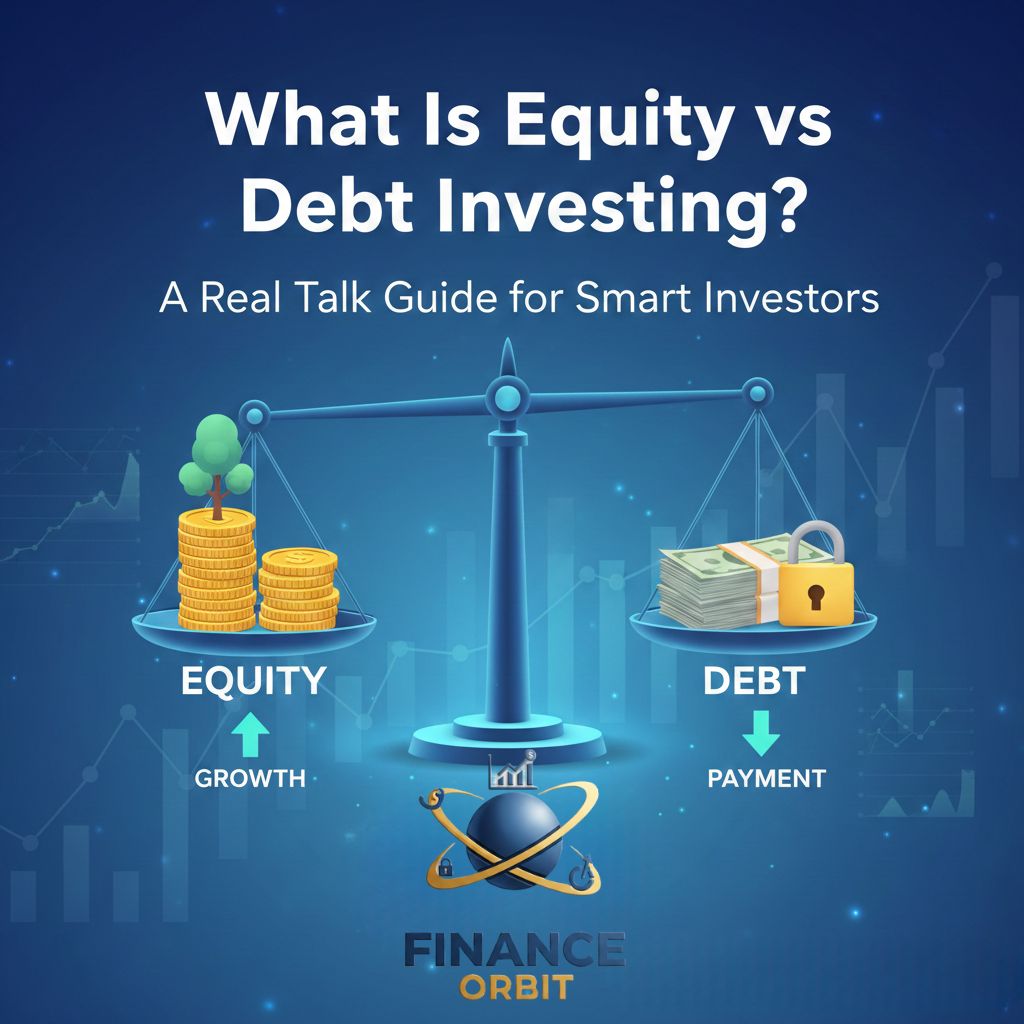
Description: Understand equity vs debt investing with this practical guide. Learn differences, risks, returns, and how to choose the right investment strategy for your goals.
Introduction: The Investment Dilemma Everyone Faces
Picture this: You've finally managed to save $10,000. It's sitting in your savings account, earning barely 1% interest. Your father says, "Put it in bonds, it's safe." Your colleague says, "Stocks, that's where the money is." Your neighbor casually mentions their portfolio is up 40% this year. Meanwhile, your partner wants to keep it in a high-yield savings account because "at least we won't lose it."
You're confused, overwhelmed, and honestly, a bit scared of making the wrong decision.
Welcome to the eternal debate: equity versus debt investing.
Here's the truth nobody tells you upfront—there's no universally "best" investment. What works for your neighbor might be terrible for you. What made your colleague wealthy might make you lose sleep. Because investing isn't just about money—it's about your goals, your risk tolerance, your life stage, and yes, your ability to handle the emotional roller coaster.
I've been investing for over a decade now, and I've made every mistake in the book. I've panicked and sold stocks at the worst time. I've kept money in low-return savings when I should've been more aggressive. I've learned the hard way that understanding equity versus debt isn't just financial literacy—it's financial survival.
So let's break this down, shall we? No jargon overload, no financial advisor speak that nobody understands. Just real talk about equity and debt investing, practical examples, and honest advice.
Grab your coffee, and let's decode this together.
What Exactly Is Equity Investing?
Let's start with equity. Simply put, equity investing means buying ownership in a company. When you buy shares of Apple, Amazon, Tesla, or any company, you become a part-owner of that business. A tiny part, yes, but still an owner.
Think of it like this: you and three friends start a coffee shop. You each invest $25,000, totaling $100,000. You own 25% of the business. That's equity. You're entitled to 25% of the profits (dividends) and your share is worth more if the coffee shop becomes wildly successful.
How Do You Make Money from Equity?
Capital Appreciation: You buy a share at $100, it goes to $150, you sell and pocket $50 profit. Simple, right? Except it doesn't always go up. Sometimes it drops to $70 and you're staring at a loss, wondering if you made a terrible mistake.
Dividends: Some companies share their profits with shareholders. If Microsoft decides to distribute $2 per share as dividend, and you own 100 shares, you get $200. It's like your share of the coffee shop's quarterly earnings.
Types of Equity Investments
Individual Stocks: Buying shares of specific companies through a brokerage account. High risk, high reward, requires research and constant monitoring. This is where fortunes are made and lost.
Equity Mutual Funds: Professional fund managers pool money from many investors and invest in multiple stocks. You get instant diversification without needing to pick individual stocks yourself. Perfect for people who don't have time to research companies.
Index Funds/ETFs: These track market indices like the S&P 500, FTSE 100, or MSCI World Index. If the index goes up 10%, your investment goes up 10%. Simple, low-cost, and Warren Buffett himself recommends these for most people.
Growth Stocks: Companies expected to grow faster than the market average. Think tech startups, innovative companies. Higher potential returns, but also higher risk.
Value Stocks: Established companies trading below their intrinsic value. Slower growth, but potentially more stable. Think traditional industries with solid fundamentals.
The Equity Reality Check
Here's what nobody tells you: equity investing can feel like a roller coaster designed by someone who hates you. The stock market in the short term is absolutely irrational. It goes up for no clear reason, crashes on random news, and will test every ounce of your patience and conviction.
But here's the beautiful part—over the long term, equity has consistently beaten every other asset class. The S&P 500 has returned about 10% annually over the past century. The global stock market has created more wealth than any other investment vehicle in human history.
The catch? You need the stomach for volatility and the discipline to not panic-sell when markets crash. And trust me, markets will crash. It's not a matter of if, but when.
What Exactly Is Debt Investing?
Now let's talk about debt. Debt investing means you're lending money to someone—a company, a government, or a financial institution—and they pay you interest for borrowing your money.
It's like when your friend borrows $5,000 and promises to return $5,500 after a year. You're the lender, they're the borrower, and that extra $500 is your interest payment.
How Do You Make Money from Debt?
Fixed Interest: You lend $10,000 at 5% annual interest. You get $500 per year. Simple, predictable, boring. And that's actually the point—it's supposed to be boring and safe.
Unlike equity where returns are uncertain (could be +30%, could be -20%), debt gives you predetermined returns. You know exactly what you're getting, which is why your risk-averse uncle loves it.
Types of Debt Investments
Government Bonds: Lending money to governments. U.S. Treasury bonds, UK Gilts, German Bunds—these are considered the safest investments because governments rarely default. Returns are modest but secure.
Corporate Bonds: You lend money to companies. They pay higher interest than government bonds but come with the risk that the company might struggle or even default on payments.
Bond Funds/ETFs: Mutual funds or ETFs that invest in a basket of bonds. You get diversification across multiple bonds without buying them individually.
Certificates of Deposit (CDs): You give money to a bank for a fixed period, they pay you guaranteed interest. Like a forced savings account with better returns.
High-Yield Savings Accounts: Not technically bonds, but they function similarly—you're essentially lending money to the bank, and they pay you interest. Currently offering 4-5% in many countries.
Money Market Funds: Invest in very short-term debt securities. Highly liquid, very safe, modest returns. Think of it as a slightly better savings account.
The Debt Reality Check
Debt investments are like the tortoise in the tortoise-and-hare story. Slow, steady, reliable, and ultimately gets you to your goal—just not quickly or excitingly.
The biggest enemy of debt investing? Inflation. If your bond pays 4% but inflation is 5%, you're actually losing purchasing power. Your money is "safe," but it's buying less each year. That's the hidden cost nobody talks about.
The Real Differences: Equity vs Debt Side by Side
Let's break down the actual differences in ways that matter to your wallet and your sleep quality.
Risk and Return
Equity: High risk, high potential return. You could double your money in a year, or you could lose 50%. The volatility is real, and it's not for everyone.
Debt: Low to moderate risk, low to moderate return. You're unlikely to get rich quickly, but you're also unlikely to lose your shirt. Predictability is the name of the game.
Ownership vs Lending
Equity: You're an owner. You have a stake in the company's success. If they innovate and dominate their industry, your shares could skyrocket. If they make terrible decisions, you suffer.
Debt: You're a lender. You don't care if the company becomes the next Amazon or just muddles along—as long as they pay you back with interest.
Income Generation
Equity: Dividend income is possible but not guaranteed. Companies can cut or eliminate dividends anytime. Most growth stocks don't pay dividends at all—they reinvest profits.
Debt: Regular, predictable interest payments. You know exactly when and how much you'll receive. Perfect for people needing steady income.
Time Horizon
Equity: Best for long-term investors (5+ years minimum, preferably 10-20 years). Short-term equity investing is basically speculation and gambling.
Debt: Works for any time horizon. Need money in 6 months? Debt. Need it in 20 years? Debt can work. More flexible.
Taxation
Equity: Tax treatment varies by country. In the U.S., long-term capital gains get favorable rates. In the UK, there's a capital gains allowance. Dividends are often taxed differently than regular income.
Debt: Interest income is usually taxed as ordinary income at your marginal rate. Less tax-efficient in many countries, though certain bonds (like U.S. municipal bonds) offer tax advantages.
Liquidity
Equity: Generally very liquid. You can sell most stocks within seconds during market hours. Get your money in a few days.
Debt: Varies widely. Government bonds are highly liquid. Corporate bonds can be harder to sell. CDs and some bonds have penalties for early withdrawal.
Which One Should You Choose?
Here's where I give you the most frustrating answer: both. You probably need both in your portfolio. Let me explain.
It Depends on Your Age
In your 20s and 30s: You should probably be heavily weighted toward equity (70-90%). You have time to recover from market crashes, and you need growth to build wealth.
In your 40s and 50s: A balanced approach makes sense (50-70% equity, 30-50% debt). You're building wealth but also need some stability.
In your 60s and beyond: Shift toward debt (40-60% equity, 40-60% debt). You need income and can't afford major losses as retirement approaches.
The classic rule of thumb: subtract your age from 100—that's your equity percentage. If you're 30, hold 70% equity. If you're 60, hold 40% equity. It's simplistic but not terrible advice.
It Depends on Your Goals
Short-term goals (less than 3 years): Debt only. Need a house down payment in two years? Do NOT put it in stocks. Use high-yield savings, short-term bonds, or CDs.
Medium-term goals (3-7 years): Balanced approach. Maybe 50-60% equity, 40-50% debt.
Long-term goals (10+ years): Equity-heavy. Retirement in 30 years? Load up on stocks and let compound growth work its magic.
It Depends on Your Personality
Can't sleep when markets drop? Increase your debt allocation. Seriously. The "optimal" portfolio that gives you panic attacks isn't actually optimal for you.
Excited by market volatility? You can handle more equity. Just don't be overconfident—everyone thinks they're rational until they watch their portfolio drop 40%.
Need steady income? Debt investments with regular interest payments might be your preference.
Common Mistakes People Make
Let me save you from the mistakes I've made (and seen others make repeatedly):
All-or-nothing thinking: "Stocks are risky, so I'll only invest in bonds." Or "Bonds barely beat inflation, so I'll go 100% stocks." Both are mistakes. Diversification isn't just smart—it's essential.
Chasing returns: Your friend made 50% in crypto or some hot stock, so you dump all your money in without understanding it. This is how people lose everything.
Panic selling: Markets drop 20%, you freak out and sell everything, locking in losses. Then markets recover and you're left behind. Emotional decisions are wealth destroyers.
Ignoring inflation: Keeping everything in "safe" debt investments while inflation erodes your purchasing power is losing money slowly.
Not rebalancing: You start with 70% equity, 30% debt. After a bull market, you're at 85% equity. You've taken on more risk without meaning to. Rebalance periodically.
Trying to time the market: "I'll buy stocks after they drop more." Narrator voice: They didn't drop more. Or they did, but you were too scared to buy then too. Time in the market beats timing the market.
Building Your Own Strategy
Here's a simple framework that's worked for me and countless others:
Step 1: Define your goals with specific time horizons and amounts needed.
Step 2: Assess your risk tolerance honestly. Not what you think you should be comfortable with—what you actually can handle emotionally.
Step 3: Create an asset allocation based on steps 1 and 2. Start simple: maybe 60% equity (through index funds), 40% debt (through bond funds or high-yield savings).
Step 4: Set up automatic investments. Dollar-cost averaging (investing regularly regardless of market conditions) removes emotion and builds discipline.
Step 5: Rebalance annually. If your target is 60-40 but it's drifted to 70-30, sell some equity and buy some debt to get back to 60-40.
Step 6: Ignore the noise. Financial media wants you to panic or get overexcited. Stick to your plan.
Conclusion: It's Not Either-Or, It's Both
Here's what I wish someone had told me when I started investing: equity versus debt isn't a battle where one side wins. It's not about choosing between safety and growth. It's about using both strategically to build a portfolio that matches your life, goals, and sleep-quality requirements.
Equity gives you growth and wealth-building potential. Debt gives you stability and predictable income. Together, they create a balanced portfolio that can weather different economic conditions and life stages.
The investor who gets rich isn't necessarily the one with the highest returns. It's the one who doesn't quit—who stays invested through crashes, who resists panic, who keeps contributing regularly, and who maintains a strategy that lets them sleep at night.
Your perfect mix of equity and debt is uniquely yours. It should reflect your age, goals, risk tolerance, and personal circumstances. Don't compare your portfolio to others. Compare it to your plan.
Start somewhere, even if it's small. Learn as you go. Adjust when needed. And remember—the best investment strategy is the one you'll actually stick with for decades.
Now stop overthinking and start investing. Your future self will thank you.
What's your current equity-to-debt ratio? Share in the comments—let's learn from each other's strategies!
Comments
No comment yet. Be the first to comment