What Is Portfolio Diversification? A Complete Guide to Spreading Investment Risk
By: Compiled from various sources | Published on Nov 29,2025
Category Intermediate
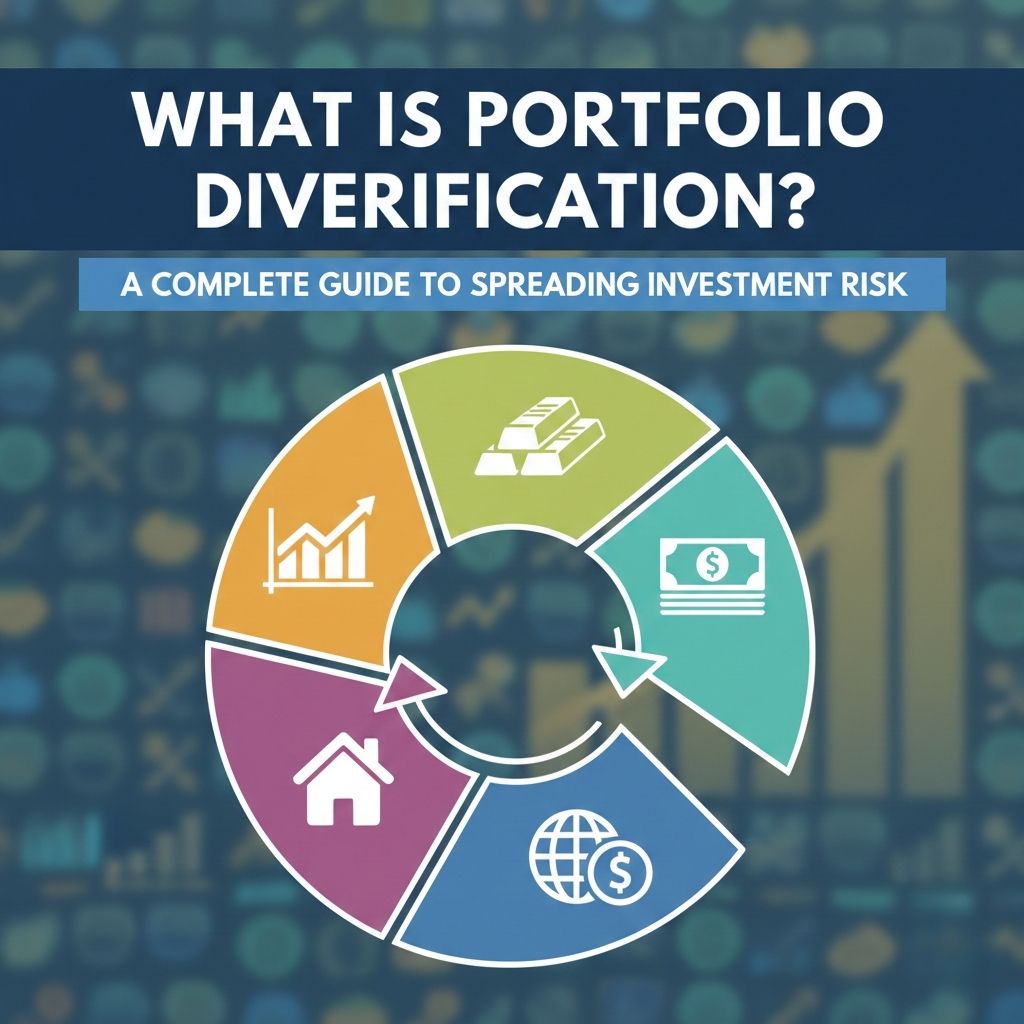
Description: Understand portfolio diversification: why it matters, how it works, and how to build a balanced investment portfolio. Clear explanations with real examples for beginners and experienced investors.
I'll never forget the look on my uncle's face in 2008. He'd invested his entire retirement savings—every penny—in financial sector stocks. "Banks are rock-solid," he'd told me just months earlier. "They'll never fail."
Then Lehman Brothers collapsed. Bear Stearns disappeared. His portfolio lost 60% of its value in less than a year.
Meanwhile, my neighbor Linda, who had a mix of stocks, bonds, real estate funds, and international investments, lost about 20%. Still painful, but she recovered within two years. My uncle? He's still working at 68 because he can't afford to retire.
The difference? Linda understood diversification. My uncle didn't.
That was my crash course (pun intended) in why putting all your eggs in one basket is the fastest way to end up with scrambled finances. Let me show you what I learned about diversification—and why it might be the most important investment concept you'll ever understand.
What Exactly Is Diversification?
At its simplest, diversification means spreading your money across different types of investments instead of putting everything into one place.
You've heard the saying "don't put all your eggs in one basket." That's literally what diversification is, applied to investing. If you're carrying all your eggs in one basket and you drop it, you lose everything. But if your eggs are distributed across multiple baskets, dropping one doesn't destroy your entire omelet-making operation.
In investment terms, this means owning a variety of assets—stocks, bonds, real estate, maybe some commodities—so that when one performs badly, others might perform well (or at least less badly), cushioning the blow to your overall portfolio.
Here's a concrete example: In 2022, the stock market had a terrible year, with the S&P 500 down about 18%. But if you also owned bonds and international stocks, your total portfolio loss was likely much smaller. Different investments don't all move together.
Why Diversification Actually Matters
The math behind diversification is surprisingly simple: it reduces your risk without necessarily reducing your returns.
Let's use my uncle and Linda as examples again. Imagine they both had $500,000 invested:
My uncle's concentrated portfolio (2008):
- 100% financial sector stocks
- Lost 60% = Down $300,000
- Portfolio value: $200,000
Linda's diversified portfolio (2008):
- 40% U.S. stocks (down 37%)
- 30% bonds (up 5%)
- 20% international stocks (down 43%)
- 10% real estate funds (down 37%)
- Average loss: approximately 20%
- Portfolio value: $400,000
Linda still lost $100,000, which sucks. But she lost half as much as my uncle despite being invested in the same terrible market. Why? Because not all of her investments cratered simultaneously.
This is the power of what financial people call "correlation"—how different investments move in relation to each other. When stocks go down, bonds often go up (or at least stay more stable). When U.S. companies struggle, international companies might thrive. When everything else is chaos, gold might hold its value.
Diversification works because different assets respond differently to market conditions.
The Different Layers of Diversification
When I first learned about diversification, I thought it just meant "own more than one stock." Turns out it's way more nuanced. There are multiple levels:
Level 1: Asset Class Diversification
This is the biggest, most important level. It means spreading money across fundamentally different types of investments:
Stocks (Equities): Ownership stakes in companies. Higher potential returns, higher volatility. When the economy is growing, stocks usually do well.
Bonds (Fixed Income): Loans to governments or corporations. Lower returns but more stable. When stocks crash, bonds often hold steady or even rise.
Real Estate: Property or real estate investment trusts (REITs). Provides income through rent and can hedge against inflation.
Commodities: Physical goods like gold, oil, or agricultural products. Often move independently of stocks and bonds.
Cash/Cash Equivalents: Money market funds, short-term bonds, savings accounts. Extremely stable but barely keeps pace with inflation.
A classic diversified portfolio might look like:
- 60% stocks
- 30% bonds
- 10% real estate/commodities
This is the famous "60/40 portfolio" (60% stocks, 40% bonds) that's been a bedrock strategy for decades.
Level 2: Geographic Diversification
Don't just invest in your home country. Different economies don't all boom or bust at the same time.
In 2010-2011, the U.S. economy was still recovering from the financial crisis and struggling. Meanwhile, emerging markets like China, Brazil, and India were growing rapidly. Investors who only owned U.S. stocks missed those gains.
Conversely, from 2010-2020, U.S. stocks massively outperformed international stocks. But heading into 2025, with U.S. valuations very high, many investors are looking abroad for better opportunities.
A well-diversified portfolio might include:
- 50-70% domestic stocks
- 20-30% international developed markets (Europe, Japan, Australia)
- 10-20% emerging markets (China, India, Brazil)
Level 3: Sector Diversification
Even within stocks, different industries perform differently at different times.
When oil prices spike, energy companies thrive while airlines suffer. During a pandemic, tech companies enabling remote work soar while travel and hospitality crater. When interest rates rise, banks benefit while growth tech stocks struggle.
Major stock market sectors include:
- Technology
- Healthcare
- Financials
- Consumer Discretionary
- Consumer Staples
- Energy
- Utilities
- Real Estate
- Industrials
- Materials
- Communication Services
You don't want 80% of your stock portfolio in one sector. If you work in tech and all your stock investments are in tech companies, you're doubling down on risk—if tech crashes, you might lose your job and your savings simultaneously.
Level 4: Company Size Diversification
Not all stocks are created equal. Companies come in different sizes:
Large-Cap: Big, established companies like Apple, Microsoft, Johnson & Johnson. More stable, slower growth.
Mid-Cap: Medium-sized companies. Balance of growth potential and stability.
Small-Cap: Smaller companies. Higher growth potential but much more volatile and risky.
Over long periods, small-cap stocks have historically delivered higher returns than large-caps. But they're also way more volatile. A diversified portfolio includes all three.
Level 5: Investment Style Diversification
Within stocks, there are different investing philosophies:
Value Stocks: Companies trading below their "true" worth. Think established businesses in out-of-favor industries.
Growth Stocks: Companies expected to grow earnings rapidly. Think fast-growing tech companies.
Dividend Stocks: Mature companies paying regular dividends.
Blend: Mix of value and growth characteristics.
Different styles outperform at different times. From 2010-2020, growth crushed value. In 2022, value did much better as interest rates rose and growth stocks crashed.
How Much Diversification Is Enough?
Here's where it gets tricky: you can actually over-diversify.
If you own 500 individual stocks, you've basically just created your own index fund (but with worse tax consequences and way more work). At that point, you might as well own an index fund.
Research suggests that owning 20-30 individual stocks from different sectors gets you most of the diversification benefits. Beyond that, you're not meaningfully reducing risk—you're just creating more work for yourself.
But there's an easier way: use funds.
The Simple Diversification Solution: Index Funds and ETFs
Most people shouldn't be picking individual stocks anyway. Index funds and ETFs (exchange-traded funds) give you instant diversification.
Total Stock Market Index Fund: One fund, thousands of companies, instant diversification across the entire U.S. market. Examples: VTSAX, ITOT, SWTSX.
Total Bond Market Index Fund: Thousands of different bonds in one fund. Examples: VBTLX, AGG, BND.
Total International Stock Fund: Thousands of companies outside the U.S. Examples: VTIAX, IXUS, VXUS.
You could build a perfectly diversified portfolio with just three funds:
- 60% Total U.S. Stock Market Fund
- 30% Total International Stock Fund
- 10% Total Bond Market Fund
That's it. Three funds. Thousands of holdings. Diversified across asset classes, geographies, sectors, and company sizes. Simple.
The 5% Rule (My Personal Guardrail)
After watching my uncle's concentrated portfolio implode, I adopted a personal rule: no single investment should ever exceed 5% of my portfolio.
Portfolio worth $100,000? No single stock should be worth more than $5,000.
This prevents catastrophic losses. If I own 20 different stocks at 5% each and one goes to zero, I've lost 5% of my portfolio. Painful but survivable. If that stock was 50% of my portfolio? I've lost half my wealth.
(Some financial advisors suggest 2-3% for individual stocks. The point is having a rule and sticking to it.)
Common Diversification Mistakes I've Seen
Mistake #1: Thinking You're Diversified When You're Not
I have a friend who owns Apple, Microsoft, Amazon, Google, and Facebook. "I'm diversified," he says. "I own five different stocks!"
No. He owns five tech companies. If the tech sector crashes, he's toast. That's concentration, not diversification.
True diversification means different sectors, different asset classes, different geographies.
Mistake #2: Over-Diversifying ("Diworsification")
My aunt owns 47 different mutual funds. "More is better, right?"
Wrong. She owns so many funds that many overlap significantly. She's paying fees on multiple funds that essentially own the same stocks. And managing 47 funds is a nightmare.
Sometimes less is more. Three well-chosen index funds beat 47 overlapping mutual funds.
Mistake #3: Ignoring Correlation
Owning both Coca-Cola and PepsiCo doesn't provide much diversification—they're competitors in the same industry and tend to move similarly.
Same with owning multiple oil companies, or multiple banks, or multiple airlines. You think you're diversified because you own different companies, but they're all subject to the same industry-specific risks.
Mistake #4: Setting It and Forgetting It
Diversification isn't a one-time event. Over time, some investments grow faster than others, throwing off your original allocation.
Say you started with 60% stocks and 40% bonds. After a great stock market year, you might be at 75% stocks and 25% bonds. You're now more aggressive than you intended, taking more risk than you're comfortable with.
This is why you need to rebalance.
Rebalancing: The Maintenance Your Portfolio Needs
Rebalancing means periodically selling some of your winners and buying more of your losers to get back to your target allocation.
I know, I know. It feels wrong to sell things that are doing well and buy things that aren't. But this is actually brilliant: you're forcing yourself to "buy low and sell high."
Here's how it works:
January 1: Your portfolio is 60% stocks ($60,000) and 40% bonds ($40,000).
December 31: Stocks had a great year and are now worth $80,000. Bonds barely moved and are worth $42,000. Your new total is $122,000.
Your allocation is now 66% stocks and 34% bonds—more aggressive than you wanted.
Rebalancing: Sell $7,200 worth of stocks and buy $7,200 worth of bonds to get back to 60/40.
You've just locked in some stock gains and bought bonds "on sale." Next year if stocks drop and bonds do well, you'll sell bonds and buy stocks cheap.
This is how you systematically buy low and sell high without trying to time the market.
Most financial advisors recommend rebalancing once or twice a year, or whenever your allocation drifts more than 5% from your target.
Diversification by Life Stage
How you diversify should change as you age.
In Your 20s-30s:
- High risk tolerance
- Long time horizon
- Can afford volatility
- Suggested allocation: 90% stocks, 10% bonds
- Aggressive growth focus
In Your 40s-50s:
- Moderate risk tolerance
- Medium time horizon
- Some protection needed
- Suggested allocation: 70% stocks, 30% bonds
- Balanced growth and stability
In Your 60s+ (Retirement):
- Lower risk tolerance
- Short time horizon
- Need stability and income
- Suggested allocation: 40-50% stocks, 50-60% bonds
- Income and preservation focus
The old rule of thumb was "subtract your age from 100 to get your stock allocation." So a 30-year-old would have 70% stocks, a 60-year-old would have 40% stocks.
With people living longer, many advisors now suggest "subtract your age from 110 or 120" to maintain more growth potential.
When Diversification Doesn't Help (And That's Okay)
Diversification doesn't protect you from everything.
In a true market panic—like March 2020 when COVID hit—everything crashes together. Stocks, bonds, real estate, commodities, everything drops at once (except maybe gold and cash).
During the 2008 financial crisis, correlations between different asset classes spiked. Things that were supposed to zig while others zagged all zagged together.
But here's the thing: even in those scenarios, diversified portfolios still usually do better than concentrated ones. And they recover faster.
Linda's diversified portfolio in 2008 recovered to its previous value by 2010. My uncle's concentrated portfolio? He's still not back to where he was.
The Emotional Benefits of Diversification
Beyond the math, diversification provides psychological peace.
When the market drops 10% and your portfolio only drops 5% because you're diversified across stocks and bonds, it's easier to stay calm and avoid panic-selling.
When one sector of your portfolio is getting crushed but another is doing well, you have tangible evidence that your overall strategy is working.
I sleep better knowing that even if U.S. tech stocks crater tomorrow, I also own international stocks, bonds, real estate funds, and a little gold. I might lose money, but I won't lose everything.
That emotional stability is worth just as much as the mathematical risk reduction.
How to Start Diversifying Today
If you're reading this thinking "oh crap, my portfolio isn't diversified," don't panic. Here's what to do:
Step 1: Assess what you currently own. List all your investments and their values. Calculate what percentage each represents.
Step 2: Identify concentration risks. Do you have more than 20% in one sector? More than 70% in stocks overall? More than 5% in a single stock?
Step 3: Decide on your target allocation. Based on your age, risk tolerance, and goals. When in doubt, start with a simple 60/40 or 70/30 stocks-to-bonds ratio.
Step 4: Make a plan to rebalance. Don't sell everything at once (tax consequences). Gradually shift new money into underweight areas and sell overweight positions over time.
Step 5: Use low-cost index funds. The easiest way to diversify is with total market index funds. Three funds can give you global diversification across thousands of holdings.
Step 6: Set up automatic rebalancing. Many robo-advisors and brokerages do this automatically. Or set a calendar reminder to check once a year.
The Bottom Line
Diversification won't make you rich overnight. It won't give you exciting stories about picking the next Amazon before everyone else.
What it will do is protect you from catastrophic losses while still capturing market growth over time.
My uncle's concentrated bet destroyed his retirement. Linda's diversified approach let her weather the worst financial crisis since the Great Depression and retire comfortably at 63.
I know which story I'd rather be part of.
Diversification is boring. It's unsexy. It won't impress anyone at parties. But it works. And after enough years in the market, you realize that boring is exactly what you want when it comes to your life savings.
Don't put all your eggs in one basket. It's the oldest investing advice in the world, and it's still the best.
Disclaimer
Important: This blog post is provided for educational and informational purposes only and should not be construed as financial, investment, tax, or legal advice. The information contained herein is based on general principles and publicly available information as of the publication date and may not reflect the most current developments or be applicable to your specific circumstances.
Investing in securities and other financial instruments involves risk, including the potential loss of principal. Diversification does not guarantee a profit or protect against loss in declining markets. Past performance does not guarantee future results. The examples and statistics cited in this article are for illustrative purposes only and are not guarantees of future performance or returns.
Before making any investment decisions, you should:
- Conduct your own research and due diligence
- Consider your personal financial situation, investment objectives, risk tolerance, and time horizon
- Understand that all investments carry risk, including diversified portfolios
- Consult with a qualified financial advisor, tax professional, or legal counsel who can provide advice tailored to your individual circumstances
The author and publisher of this content are not registered investment advisors, financial planners, or licensed professionals, and nothing in this article should be interpreted as personalized investment recommendations. The mention of specific investment products, funds, companies, or allocation strategies is for educational illustration only and does not constitute an endorsement or recommendation to buy, sell, or hold any particular investment.
Investment products are not FDIC insured, are not bank guaranteed, and may lose value. Asset allocation and diversification strategies do not ensure a profit or guarantee against loss. You are solely responsible for your investment decisions and any consequences thereof.
By reading this content, you acknowledge that you understand and accept these limitations and disclaimers.
How do you approach diversification in your portfolio? Have you ever learned a hard lesson about concentration risk? Share your experiences in the comments—we can all learn from each other's successes and mistakes!
Comments
No comment yet. Be the first to comment