Difference Between Savings and Investment: Understanding Where Your Money Should Go
By: Compiled from various sources | Published on Dec 24,2025
Category Beginner
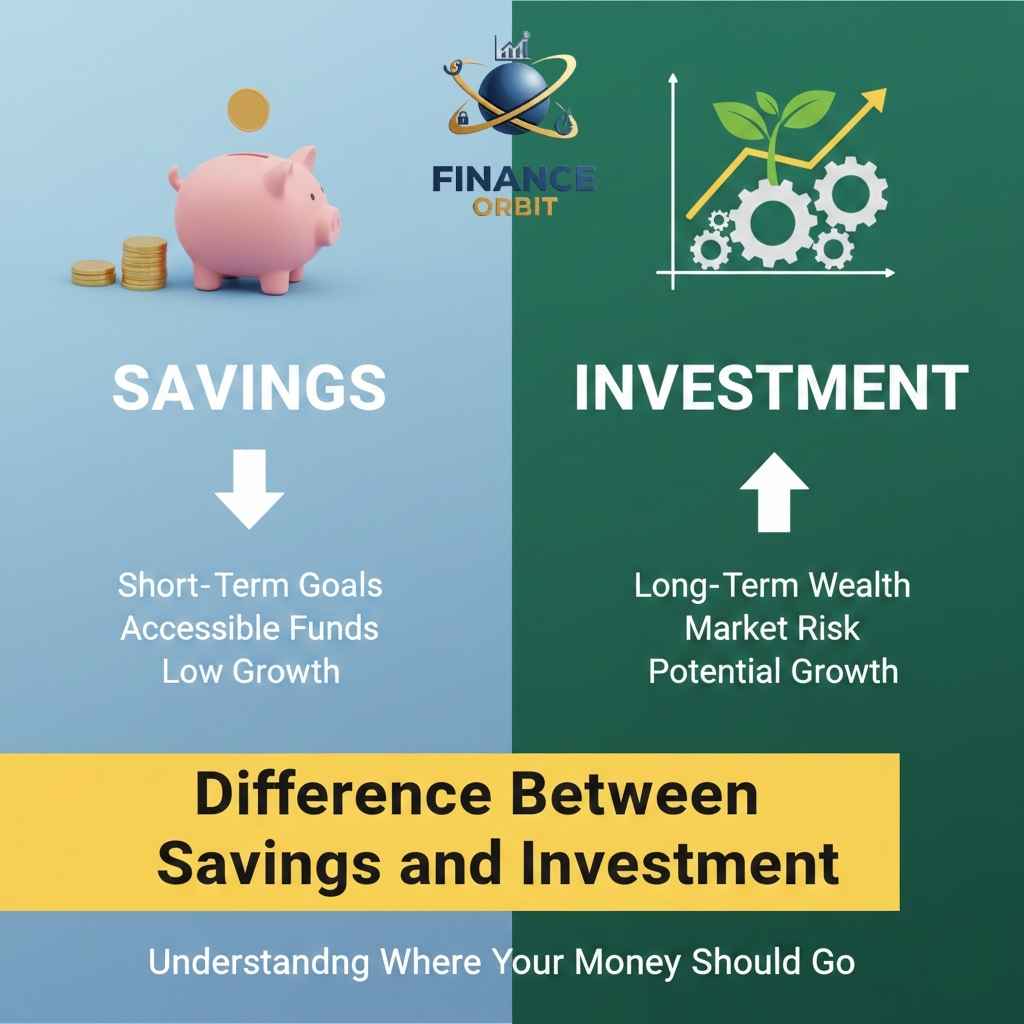
Description: Master the crucial difference between savings and investment. Learn when to save vs. invest, risk profiles, returns, liquidity, and how to balance both for financial security.
I kept ₹12 lakhs in a savings account for three years thinking I was being "financially responsible"—until I calculated how much purchasing power I'd lost to inflation.
It was 2019. I'd been diligently saving for five years, building what I called my "financial security fund." I felt proud—I had ₹12 lakhs in my bank account, untouched, earning 4% interest annually.
Everyone praised my discipline: "You're so responsible! You've saved so much! You're financially stable!"
I believed I was doing everything right.
Then during a casual conversation, a finance-savvy friend asked: "What are you doing with your savings? Are you investing?"
"It's in my savings account earning interest," I replied confidently.
His face fell. "For how long?"
"Three years. Why?"
He pulled out his phone and showed me a calculator: "Your ₹12 lakhs earned 4% interest annually—about ₹48,000 per year. But inflation averaged 6% annually. Your purchasing power decreased ₹24,000 per year. Over three years, you effectively lost ₹72,000 in real value."
I was stunned. "What do you mean I lost money? I gained ₹1.44 lakhs in interest!"
He explained: "Nominal gains don't matter—real gains do. If a car cost ₹10 lakhs three years ago, it costs ₹11.9 lakhs today with 6% annual inflation. Your ₹12 lakhs can buy less than it could three years ago. Meanwhile, if you'd invested in a basic index fund averaging 12% annually, your ₹12 lakhs would be worth ₹16.9 lakhs today—a real gain of ₹3.5 lakhs after accounting for inflation."
The math was devastating:
My approach (savings account):
- ₹12 lakhs (2016) → ₹13.49 lakhs (2019)
- Nominal gain: ₹1.49 lakhs
- But purchasing power in 2016 rupees: ₹11.28 lakhs
- Real loss: ₹72,000
Alternative approach (investment):
- ₹12 lakhs (2016) → ₹16.87 lakhs (2019) at 12% annual returns
- Inflation-adjusted value: ₹14.11 lakhs in 2016 rupees
- Real gain: ₹2.11 lakhs
The difference: ₹2.83 lakhs in three years from understanding the difference between saving and investing.
That conversation completely changed my understanding of money. I realized I'd confused saving (preserving capital for short-term needs) with investing (growing wealth for long-term goals).
Over the next two years, I learned:
- When to save vs. when to invest
- How much emergency savings I actually needed (not ₹12 lakhs sitting idle)
- Different investment vehicles and their purposes
- How to balance safety and growth
- The true cost of "playing it safe" with all money in savings
The transformation:
- Kept ₹3 lakhs in emergency fund (6 months expenses)
- Invested remaining ₹9 lakhs across diversified options
- Built systematic investment plan for monthly savings
- Stopped losing purchasing power to inflation
- Started building real wealth instead of nominal balances
Understanding savings vs. investment didn't just improve my returns—it gave me a framework for making every financial decision.
Today, I'm explaining the crucial difference between savings and investment—not theoretical economics, but practical guidance on when to use each tool, how much to allocate where, and why most people get this wrong.
Because here's the uncomfortable truth: keeping all your money in savings accounts feels safe but guarantees you lose purchasing power over time. Yet investing everything without emergency savings creates dangerous vulnerability. The key is understanding what each tool does and using both strategically.
Let's master savings vs. investment permanently.
Defining Savings and Investment
Before exploring differences, let's clearly define each.
What Is Savings?
Savings: Money set aside for short-term needs, emergencies, and upcoming expenses, typically kept in highly liquid, low-risk accounts.
Characteristics:
- Liquid: Accessible immediately or within days
- Safe: Minimal to no risk of losing principal
- Low returns: 2-4% interest typically
- Short-term focus: For goals within 1-3 years
- Guaranteed capital: Your ₹1 lakh remains ₹1 lakh
Common savings vehicles:
- Savings bank account (3-4% interest)
- Fixed deposits (6-7% interest, lock-in period)
- Recurring deposits (6-7% interest, monthly deposits)
- Liquid mutual funds (3-5% returns, redeemable in 1-2 days)
Purpose: Safety net, liquidity, capital preservation for known upcoming needs.
What Is Investment?
Investment: Money deployed to generate returns over medium to long term, accepting some level of risk in exchange for higher potential growth.
Characteristics:
- Less liquid: May take days or face penalties to access
- Risk involved: Potential to lose some/all principal (varies by investment)
- Higher returns: 8-15%+ potentially (varies widely)
- Long-term focus: Goals 5+ years away
- Variable capital: Your ₹1 lakh might become ₹1.5 lakhs or ₹80,000
Common investment vehicles:
- Stocks/equity mutual funds (10-15% historical average, high volatility)
- Bonds/debt mutual funds (7-9% returns, moderate risk)
- Real estate (8-12% appreciation, very illiquid)
- Gold (8-10% long-term returns, volatile short-term)
- PPF/EPF (7-8% returns, tax benefits, lock-in)
Purpose: Wealth building, beating inflation, achieving long-term financial goals.
Key Differences: Savings vs. Investment
Let's break down the fundamental distinctions.
Difference 1: Purpose and Time Horizon
Savings:
Purpose:
- Emergency fund (medical emergencies, job loss, urgent repairs)
- Known upcoming expenses (vacation in 6 months, annual insurance premium)
- Short-term goals (down payment in 2 years)
Time horizon: 0-3 years
Mindset: Capital preservation, ready availability
Example scenarios:
- Saving for wedding in 18 months: Keep in FD or savings account
- Building 6-month emergency fund: Keep in liquid fund or savings account
- Down payment for home in 2 years: Keep in short-term FD
Investment:
Purpose:
- Retirement (30+ years away)
- Child's education (10-18 years away)
- Wealth accumulation
- Financial independence
- Beating inflation
Time horizon: 5+ years (ideally 10+ for equity)
Mindset: Growth, accepting short-term volatility for long-term gains
Example scenarios:
- Retirement savings at age 30: Invest in equity mutual funds
- Child's education fund (child is 3 years old): Invest in balanced/equity funds
- Building wealth over decades: Systematic equity investment
Difference 2: Risk Profile
Savings:
Risk level: Very low to none
- Bank deposits: Government-insured up to ₹5 lakhs per bank
- Fixed deposits: Virtually guaranteed returns
- Liquid funds: Extremely low risk
Worst-case scenario: Bank failure (unlikely, covered by insurance up to ₹5 lakhs)
Best-case scenario: Earn stated interest rate (known in advance)
Predictability: High—you know exactly what you'll earn
Investment:
Risk level: Low to high (depending on asset class)
Low risk investments:
- Government bonds: 6-7% returns, very safe
- Debt mutual funds: 7-9% returns, low risk
- PPF: 7.1% returns, government-backed
Moderate risk investments:
- Balanced funds: 9-11% returns, moderate volatility
- Corporate bonds: 8-10% returns, default risk exists
High risk investments:
- Equity stocks: 12-15% average returns, high short-term volatility
- Equity mutual funds: 10-15% average returns, can lose 30-40% in bad years
- Cryptocurrency: Extremely volatile, can lose 70%+ rapidly
Worst-case scenario: Significant capital loss (stocks can fall 50%+, though historically recover)
Best-case scenario: Substantial gains (stocks can rise 100%+, multibagger potential)
Predictability: Low—returns vary significantly year to year
The trade-off: Higher risk typically means higher potential returns. Safety costs you in terms of growth.
Difference 3: Liquidity (How Quickly You Can Access Money)
Savings:
Immediate access:
- Savings account: ATM/bank withdrawal anytime
- Liquid mutual funds: Redeem today, money in 1-2 days
Short waiting period:
- Fixed deposits: Break prematurely (lose some interest, small penalty)
- Recurring deposits: Break prematurely (similar to FD)
Key advantage: Money available when you need it urgently
Investment:
Varies significantly by type:
High liquidity (but not recommended for short-term):
- Stocks: Sell today, money in T+2 days (2 days after trade)
- Equity mutual funds: Redeem today, money in 3-4 days
- Gold ETFs: Similar to stocks
Moderate liquidity:
- Debt mutual funds: 3-4 days typically
- Some have exit load (penalty) for early redemption
Low liquidity:
- Real estate: Months to sell (6-18 months typical)
- PPF: 15-year lock-in (partial withdrawal after 7 years)
- ELSS funds: 3-year lock-in
- Fixed maturity plans: Lock-in until maturity
Key consideration: Liquidity ≠ advisable to sell. You can access equity investments quickly, but shouldn't for short-term needs due to volatility.
Difference 4: Returns and Inflation
This is where most people misunderstand the crucial difference.
Savings:
Typical returns:
- Savings account: 3-4% annually
- Fixed deposit: 6-7% annually
- Recurring deposit: 6-7% annually
Inflation reality (India):
- Historical average: 5-7% annually
- Recent years (2021-2023): 6-7%
Real returns calculation: Real Return = Nominal Return - Inflation
Example:
- FD earning 6.5% annually
- Inflation: 6% annually
- Real return: 0.5% annually
The harsh truth: Most savings vehicles barely beat inflation (sometimes don't beat it). You're preserving capital nominally but losing purchasing power.
Investment:
Typical returns (long-term averages):
- Equity mutual funds: 12-15% annually (15+ year average)
- Balanced funds: 10-12% annually
- Debt funds: 7-9% annually
- Real estate: 8-12% annually (location-dependent)
- Gold: 8-10% annually (long-term)
Real returns (after inflation):
- Equity: 6-9% real returns (substantial wealth building)
- Balanced: 4-6% real returns
- Debt: 1-3% real returns
Example:
- Equity fund earning 12% annually
- Inflation: 6% annually
- Real return: 6% annually
The power: Investments (especially equity) significantly beat inflation over long periods, building real wealth.
The caveat: Short-term volatility—equity can lose 30% in a single year, but historically recovers and provides superior returns over 10+ years.
Difference 5: Taxation
How your returns are taxed matters enormously.
Savings:
Interest income taxation:
- Savings account interest: Added to income, taxed at your income tax slab (10-30%)
- FD interest: Added to income, taxed at your slab, TDS deducted if interest >₹40,000 annually
- No capital gains (you're not selling an asset)
Example:
- ₹10 lakhs FD earning 7% = ₹70,000 interest
- If you're in 30% tax bracket: Pay ₹21,000 tax
- Post-tax return: ₹49,000 (4.9% effective return)
Investment:
Tax treatment varies by investment type:
Equity investments (stocks, equity mutual funds):
- Long-term capital gains (LTCG): Held >1 year, taxed at 10% above ₹1 lakh annual gains (12.5% from 2024 budget, thresholds may change)
- Short-term capital gains (STCG): Held <1 year, taxed at 15%
Debt investments (bonds, debt mutual funds):
- LTCG: Held >3 years, taxed at 20% with indexation benefit (reduces taxable amount)
- STCG: Held <3 years, taxed at your income tax slab
Example (equity mutual fund):
- Invested ₹10 lakhs, grew to ₹15 lakhs over 3 years
- Gain: ₹5 lakhs
- First ₹1 lakh: Tax-free (under old rules; thresholds may vary post-2024 budget)
- Remaining ₹4 lakhs: Taxed at 10% = ₹40,000 tax
- Post-tax gain: ₹4.6 lakhs (much better than FD taxation on similar gains)
Tax-advantaged investments:
- PPF: Interest tax-free, contributions get 80C deduction
- ELSS mutual funds: Equity returns + 80C deduction on contribution
- NPS: Tax benefits on contribution and partial withdrawal
The insight: Investments often have more favorable tax treatment than savings interest, especially long-term capital gains.
The Critical Balance: How Much to Save vs. Invest
The most practical question: how to allocate your money.
The Emergency Fund: Your Foundation
Before investing anything, build emergency fund.
How much:
- Minimum: 3 months of essential expenses
- Recommended: 6 months of expenses
- Conservative (job uncertainty, dependents): 12 months of expenses
Calculation example:
- Monthly expenses: ₹50,000
- 6-month emergency fund: ₹3,00,000
Where to keep it:
- 50% in savings account (immediate access)
- 50% in liquid mutual fund (1-2 day access, slightly better returns)
Why this is non-negotiable:
- Medical emergencies
- Job loss
- Urgent home/vehicle repairs
- Family emergencies
Without emergency fund: Forced to sell investments at worst possible time (market low, real estate panic sale) or take expensive debt.
My mistake: Kept ₹12 lakhs as "emergency fund" when ₹3 lakhs was sufficient. The extra ₹9 lakhs should have been invested.
The Upcoming Expenses: Short-Term Savings
Beyond emergency fund, save for known upcoming expenses.
Examples:
- Annual insurance premium due in 8 months: Save monthly
- Vacation planned in 6 months: Set aside money
- Car down payment in 2 years: Build through FDs/RDs
Where to keep it:
- Savings account (if needed within 6 months)
- Fixed deposit (if 1-3 years away)
- Short-term debt fund (if 1-2 years away)
Guideline: If you'll need the money within 3 years, keep it in savings vehicles—don't risk market volatility.
The Investment Allocation: Long-Term Wealth
Everything beyond emergency fund and short-term savings should be invested.
Basic allocation framework (depends on age, risk tolerance, goals):
Young professionals (20s-30s):
- Emergency fund: ₹2-3 lakhs (savings)
- Short-term goals: As needed (savings)
- Everything else: 80-100% equity investments (long time horizon can ride out volatility)
Mid-career (40s):
- Emergency fund: ₹3-5 lakhs (savings)
- Short-term goals: As needed (savings)
- Investment: 60-70% equity, 30-40% debt/balanced funds (balancing growth and stability)
Pre-retirement (50s+):
- Emergency fund: ₹5-6 lakhs (savings)
- Short-term goals: As needed (savings)
- Investment: 40-50% equity, 50-60% debt/stable investments (preserving capital while maintaining some growth)
The principle: Longer time horizon = more equity allocation (higher growth potential, time to recover from volatility).
Common Mistakes People Make
Avoiding these errors saves thousands (or lakhs).
Mistake 1: Keeping All Money in Savings (My Mistake)
The problem:
- Losing purchasing power to inflation
- Missing decades of compounding returns
- False sense of security (nominal balance grows but real value shrinks)
Example:
- ₹10 lakhs in savings account for 20 years at 4% interest
- Grows to ₹21.9 lakhs (nominal)
- With 6% inflation, purchasing power: ₹6.9 lakhs (you effectively lost ₹3.1 lakhs in real terms)
Same ₹10 lakhs invested in equity at 12% average:
- Grows to ₹96.5 lakhs (nominal)
- With 6% inflation, purchasing power: ₹30 lakhs
- Real gain: ₹20 lakhs vs. loss of ₹3.1 lakhs with savings
Solution: Build adequate emergency fund (6 months expenses), save for short-term goals, invest everything else.
Mistake 2: Investing Emergency Fund (Opposite Extreme)
The problem:
- Emergency hits during market downturn
- Forced to sell investments at 30-40% loss
- Defeats entire purpose of emergency fund
Example:
- ₹5 lakhs emergency fund invested in stocks
- Medical emergency during market crash
- Stocks down 35%
- Forced to sell at ₹3.25 lakhs value
- Lost ₹1.75 lakhs due to timing
Solution: Keep true emergency fund in liquid, safe savings vehicles—not investments.
Mistake 3: Thinking "Investment" Means Only Stocks/Real Estate
The problem:
- All-or-nothing thinking (either savings account or risky stocks)
- Missing middle ground (debt funds, balanced funds, PPF)
- Unnecessary risk or unnecessary caution
Reality: Investment spectrum from low-risk (debt funds, PPF) to high-risk (individual stocks, crypto).
Solution: Match investment risk to goal timeline. Child's education in 15 years? Equity appropriate. Buying house in 3 years? Debt funds/FDs appropriate.
Mistake 4: Market Timing
The problem:
- Waiting for "right time" to invest
- Keeping money in savings waiting for market crash
- Missing years of returns
Reality:
- Time in market > timing the market
- Historically, staying invested beats trying to time entry/exit
Example:
- Investor A: Invested ₹10 lakhs in 2015, stayed fully invested through ups and downs
- Investor B: Kept ₹10 lakhs in savings waiting for "crash," finally invested in 2020 after crash already recovered
- By 2024, Investor A's portfolio much larger despite experiencing 2020 crash (but staying invested)
Solution: Invest systematically (SIPs), stay invested for long term, ignore short-term volatility.
Mistake 5: Not Distinguishing Between Short-Term and Long-Term Money
The problem:
- Investing money needed in 2 years (risky—might be down when you need it)
- Keeping money in savings for 15-year goal (losing to inflation)
Solution: Clear mental accounting:
- Money needed in <3 years: Savings
- Money needed in 3-5 years: Low-risk investments (debt funds, balanced funds)
- Money needed in 5+ years: Growth investments (equity)
- Money needed in 15+ years: Aggressive growth (mostly equity)
Practical Action Plan: Balancing Savings and Investment
Let's make this concrete with step-by-step guidance.
Step 1: Calculate Your Emergency Fund Need
Formula: Monthly essential expenses × 6 (or 3-12 depending on situation)
Example:
- Rent/EMI: ₹25,000
- Groceries: ₹8,000
- Utilities: ₹3,000
- Insurance: ₹2,000
- Transportation: ₹4,000
- Minimum medical: ₹3,000
- Total: ₹45,000 monthly
- 6-month emergency fund: ₹2,70,000
Action: Build this first before aggressive investing.
Step 2: Identify Short-Term Savings Goals
List upcoming expenses (next 1-3 years):
- Annual insurance premium: ₹30,000 (due in 10 months)
- Vacation: ₹80,000 (in 8 months)
- Home renovation: ₹2,00,000 (in 18 months)
Total short-term savings needed: ₹3,10,000
Action: Set aside money monthly in savings account or short-term FD.
Step 3: Calculate Investment Capacity
Formula: Monthly income - Monthly expenses - Emergency fund contribution - Short-term savings = Investment capacity
Example:
- Monthly income (in-hand): ₹80,000
- Monthly expenses: ₹50,000
- Emergency fund contribution: ₹10,000 (until ₹2.7L reached)
- Short-term savings: ₹15,000 (for vacation/insurance/renovation)
- Investment capacity: ₹5,000 monthly
Once emergency fund complete: ₹15,000 monthly available for investment (₹10,000 + ₹5,000)
Step 4: Choose Appropriate Investment Vehicles
Based on goals and time horizon:
Goal: Retirement (30 years away, age 30)
- Vehicle: Equity mutual funds (index funds or actively managed)
- Allocation: ₹8,000 monthly SIP
- Rationale: Long horizon allows riding volatility, need inflation-beating returns
Goal: Child's education (12 years away, child age 6)
- Vehicle: Balanced funds or child education plans
- Allocation: ₹5,000 monthly SIP
- Rationale: Moderate horizon, balanced growth and stability
Goal: Home down payment (7 years away)
- Vehicle: Debt mutual funds or PPF
- Allocation: ₹2,000 monthly
- Rationale: Moderate horizon, capital preservation important
Total investment: ₹15,000 monthly across different goals
Step 5: Automate Everything
Set up automatic transfers:
- Salary day: ₹10,000 → Emergency fund (until target reached)
- Salary day: ₹15,000 → Short-term savings account
- Salary day + 1: ₹15,000 → Investment SIPs (auto-debit)
Why automation works:
- Remove decision-making (happens automatically)
- "Pay yourself first" (savings/investment before discretionary spending)
- Consistency (doesn't depend on willpower or memory)
Step 6: Review and Rebalance Annually
Once per year:
- Check emergency fund adequacy (expenses changed? Family grown?)
- Review investment performance (not to panic sell, but to rebalance)
- Adjust allocations based on age/goals (moving closer to retirement? Shift more to debt)
- Increase SIP amounts (got raise? Invest the increment)
The Compounding Power: Why Starting Early Matters
The single most important factor in wealth building: time.
Example: Two Friends, Different Starting Points
Friend A (starts at 25):
- Invests ₹5,000 monthly
- Continues until age 60 (35 years)
- Average return: 12% annually
- Total invested: ₹21,00,000
- Final corpus: ₹2.59 crores
Friend B (starts at 35):
- Invests ₹10,000 monthly (double Friend A)
- Continues until age 60 (25 years)
- Average return: 12% annually
- Total invested: ₹30,00,000
- Final corpus: ₹1.88 crores
The shocking result:
- Friend A invested less total (₹21L vs. ₹30L)
- But accumulated more (₹2.59 Cr vs. ₹1.88 Cr)
- Difference: ₹71 lakhs extra just from starting 10 years earlier
The lesson: Time is more valuable than amount. Starting early with small amounts beats starting late with large amounts.
The implication: Don't wait until you can invest "large amounts"—start with whatever you can (even ₹1,000 monthly) as early as possible.
The Bottom Line
Keeping ₹12 lakhs in a savings account for three years taught me the most expensive lesson: confusing savings (capital preservation) with investment (wealth building) cost me ₹2.83 lakhs in lost returns and taught me nothing about strategic money management.
My mistake—treating all money the same, keeping everything in "safe" savings—felt responsible but guaranteed I lost purchasing power while missing years of compounding growth.
The transformation came from understanding:
- Savings preserve capital for short-term needs (emergency fund, upcoming expenses)
- Investment grows wealth for long-term goals (retirement, education, financial freedom)
- You need both, strategically allocated
- Neither is "better"—they serve different purposes
Once I learned to distinguish short-term money (keep safe in savings) from long-term money (invest for growth), my financial life transformed:
- Built proper emergency fund (₹3 lakhs, not ₹12 lakhs sitting idle)
- Invested long-term money appropriately (₹9 lakhs growing at 10-12% vs. 4%)
- Stopped losing purchasing power to inflation
- Started building real wealth instead of nominal balances
You now understand:
- Clear definitions (savings vs. investment characteristics)
- Key differences (purpose, risk, liquidity, returns, taxation)
- Critical balance (emergency fund → short-term savings → investments)
- Common mistakes (keeping everything in savings, investing emergency fund, market timing)
- Practical action plan (calculating needs, choosing vehicles, automation)
- Compounding power (why starting early matters more than amount)
Savings and investment aren't competitors—they're complementary tools serving different purposes.
This month, take action:
- Calculate emergency fund need (6 months expenses)
- If you don't have it, build it first (savings account/liquid fund)
- Once emergency fund complete, identify short-term needs (next 1-3 years)
- Save for those appropriately (savings accounts, FDs)
- Everything else? Invest according to goal timeline
One year from now, you'll either have money strategically allocated between savings and investments building real wealth, or you'll still be losing purchasing power keeping everything in savings accounts "playing it safe."
The math doesn't lie. Inflation doesn't care about your intentions. Time is passing whether you invest or not.
Safe and sorry is still sorry—when "safe" means guaranteed loss of purchasing power.
Your money deserves better. Your future self deserves better. The only question: will you give both what they deserve, or keep confusing safety with strategy?
The framework is clear. The tools are available. Your balanced financial future starts now.
Comments
No comment yet. Be the first to comment