Fixed vs. Floating: The Interest Rate Choice That Could Cost You Thousands
By: Compiled from various sources | Published on Jan 02,2026
Category Beginner
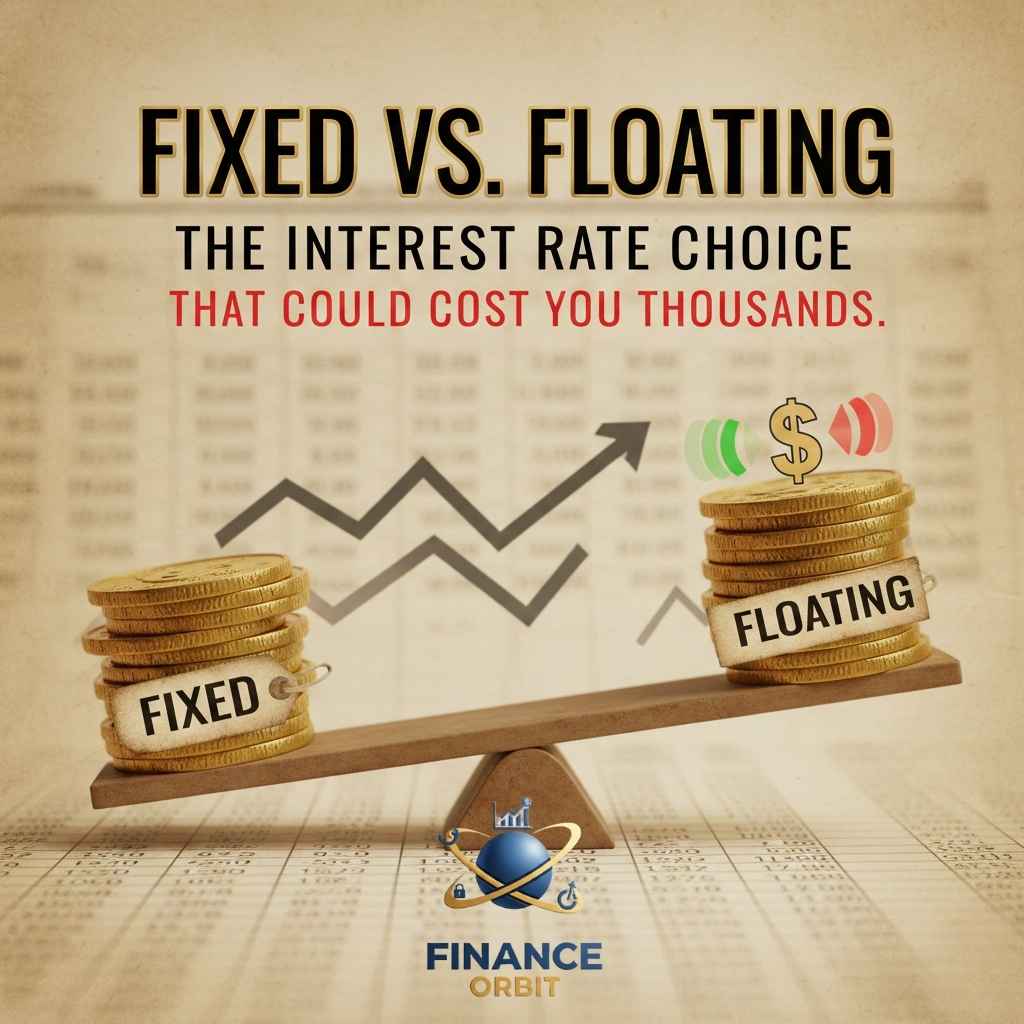
Description: Understanding fixed and floating interest rates simplified. Learn which option saves money on mortgages, loans, and investments with real examples and expert insights.
Let's be honest: the moment your banker starts talking about "fixed versus floating interest rates," your eyes probably glaze over faster than a donut at Krispy Kreme.
I get it. Interest rates sound boring. They sound like something your accountant should worry about, not you. But here's the uncomfortable truth: choosing between fixed and floating interest rates is one of those financial decisions that can literally cost or save you tens of thousands of dollars over the life of a loan.
And most people? They're making this choice based on gut feeling, whatever their neighbor did, or whichever option the banker pushes hardest. That's like choosing surgery based on which hospital has better parking.
So let me break this down in a way that actually makes sense, because understanding this stuff isn't optional if you care about your money. And you should, because that money represents your time, your work, your life.
The Basic Breakdown: What These Actually Mean
Fixed interest rates are exactly what they sound like—locked in for a specific period or the entire loan term. You borrow money at 6.5%, you pay 6.5% whether interest rates drop to 3% or spike to 12%. Your monthly payment stays the same. Predictable. Boring. Safe.
Floating interest rates (also called variable or adjustable rates) move up and down based on market conditions, usually tied to some benchmark like the prime rate or LIBOR (now being replaced by SOFR, but that's another rabbit hole). Rates drop, your payment drops. Rates rise, so does your payment. Exciting. Unpredictable. Potentially terrifying.
Neither is inherently "better." They're different tools for different situations, like choosing between a motorcycle and a minivan. The right choice depends on your circumstances, goals, and honestly, your tolerance for financial uncertainty.
How Fixed Rates Actually Work
When you lock in a fixed rate loan, you're essentially making a bet with the bank: "I think rates might go up, so I'm willing to pay a premium now for certainty."
And yes, fixed rates typically start higher than floating rates. That's the price of predictability. The bank is taking on the risk that rates might rise, and they charge you for that risk upfront.
The Beautiful Simplicity
Your monthly payment on a fixed-rate mortgage or loan never changes (assuming it's not an adjustable-rate mortgage with an initial fixed period, which we'll get to). This makes budgeting ridiculously easy.
Bought a house with a $2,000 monthly payment? That's your payment in year one, year fifteen, and year thirty. Inflation might make that payment feel smaller over time (a nice side benefit), but the number itself doesn't budge.
For fixed rate mortgages, this stability is psychological gold. You know exactly what you're paying. No surprises. No midnight anxiety about rate hikes. No constantly checking financial news to see if you're screwed.
The Catch
You're locked in. Rates drop by 2%? Too bad. Everyone with floating rates is celebrating while you're still paying your higher rate.
Sure, you can refinance, but that involves fees, paperwork, qualification requirements, and time. It's possible, but it's not automatic like with floating rates.
Also, fixed rates sometimes come with prepayment penalties—fees if you pay off the loan early. Not always, but read the fine print because getting hit with thousands in penalties for trying to save money is peak financial irony.
How Floating Rates Actually Work
Floating interest rates are tied to an underlying benchmark rate plus a margin (the bank's profit).
For example: Prime rate (currently around 8.5% in the US as of late 2024) + 2% margin = 10.5% interest rate. When prime moves, your rate moves.
The Appeal
Floating rates typically start lower than fixed rates. Sometimes significantly lower. Over time, if rates stay stable or drop, you could save substantial money compared to a fixed rate.
There's also flexibility. Want to make extra payments without penalty? Usually easier with floating rates. Want to pay off the loan early? Often no prepayment penalties.
And if rates drop, you benefit automatically. No refinancing hassle, no fees—just lower payments. Sweet.
The Terror
Rates can also rise. And rise. And rise some more.
Your $1,500 monthly payment could become $1,800, then $2,200. Your "affordable" loan becomes a financial burden. People have literally lost homes because rate increases made payments unsustainable.
The interest rate risk is real. You're betting that rates will stay stable or drop. If you're wrong, you pay for that mistake every single month.
When Fixed Rates Make Sense
Let me tell you when locking in is probably smart:
You're Risk-Averse
If the thought of fluctuating payments gives you anxiety, pay the premium for fixed. Peace of mind has value. Losing sleep over potential rate hikes isn't worth saving a few dollars monthly.
Rates Are Historically Low
When interest rates are at or near historic lows, locking in is often brilliant. You're essentially capturing cheap money for decades. This was the move during 2020-2021 when mortgage rates hit record lows.
Your Budget Is Tight
If you're stretching to afford payments already, you can't risk them increasing. Fixed rates protect you from payment shock that could wreck your finances.
Long-Term Loans
For 30-year mortgage rates or other long-term borrowing, fixed rates provide crucial stability. A lot can happen in three decades. Locking in certainty makes sense.
You're Bad at Monitoring Finances
Be honest: will you actually watch rate trends and make smart decisions? Or will you forget about it until payments have doubled? If you're the latter (no judgment, most people are), fixed protects you from yourself.
When Floating Rates Make Sense
Floating isn't just for gamblers and risk-takers. Sometimes it's the smarter play:
Rates Are High
When interest rates are elevated, floating rates give you the potential to benefit when they eventually drop. You're not locking in expensive money.
Short-Term Borrowing
Planning to pay off the loan quickly? Floating's lower initial rate saves you money during the brief period you're borrowing. The risk of rate increases matters less if you're only exposed for a couple years.
You Have Financial Flexibility
If rate increases won't break your budget—you have emergency savings, room in your income, or can easily cut expenses—then floating's potential savings might outweigh the risk.
You're Financially Savvy
If you actively monitor economic conditions and can refinance or adjust your strategy when needed, floating rates give you more options to optimize over time.
You Expect Rates to Drop
This is speculation, but if economic indicators suggest rate decreases are likely (recession fears, cooling inflation, central bank signals), floating lets you capitalize on those drops.
The Hybrid Approach: Having Your Cake and Eating It Too
Some loans offer hybrid interest rate structures—fixed for an initial period, then converting to floating.
Common examples: 5/1 ARM (fixed for 5 years, then adjustable annually), 7/1 ARM, 10/1 ARM.
These give you initial payment stability while potentially benefiting from lower rates later. They're great if you plan to sell or refinance before the adjustable period kicks in.
The catch? If you're still holding the loan when it converts and rates have risen, you're exposed to the same risks as any floating rate loan.
Real Numbers: The Difference Actually Matters
Let's get concrete with a fixed vs variable rate comparison.
Scenario: $300,000 mortgage, 30-year term
Option A - Fixed: 6.5% for entire term
- Monthly payment: $1,896
- Total interest paid: $382,633
Option B - Floating: Starts at 5.5%, varies over time
- Initial monthly payment: $1,703
- If rate stays at 5.5%: Total interest paid: $312,914 (saves $69,719)
- If rate averages 7.5% over 30 years: Total interest paid: $428,531 (costs $45,898 more)
See the stakes? We're talking about differences of $50,000+ depending on which way rates move.
How to Actually Decide (A Framework That Works)
Stop guessing. Use this decision framework:
Step 1: Assess Your Financial Cushion
Can you handle a 2-3% rate increase without lifestyle damage? If yes, floating becomes more viable. If no, lean toward fixed.
Step 2: Check Current Rate Environment
Research where rates are historically. Near multi-decade lows? Fixed is probably smart. At peaks? Floating has more upside potential.
Step 3: Consider Your Timeline
Paying off in 3-5 years? Floating's lower initial rate saves money. Holding for 20-30 years? Fixed provides crucial long-term certainty.
Step 4: Know Yourself
Are you a worrier or a risk-taker? Will you actively manage this or forget about it? Your personality matters as much as the numbers.
Step 5: Run Multiple Scenarios
Use online calculators to model different rate environments. See what happens if rates rise 1%, 2%, 3%. If the worst-case scenario is manageable, floating might work.
The Economic Context: What Affects These Rates
Understanding factors affecting interest rates helps you make smarter timing decisions:
Central bank policy: When the Federal Reserve (or your country's equivalent) raises rates to fight inflation, borrowing costs increase. When they cut rates to stimulate growth, borrowing gets cheaper.
Inflation: Higher inflation typically leads to higher interest rates as central banks try to cool the economy.
Economic growth: Strong growth often means higher rates; recessions typically bring rate cuts.
Global conditions: International events, currency movements, and foreign investment flows all influence rates.
You don't need a PhD in economics, but following basic rate trends helps you time major borrowing decisions better.
Common Mistakes People Make
Let me save you from some expensive errors:
Choosing based solely on initial rate: That 1% lower starting rate on a floating loan means nothing if rates spike later. Look at the total picture.
Ignoring your own psychology: Taking floating rates then losing sleep over rate anxiety costs you in stress and potentially bad panic decisions.
Not reading the fine print: Rate caps, adjustment frequency, prepayment penalties—these details matter enormously.
Refinancing too often: Every refinance has costs. Constantly chasing slightly better rates can cost more than you save.
Forgetting about inflation: Fixed-rate payments become relatively cheaper over time as your income (hopefully) increases with inflation.
The Bottom Line Truth
There's no universal "right" answer to choosing between fixed and floating rates. Anyone who tells you otherwise is selling you something.
Fixed rates buy certainty at a premium. You're paying extra for predictability and protection from rate increases.
Floating rates offer potential savings at the cost of uncertainty. You're accepting risk in exchange for lower initial costs and potential future benefits.
The smart money? It matches the choice to the specific situation—your financial stability, risk tolerance, loan timeline, and current rate environment.
My advice: For your primary home mortgage or other major, long-term debt you can't easily escape, lean toward fixed unless you're very financially secure. The peace of mind is worth it.
For shorter-term borrowing, investment properties, or situations where you have financial flexibility, floating rates can absolutely make sense.
And remember: you can always refinance later if circumstances change dramatically. Your first choice isn't permanent.
Ready to make your decision? Talk to multiple lenders, run the numbers in different scenarios, honestly assess your risk tolerance, and then commit.
Second-guessing yourself for the next 30 years helps nobody. Make an informed choice and move forward.
Your financial future will thank you for actually understanding this stuff instead of just signing whatever the banker puts in front of you.
Now you know better. Time to do better.
Comments
abhilasm1234
January 05,2026
👍
abhilasm1234
January 05,2026
wonderful
abhilasm1234
January 05,2026
I don't know what about