Modern Finance & Technology: How Your Bank Became an App (And Why Your Grandma's Confused)
By: Compiled from various sources | Published on Jan 08,2026
Category Professional
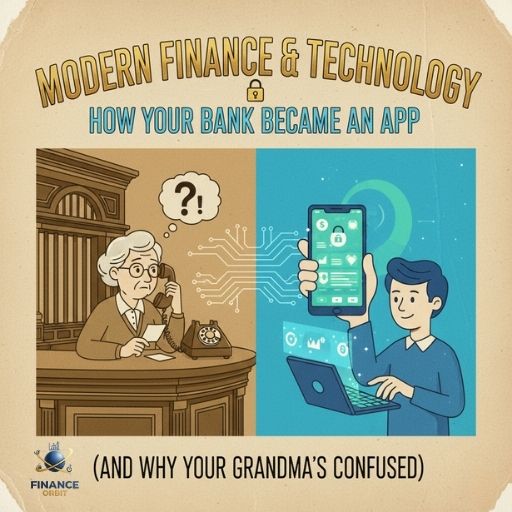
Description: Explore how technology transformed modern finance—from mobile banking to cryptocurrency. Understand fintech, digital payments, blockchain, and the future of money in the tech age.
Remember when "doing your banking" meant physically going to a bank?
You'd drive to a building with marble floors and tellers behind glass windows. You'd wait in line with a paper deposit slip you filled out with a pen chained to a counter. You'd receive a little booklet where someone stamped your transaction. The whole ordeal took 45 minutes for something that now takes 30 seconds on your phone while you're sitting on the toilet.
That world is dead. And honestly? It's been dead longer than most people realize.
Modern finance and technology have merged so completely that they're basically inseparable. Your "bank" is increasingly just software. Money is increasingly just data. Financial transactions happen at the speed of internet connections, not the speed of human tellers counting cash.
How technology changed finance isn't just about convenience—it's about fundamental restructuring of what money is, how it moves, who controls it, and what financial services even mean.
And here's the thing: most people are using these technologies daily without understanding how profoundly different the financial system has become from what existed just 20 years ago.
So let me walk you through this revolution—the fintech transformation that turned your wallet into an app, your bank into a server farm, and money into ones and zeros that move at the speed of light.
Because understanding how modern finance actually works means understanding the technology underneath it.
And that matters more than you think.
Digital Banking: The Death of the Branch
Online banking evolution happened faster than almost anyone predicted.
The Before Times
Pre-2000s banking:
- Physical branches for every transaction
- Paper checks taking days to clear
- Statements mailed monthly
- No way to check your balance without calling or visiting
- ATMs were revolutionary technology
The limitations: Banking was constrained by geography and business hours. You banked where you lived. You waited for banks to open.
The Digital Shift
Early online banking (late 1990s-2000s): Check balances, transfer between accounts, pay bills. Revolutionary at the time, laughably limited now.
Mobile banking (2010s): Everything online banking did, but in your pocket. Deposit checks with photos. Transfer money instantly. Banking became 24/7.
Current state: Full-service banking without ever visiting a branch. Open accounts digitally. Apply for loans via app. Video chat with advisors.
What Changed Fundamentally
Banking became software. The physical branch is increasingly irrelevant. Your relationship with your bank is mediated entirely through screens.
Barriers to entry dropped: Starting a bank traditionally required massive capital and infrastructure. Digital banking requires servers and software—still expensive but vastly cheaper.
This enabled: Challenger banks, neobanks, and fintech companies competing with traditional institutions.
Examples: Chime, Revolut, N26—banks that exist entirely digitally, no branches at all.
Mobile Payments: Money Moves at Light Speed
Digital payment systems transformed how transactions happen.
The Old Way
Cash: Physical exchange. Immediate but requires face-to-face interaction.
Checks: Written promise to pay. Takes days to clear. Can bounce.
Credit cards: Plastic card swiped through reader. Authorization takes seconds but settlement takes days.
Limitations: Geographic constraints, processing delays, fees, intermediaries.
The New Way
Mobile wallets: Apple Pay, Google Pay, Samsung Pay—your phone becomes your wallet.
Peer-to-peer apps: Venmo, PayPal, Cash App, Zelle—send money to friends instantly.
QR code payments: Scan code, pay instantly. Huge in Asia (Alipay, WeChat Pay), growing globally.
Contactless: Tap card or phone, pay instantly. No PIN needed for small amounts.
What This Enables
Instant transfers: Money moves in seconds, not days.
Reduced cash dependence: Some businesses no longer accept cash.
Lower transaction costs: Digital transfers cost less than processing checks or physical cash.
Financial inclusion: People without traditional bank accounts can participate via mobile money.
Data generation: Every transaction creates data about your spending habits.
The Dark Side
Privacy concerns: Every digital payment is tracked. Your spending patterns are known and potentially sold.
Exclusion: Cash-only businesses or individuals without smartphones/bank accounts get left behind.
Technical dependence: If the system goes down, you can't pay for anything.
Fintech: When Finance Met Silicon Valley
Fintech revolution refers to companies using technology to compete with traditional financial services.
What Fintech Companies Do
Lending: LendingClub, SoFi—peer-to-peer lending, algorithm-based loan decisions
Investment: Robinhood, Betterment—zero-commission trading, robo-advisors
Insurance: Lemonade, Root—AI-driven underwriting, instant claims
Personal finance: Mint, YNAB—automated budgeting, expense tracking
Business services: Stripe, Square—payment processing, point-of-sale systems
Cryptocurrency: Coinbase, Binance—digital currency exchanges
How They Compete
Lower costs: Less overhead (no branches) means lower fees.
Better UX: Consumer-focused design vs. bank legacy systems from the 1980s.
Speed: Instant approvals, same-day funding, real-time transactions.
Data-driven: Using algorithms and AI for decisions traditionally made by humans.
Specialization: Focus on doing one thing well rather than offering everything.
Why Traditional Banks Struggled
Legacy systems: Running on decades-old technology that's expensive to maintain and difficult to update.
Regulatory burden: Banks face heavy regulation. Fintech companies initially operated in regulatory gray areas.
Cultural inertia: Bank culture developed around physical branches and face-to-face service. Digital-first thinking was foreign.
Profit models: Banks made money on fees and float (time between transaction and settlement). Technology compressed these.
The Current State
Collaboration: Many fintechs partner with traditional banks rather than replacing them.
Acquisition: Big banks buying fintech companies to acquire technology and talent.
Regulation catching up: Fintechs now face increasing regulatory scrutiny.
Blockchain and Cryptocurrency: The Wild West
Blockchain in finance is simultaneously revolutionary and massively overhyped.
What Blockchain Actually Is
Distributed ledger technology: Instead of one central authority (bank) maintaining transaction records, the ledger is distributed across many computers.
Key characteristics:
- Decentralized (no single authority)
- Transparent (transactions visible to network participants)
- Immutable (can't change historical transactions)
- Secured by cryptography
Cryptocurrency Basics
Bitcoin (2009): First major cryptocurrency. Digital currency not controlled by any government or central bank.
Ethereum: Blockchain that enables "smart contracts"—self-executing agreements coded into the blockchain.
Thousands of others: Varying legitimacy, from serious projects to outright scams.
The Promise
Financial inclusion: Banking for the unbanked. No permission needed to participate.
Reduced intermediaries: Direct peer-to-peer transactions without banks taking cuts.
Transparency: All transactions recorded publicly (though identities can be pseudo-anonymous).
Programmable money: Smart contracts enable automated financial agreements.
The Reality
Volatility: Cryptocurrency prices swing wildly. Terrible for actual currency use.
Scalability issues: Bitcoin processes 7 transactions per second. Visa processes 24,000. Blockchain is slow.
Energy consumption: Bitcoin mining uses as much energy as entire countries.
Speculation dominates: Most cryptocurrency activity is trading/speculation, not actual use as currency.
Scams and fraud: Unregulated space attracts bad actors. Billions lost to scams, hacks, and fraud.
Regulatory uncertainty: Governments worldwide still figuring out how to regulate this.
Where It Might Actually Matter
Cross-border payments: Traditional international transfers are slow and expensive. Cryptocurrency potentially offers improvement.
Smart contracts: Automated execution of agreements without intermediaries has legitimate use cases.
Tokenization: Representing real-world assets (real estate, art) as digital tokens on blockchain.
Central Bank Digital Currencies (CBDCs): Governments creating digital versions of national currencies using blockchain-adjacent tech.
AI and Machine Learning in Finance
Artificial intelligence in finance is transforming operations behind the scenes.
Where AI Is Used
Fraud detection: Algorithms spot unusual patterns indicating fraud faster than humans.
Credit decisions: AI analyzes thousands of data points to assess creditworthiness.
Trading: Algorithmic trading executes millions of trades per second based on market conditions.
Customer service: Chatbots handle basic inquiries, route complex ones to humans.
Risk assessment: AI models predict default risk, market movements, and portfolio performance.
Personalization: Algorithms recommend financial products based on your behavior and profile.
The Benefits
Speed: Decisions in milliseconds that took humans hours or days.
Scale: Process millions of transactions simultaneously.
Pattern recognition: Spot correlations humans miss in massive datasets.
Cost reduction: Automation reduces need for human labor in routine tasks.
The Concerns
Bias: AI learns from historical data. If that data reflects historical discrimination, AI perpetuates it.
Opacity: Deep learning models are "black boxes"—even creators don't fully understand how they reach decisions.
Job displacement: Automation eliminates jobs in banking, insurance, and financial services.
Systemic risk: If everyone uses similar algorithms, they might all make the same mistakes simultaneously, amplifying crises.
Accountability: When AI makes bad decisions, who's responsible?
Open Banking and APIs: Data as Currency
Open banking technology is restructuring how financial data flows.
What Open Banking Means
Traditional model: Your financial data lives in your bank's closed system. Other services can't access it without giving them your login credentials (which violates terms of service).
Open banking model: With your permission, banks must share your data with third-party services via secure APIs (Application Programming Interfaces).
What This Enables
Account aggregation: See all accounts from multiple banks in one app.
Better lending decisions: Lenders access real transaction data, not just credit scores.
Personal finance tools: Apps like Mint can automatically categorize spending and create budgets.
Faster payments: Services like Plaid enable instant bank transfers for apps.
Innovation: Third-party developers can create services building on banking infrastructure.
The Tradeoffs
Convenience vs. privacy: Sharing financial data widely creates convenience but also risk.
Security concerns: More access points mean more potential vulnerabilities.
Data monetization: Your financial data has value. Companies profit from it.
Regulatory questions: Who's liable when third-party services mishandle data?
Robo-Advisors: Automated Investing
Robo-advisor platforms democratized investment advice.
How They Work
Traditional advisor: Human financial advisor creates investment plan, manages portfolio, charges 1% of assets annually.
Robo-advisor: Algorithm asks questions about goals and risk tolerance, automatically creates and manages diversified portfolio, charges 0.25% or less.
Examples: Betterment, Wealthfront, Vanguard Personal Advisor Services.
Why They Matter
Accessibility: No minimum investment or much lower minimums than traditional advisors.
Cost: Dramatically lower fees mean more of your returns stay with you.
Simplicity: Automated rebalancing, tax-loss harvesting, and diversification without effort.
Removes emotion: Algorithm doesn't panic during market downturns or get greedy during booms.
The Limitations
No human judgment: Can't account for complex personal situations or provide true personalized advice.
One-size-fits-most: Algorithm-driven strategies work for average cases but might not optimize for unique circumstances.
Can't replace comprehensive planning: Estate planning, tax strategy, insurance needs—these still benefit from human expertise.
The Gig Economy and Financial Services
Technology and gig economy finance created new challenges.
The Problem
Gig workers (Uber drivers, freelancers, delivery people) have irregular income that doesn't fit traditional financial services designed for salaried employees.
Technology Solutions
Instant pay: Services letting gig workers access earnings immediately instead of waiting for weekly/monthly payment cycles.
Income verification: Alternative credit scoring using gig platform data instead of traditional employment verification.
Budgeting tools: Apps helping manage irregular income, predict earnings, smooth cash flow.
Benefits platforms: Technology enabling gig workers to access health insurance, retirement savings, and other benefits traditionally tied to employment.
The Bigger Picture
Work is changing: Traditional employment models are eroding. Financial services must adapt to new realities.
Financial precarity: Many gig workers live paycheck to paycheck. Technology both enables and potentially exploits this.
Cybersecurity: The New Bank Robbery
Financial cybersecurity is now the primary security concern for financial institutions.
The Threats
Data breaches: Stealing customer information to commit identity theft.
Ransomware: Encrypting bank systems and demanding payment to unlock them.
Phishing: Tricking customers into revealing login credentials.
Account takeover: Using stolen credentials to drain accounts.
Payment fraud: Intercepting or redirecting payments.
The Arms Race
Banks invest billions in cybersecurity—firewalls, encryption, multi-factor authentication, biometrics, AI-driven threat detection.
Criminals adapt: As defenses improve, attacks get more sophisticated.
Human factor: Most breaches involve human error—clicking phishing links, weak passwords, social engineering.
Regulation requires it: Financial institutions face strict cybersecurity requirements and massive penalties for breaches.
The Future: What's Coming
Future of finance and technology:
Central Bank Digital Currencies (CBDCs)
Governments creating digital versions of national currencies. China's digital yuan is already being tested. Many countries exploring this.
Implications: Could eliminate need for commercial banks in payments. Raises surveillance concerns (government tracking all transactions).
Embedded Finance
Financial services built directly into non-financial apps. Buy something on Instagram, get financing instantly without leaving the app.
Already happening: Apple Card, Amazon lending to sellers, Tesla insurance.
Quantum Computing
Could break current encryption methods, requiring complete cybersecurity overhaul. Also could revolutionize risk modeling and trading algorithms.
Further AI Integration
More decisions automated. Potentially better fraud detection and personalized services. Also potentially greater algorithmic bias and systemic risks.
Continued Decentralization
Blockchain and cryptocurrency development continues. Whether it becomes mainstream or remains niche is uncertain.
The Bottom Line
Modern finance and technology have merged into a single entity. Your financial life is now mediated entirely through technology—apps, algorithms, and automation.
This brings enormous benefits: convenience, speed, lower costs, accessibility.
It also brings risks: privacy concerns, cybersecurity threats, algorithmic bias, and dependence on technology that can fail.
Understanding this matters because financial decisions increasingly depend on understanding the technology underlying them. You're not just choosing a bank—you're choosing a technology platform. You're not just making payments—you're generating data about yourself. You're not just investing—you're trusting algorithms with your future.
The transformation is permanent. Banking will never go back to physical branches and paper checks. Money will never be purely physical cash again. Finance is now technology.
So whether you're a digital native who's never written a check or someone who remembers when "online banking" sounded like science fiction, understanding how technology reshaped finance is essential for navigating the modern financial world.
Your grandma's confused because the world changed fundamentally.
But now you're not.
Welcome to modern finance. It's all just software now.
And that changes everything.
Comments
No comment yet. Be the first to comment