Interest Rates Explained: Why Your Mortgage, Job, and Retirement All Care About What the Fed Does
By: Compiled from various sources | Published on Jan 13,2026
Category Intermediate
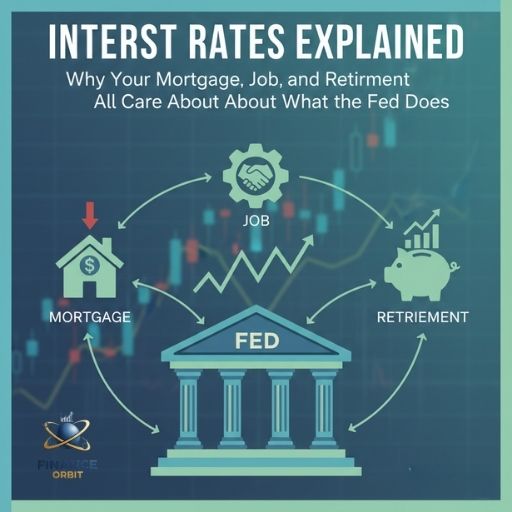
Description: Understand how interest rates affect the economy—from your mortgage to employment. Learn why central banks raise or lower rates and how it impacts your daily financial life.
Let me tell you about the time I finally understood why everyone freaks out when the Federal Reserve changes interest rates by a quarter of a percent.
I was buying a house. My lender called and said, "The Fed might raise rates next month. Lock in your rate now or risk paying thousands more over the life of your loan."
I vaguely understood that interest rate increases meant my mortgage would cost more. What I didn't understand was why the Fed was raising rates, how this tiny policy decision in Washington affected my personal mortgage, and what it all meant for the broader economy.
So I did what any confused person does—I went down the research rabbit hole. And discovered that interest rates and the economy are so interconnected that literally everything economic—your job security, your savings account returns, stock market performance, housing prices, inflation, business expansion—is affected by what central banks do with interest rates.
How interest rates work is the most important economic concept most people don't understand. And the impact of interest rates on daily life is vastly more significant than anyone realizes until they're suddenly facing higher mortgage payments, seeing their savings account actually earn something, or wondering why layoffs are happening during an economic "cooling."
Central banks and interest rates aren't abstract macroeconomic theory. They're the levers controlling whether you can afford a house, whether businesses are hiring, whether your retirement savings grow, and whether inflation eats away at your purchasing power.
So let me explain what took me way too long to figure out: how changing a percentage point or two ripples through the entire economy and affects everything from your grocery bill to your job prospects.
Because understanding this means understanding the economic world you're navigating.
And that's worth way more than another finance article that puts you to sleep by the third paragraph.
What Interest Rates Actually Are
Interest rate basics start with a simple concept that gets complicated fast.
The Simple Definition
Interest rate: The cost of borrowing money, or the reward for saving/lending money.
For borrowers: The percentage you pay on top of what you borrowed.
For savers/lenders: The percentage you earn on money you've saved or lent.
Example: Borrow $10,000 at 5% annual interest. After one year, you owe $10,500. The $500 is the interest—the cost of borrowing.
Different Types of Interest Rates
Federal funds rate: The rate banks charge each other for overnight loans. This is the rate the Federal Reserve (or other central banks) directly controls.
Prime rate: What banks charge their best customers. Usually federal funds rate + 3%.
Mortgage rates: What you pay to borrow for house purchase. Based on federal funds rate plus risk premium.
Credit card rates: What you pay on credit card debt. Usually much higher than other rates.
Savings account rates: What banks pay you to keep money with them. Based on federal funds rate.
All these rates move together: When the Fed raises/lowers the federal funds rate, all other rates tend to follow.
Why Interest Rates Exist
Risk compensation: Lending money is risky (borrower might not repay). Interest compensates for that risk.
Opportunity cost: Money lent to you can't be used elsewhere. Interest compensates lender for lost opportunities.
Time value of money: Money today is worth more than money tomorrow (you can invest it, use it now, etc.). Interest compensates for delayed access.
Inflation: Money loses purchasing power over time. Interest compensates for this erosion.
How Central Banks Control Interest Rates
Central bank monetary policy is how governments manage economic growth and inflation.
What Central Banks Do
Federal Reserve (US), European Central Bank (EU), Bank of England (UK), Reserve Bank of India—these are central banks. They don't serve regular customers. They regulate commercial banks and control money supply.
Their main tool: Setting the interest rate at which banks can borrow from them or from each other.
The mechanism:
- Fed raises rates → Banks' borrowing costs increase → Banks raise rates for customers → Borrowing becomes more expensive → People and businesses borrow/spend less
- Fed lowers rates → Banks' borrowing costs decrease → Banks lower rates for customers → Borrowing becomes cheaper → People and businesses borrow/spend more
The Dual Mandate (For the Fed)
Maximum employment: Keep unemployment low, economy growing.
Price stability: Keep inflation around 2% (not too high, not deflation).
The balancing act: These goals can conflict. Strong employment can create inflation. Controlling inflation can increase unemployment.
Interest rates are the lever: Raising/lowering rates tries to balance these objectives.
How Interest Rates Affect Borrowing and Spending
Interest rates impact on consumers flows through multiple channels:
Mortgages and Housing
When rates are low:
- Mortgages are cheap
- More people can afford to buy houses
- Housing demand increases
- Home prices rise
- Construction increases
- Related industries (furniture, home improvement, real estate) boom
When rates are high:
- Mortgages are expensive
- Fewer people can afford houses
- Housing demand decreases
- Home prices stabilize or fall
- Construction slows
- Related industries suffer
Real example: 3% mortgage rate on $300,000 = $1,265/month payment. 7% rate = $1,996/month. That's $731 more monthly, $263,000 more over 30 years. Same house, vastly different affordability based on interest rates alone.
Car Loans and Big Purchases
Same logic as mortgages: Low rates make car loans, appliance financing, and other big purchases cheaper. High rates make them more expensive.
The ripple: When rates rise, people postpone big purchases. Auto sales drop. Appliance sales decline. Manufacturing slows.
Credit Cards and Consumer Debt
Credit card rates follow Fed rates: When Fed raises rates, credit card rates increase (usually quickly). When Fed lowers rates, credit card rates decrease (usually slowly).
Debt burden increases: If you carry credit card balance, higher rates mean more of your income goes to interest payments, less to actual purchases or savings.
Spending decreases: Higher debt costs reduce discretionary spending.
Business Investment
Businesses borrow to expand: New equipment, facilities, inventory, hiring—these often require borrowed money.
Low rates encourage expansion: Cheap borrowing makes investment attractive. Businesses expand, hire, increase production.
High rates discourage expansion: Expensive borrowing makes investment less attractive. Projects get postponed or cancelled. Hiring slows or stops. Some businesses lay off workers.
The multiplier effect: One business's expansion creates jobs, which creates income, which creates spending, which benefits other businesses. Contraction works in reverse.
How Interest Rates Affect Savings and Investment
Interest rates and investments work in seemingly contradictory ways:
Savings Accounts
Low interest rates:
- Savings earn almost nothing
- Incentive to spend or invest elsewhere (stocks, real estate)
- Good for borrowers, bad for savers
High interest rates:
- Savings earn meaningful returns
- Incentive to save rather than spend
- Good for savers, bad for borrowers
Example: $10,000 in savings at 0.5% earns $50/year. At 5%, it earns $500/year. That's $450 difference for doing nothing different.
Bonds
Inverse relationship: When interest rates rise, bond prices fall. When interest rates fall, bond prices rise.
Why: Existing bonds paying 3% become less valuable when new bonds pay 5%. Investors sell old bonds (driving price down) to buy new higher-yielding bonds.
Impact on bond holders: Rising rates hurt existing bond portfolio values. Falling rates help.
Stocks
Complicated relationship:
Low rates generally help stocks:
- Cheap borrowing helps corporate profits
- Bonds offer poor returns, pushing investors to stocks
- Consumer spending boosts corporate revenues
High rates generally hurt stocks:
- Expensive borrowing hurts corporate profits
- Bonds offer competitive returns, some investors leave stocks
- Reduced consumer spending hurts revenues
But: It's not absolute. Sometimes high rates signal strong economy, which supports stocks. Sometimes low rates signal recession fears, which hurts stocks.
Retirement Accounts
Indirectly affected: 401(k)s and IRAs invested in stocks and bonds experience the effects described above.
Long-term perspective: For retirement decades away, short-term rate fluctuations matter less than consistent contributions and time horizon.
Interest Rates and Inflation: The Primary Relationship
Interest rates inflation relationship is why central banks obsess over rates:
How Inflation Works
Too much money chasing too few goods: When demand exceeds supply across the economy, prices rise.
Wage-price spiral: Workers demand raises to keep up with inflation. Businesses raise prices to cover higher wages. Workers need more raises. Cycle continues.
Inflation erodes purchasing power: Your money buys less. Savings lose value.
How Interest Rates Control Inflation
Raising rates cools economy:
- Borrowing becomes expensive
- Spending decreases
- Demand falls
- Businesses can't raise prices as easily
- Inflation slows
The pain: Slower growth, potential job losses, stock market declines, recession risk.
The necessity: Uncontrolled inflation is economically catastrophic. Short-term pain prevents long-term disaster.
Historical example: 1980s—Fed Chair Paul Volcker raised rates to 20% to break devastating inflation. Caused severe recession but ultimately worked.
Lowering Rates Stimulates Economy
When inflation is low and economy is weak:
- Lower rates encourage borrowing and spending
- Demand increases
- Businesses expand and hire
- Economy grows
The risk: If rates stay too low too long, inflation can accelerate beyond control.
The Goldilocks Target
Central banks aim for ~2% inflation: Not too hot (runaway inflation), not too cold (deflation), just right (steady, predictable growth).
Why 2% not 0%: Small positive inflation is healthy. Deflation (falling prices) is economically devastating—encourages hoarding money, postponing purchases, economic contraction spiral.
Interest Rates and Employment
How interest rates affect jobs isn't immediately obvious but is profound:
The Growth-Employment Connection
Low rates → growth → hiring:
- Cheap borrowing enables business expansion
- Expansion requires workers
- Unemployment falls
- Wages rise (competition for workers)
High rates → slowdown → layoffs:
- Expensive borrowing discourages expansion
- Reduced consumer spending hurts revenues
- Businesses cut costs (layoffs)
- Unemployment rises
The Fed's Dilemma
The uncomfortable truth: Sometimes the Fed raises rates to slow job growth and increase unemployment slightly.
Why: Very low unemployment can create wage inflation (workers demand higher pay), which feeds overall inflation.
The balancing act: Enough job growth for prosperity, not so much it causes inflation spiral.
The human cost: These are real people losing jobs. The Fed makes decisions that affect millions of livelihoods.
Industry-Specific Impacts
Rate-sensitive industries (construction, auto, real estate) suffer immediately when rates rise. Others (dollar stores, discount retailers) might benefit as consumers seek value.
Your job security: Partially depends on how interest-rate-sensitive your industry is.
Interest Rates and Currency Exchange
Interest rates affect currency value, which affects imports, exports, and international investments:
The Connection
Higher rates attract foreign investment: If US rates are 5% and Europe's are 2%, investors buy dollars to invest in US assets, driving up dollar value.
Lower rates discourage foreign investment: Money flows to countries with higher returns.
Currency Impact on Economy
Strong dollar (from high rates):
- Imports cheaper (good for consumers)
- Exports more expensive (bad for US manufacturers)
- Tourism abroad cheaper for Americans
- Foreign tourism to US more expensive
Weak dollar (from low rates):
- Imports more expensive (bad for consumers)
- Exports cheaper (good for manufacturers)
- Tourism abroad more expensive
- Foreign tourism to US cheaper
Trade balance affected: Exchange rates influence what countries buy from whom.
Real-World Example: The 2020s Rate Roller Coaster
Recent interest rate changes illustrate everything:
COVID-19: Rates to Zero (2020)
What happened: Fed slashed rates to near 0% to prevent economic collapse during pandemic.
Results:
- Borrowing became incredibly cheap
- Housing market exploded
- Stock market recovered quickly
- But: Seeds of inflation planted
Inflation Surge (2021-2022)
Supply chain problems + massive stimulus spending + very low rates = inflation rose to 9% (highest in 40 years).
Your experience: Everything suddenly cost way more. Groceries, gas, rent—all significantly more expensive.
Aggressive Rate Hikes (2022-2023)
Fed raised rates rapidly: From near 0% to over 5% in 18 months—fastest pace in decades.
Results:
- Mortgage rates doubled (3% to 7%+)
- Housing market cooled dramatically
- Stock market declined
- Recession fears (though recession didn't materialize)
- Inflation gradually decreased
Your experience: Buying a house became much harder. Credit card debt became more expensive. Savings accounts finally earned something.
The Current Balance (2024-2025)
Fed holding rates high until confident inflation is controlled, then will gradually lower.
The debate: Lower too soon = inflation returns. Hold too long = unnecessary economic pain.
Your stakes: Affects when mortgages become affordable again, when businesses start hiring aggressively, when your 401(k) stops fluctuating wildly.
How This Affects Your Personal Decisions
Interest rate impact on personal finance:
When Rates Are Low
Do:
- Refinance mortgages to lock in low rates
- Make big purchases on credit (if you were planning them anyway)
- Invest in stocks and real estate (potentially)
Don't:
- Rely on savings account for meaningful returns
- Expect bond returns to be competitive
When Rates Are High
Do:
- Build savings (finally earning something)
- Pay down variable-rate debt (credit cards, variable mortgages)
- Consider bonds for safer returns
Don't:
- Take on new expensive debt (unless absolutely necessary)
- Expect cheap mortgages
Always
Have emergency fund: Regardless of rates, 3-6 months expenses in accessible savings.
Don't time the market based on rates: Long-term investing beats trying to perfectly time rate cycles.
Understand what you're paying: Know your interest rates on debts and what savings accounts earn.
The Bottom Line
How interest rates affect the economy is straightforward in concept but complex in execution:
Central banks raise rates to slow economic growth and control inflation. This makes borrowing expensive, reduces spending, cools job market, and potentially causes economic pain.
Central banks lower rates to stimulate economic growth. This makes borrowing cheap, increases spending, boosts job market, but risks inflation if overdone.
You feel this through: Mortgage rates, credit card rates, savings account returns, job security, stock market performance, prices of everything you buy.
Understanding interest rates means understanding that when the Fed announces a rate change, it's not abstract policy—it's decisions that affect whether you can afford a house, whether your employer is hiring or firing, and whether your retirement savings grow or shrink.
The Fed's job is impossible: Balance growth and inflation, employment and price stability, short-term pain and long-term stability.
Your job: Understand how rate changes affect your specific financial situation and make informed decisions accordingly.
Interest rates aren't boring economic theory.
They're the invisible force shaping your financial life whether you pay attention or not.
Now you know how it works.
Use that knowledge wisely when making financial decisions.
Because that quarter-point rate change the Fed just announced?
It affects you more than you realize.
And now you understand why.
Comments
No comment yet. Be the first to comment