Monetary Policy Explained: Why Your Home Loan Rate Changes When RBI Meets (And What Repo Actually Means)
By: Compiled from various sources | Published on Jan 22,2026
Category Intermediate
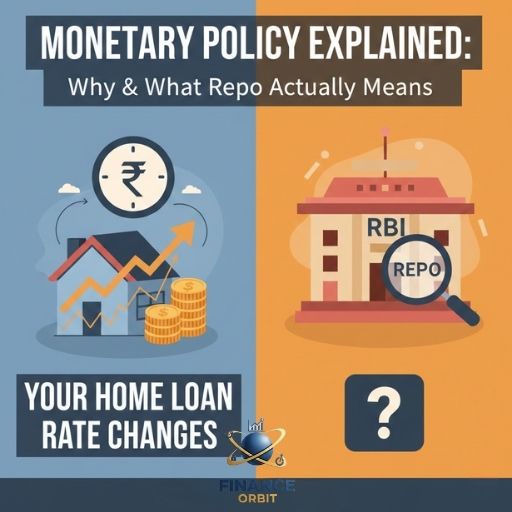
Description: Understand monetary policy, repo rate, and reverse repo rate—how central banks control inflation and interest rates. Learn why RBI's decisions affect your loans, savings, and the economy.
Let me tell you about the moment I realized monetary policy wasn't just boring economics jargon but something that directly affects my actual money.
I was complaining to a friend about my home loan interest rate increasing. "Why did it go up? I didn't do anything different. My credit score didn't change. The bank just randomly decided to charge me more?"
He looked at me like I was an idiot. "The RBI increased the repo rate. Your loan rate is tied to that. Did you not know this?"
I did not know this. I thought interest rates were just... numbers banks decided arbitrarily based on vibes. Turns out there's an entire systematic process involving the central bank manipulating rates to control inflation, economic growth, and money supply that directly determines whether my loan gets cheaper or more expensive.
What is monetary policy sounds academic and irrelevant until you realize it's the reason your savings account pays 3% instead of 7%, why home loans cost more during some periods than others, and why the RBI is constantly in the news making decisions that affect your wallet.
Repo rate and reverse repo rate explained requires understanding that central banks don't directly control the economy—they manipulate the cost of borrowing money, which then cascades through the entire financial system affecting every loan, deposit, and investment you have.
How monetary policy works is simultaneously simple (central bank makes borrowing expensive or cheap to control inflation and growth) and complex (the transmission mechanisms involve banking liquidity, inflation expectations, currency values, and international capital flows).
So let me walk through monetary policy basics with actual examples of how these abstract policy decisions affect your money, why central banks obsess over inflation rates, and what those RBI announcements actually mean for your financial life.
Because this isn't theoretical economics. This is why your EMI just increased.
What Monetary Policy Actually Is (The Big Picture)
Monetary policy is how a country's central bank manages the money supply and interest rates to achieve economic objectives—primarily controlling inflation while supporting economic growth and employment.
Think of the central bank as the economy's thermostat. The economy can run too hot (high inflation, asset bubbles, overheating) or too cold (recession, deflation, high unemployment). The central bank adjusts monetary policy—the economic temperature—to keep things in the optimal range.
The central banks: In India, it's the Reserve Bank of India (RBI). In the United States, it's the Federal Reserve (Fed). In Europe, the European Central Bank (ECB). In the UK, the Bank of England. Each country has its central bank with the same fundamental job: manage money supply and interest rates.
The primary objectives vary slightly by country, but generally include controlling inflation (keeping price increases stable and predictable), supporting economic growth (not strangling the economy with tight money), maintaining employment (monetary policy affects job creation), and ensuring financial stability (preventing banking crises and market crashes).
The most important tool for achieving these objectives is controlling interest rates. When the central bank makes borrowing expensive, economic activity slows down (people and businesses borrow and spend less). When borrowing is cheap, activity speeds up (more loans, more spending, more investment). By adjusting this dial, central banks try to keep the economy growing steadily without overheating into high inflation.
Repo Rate: The Interest Rate That Controls All Other Interest Rates
The repo rate is the rate at which the central bank lends money to commercial banks (your bank, ICICI, HDFC, SBI, etc.) for short-term needs.
What "repo" actually means: Repo is short for "repurchase agreement." When a commercial bank needs money from the RBI, it sells government securities to the RBI with an agreement to repurchase them later (usually the next day or within days). The interest rate on this transaction is the repo rate.
Think of it as the RBI giving your bank an overnight loan, with government securities as collateral. The bank gets cash immediately, promises to buy back the securities tomorrow, and pays the repo rate as interest for that one-day loan.
Why this matters to you: The repo rate is the baseline cost of money for banks. If banks can borrow from RBI at 6%, they'll lend to you at 6% plus their profit margin (maybe 8-10% for home loans, 11-14% for personal loans, etc.). If the repo rate increases to 7%, your lending rates increase proportionally.
When the RBI announces a repo rate change, it's essentially changing the wholesale price of money. Banks buy money from RBI at the repo rate and sell it to you at a markup. When wholesale prices go up, retail prices (your loan rates) follow.
How banks use it: Banks need cash daily to meet withdrawal demands, clear checks, and maintain required reserve ratios. Rather than holding massive idle cash reserves, they borrow short-term from the RBI when needed. This keeps the banking system liquid and functioning smoothly.
Reverse Repo Rate: When Banks Lend Money to RBI
The reverse repo rate is exactly what it sounds like—the reverse of repo. It's the rate at which the RBI borrows money from commercial banks.
The mechanism: Banks park their excess cash with the RBI overnight and earn interest at the reverse repo rate. This provides banks a safe, guaranteed return on surplus funds they don't immediately need.
From the bank's perspective, lending to RBI is zero-risk. The central bank won't default. So the reverse repo rate represents the absolute safest return available in the economy. Any other investment must offer returns higher than the reverse repo rate to be attractive, otherwise why not just park money with RBI risk-free?
Why RBI does this: The reverse repo rate allows the RBI to absorb excess liquidity from the banking system. If there's too much money floating around (which can cause inflation), the RBI increases the reverse repo rate, incentivizing banks to park money with RBI instead of lending it out to businesses and consumers. This reduces money supply in the economy.
The relationship between repo and reverse repo: The reverse repo rate is always lower than the repo rate. This spread creates the "corridor" within which market interest rates operate. Currently in India, if repo is 6.50%, reverse repo might be 3.35% (the spread was historically smaller but was widened during COVID).
Think of it as a floor and ceiling. Banks can always lend to RBI at reverse repo (the floor—lowest possible return). They can always borrow from RBI at repo (the ceiling—highest they might pay for short-term funds). Market rates for interbank lending fall somewhere in this corridor.
How These Rates Affect Your Actual Money
The transmission mechanism from policy rates to your wallet works through several channels, and understanding this helps you make better financial decisions.
Your loan rates go up or down: Most floating-rate loans in India are linked to external benchmarks, often the repo rate itself or repo-linked rates like MCLR (Marginal Cost of Funds based Lending Rate). When RBI increases the repo rate, banks increase their lending rates within weeks or months. Your home loan EMI increases. Your car loan costs more. Business loans become expensive.
Conversely, when RBI cuts the repo rate (making money cheaper), banks reduce lending rates and your EMI decreases. This is why people cheer repo rate cuts—cheaper loans mean more money in your pocket each month.
Your deposit rates change: When the repo rate increases, banks can afford to pay higher interest on deposits because they're earning more on loans. Your fixed deposit might offer 6.5% instead of 5.5%. Your savings account interest might tick up slightly (though savings rates are always pathetic).
When repo rates fall, deposit rates also fall. That FD that was giving you 7% last year might only offer 5% now. This is frustrating for savers but intentional—the RBI wants to discourage just saving and encourage spending or investing to stimulate the economy.
The bond market reacts: Government bond yields move in response to repo rate changes. When repo rates increase, bond yields rise (bond prices fall). When repo rates decrease, bond yields fall (bond prices rise). If you invest in debt mutual funds, your returns fluctuate with these rate changes.
Stock markets respond: Higher interest rates generally hurt stock markets (borrowing costs increase for companies, consumer spending decreases, fixed income becomes more attractive relative to stocks). Lower rates generally help stocks (cheap borrowing fuels business expansion, consumers spend more, stocks become relatively more attractive). Though many other factors affect markets, monetary policy is a significant driver.
Currency values shift: Higher interest rates attract foreign investment (foreign investors chase higher returns), strengthening the currency. Lower rates can weaken the currency. This affects import/export costs and inflation (stronger rupee makes imports cheaper, weaker rupee makes imports expensive).
Inflation gets controlled (or encouraged): The primary purpose of rate hikes is controlling inflation. When RBI increases rates, borrowing becomes expensive, spending decreases, demand falls, and price increases slow down. When RBI cuts rates, the opposite happens—cheaper borrowing encourages spending, demand increases, and some inflation is acceptable if it comes with economic growth.
The RBI's Balancing Act: Growth vs Inflation
The RBI faces a constant tension between two competing objectives, and understanding this helps you predict policy moves.
The inflation mandate: The RBI is legally required to keep inflation within a target range—currently 2% to 6%, with 4% as the midpoint. If inflation consistently exceeds 6% or falls below 2% for three consecutive quarters, the RBI must explain to the government why it failed.
When inflation is high (prices rising rapidly), the RBI's primary job is to cool it down. They increase the repo rate, making borrowing expensive, which slows economic activity and reduces demand, which slows price increases. This fights inflation but can also slow economic growth and job creation. That's the tradeoff.
The growth imperative: The RBI also wants to support economic growth. Growth requires investment, business expansion, and consumer spending—all of which need credit (loans). If the RBI keeps rates too high for too long, it strangles growth. Businesses can't afford to borrow for expansion. Consumers can't afford home loans or car loans. The economy slows down, unemployment might rise.
When growth is sluggish and inflation is under control, the RBI cuts rates to stimulate the economy. Cheaper loans encourage borrowing, spending, and investment. But cut too aggressively and you risk overheating the economy and triggering inflation.
The impossible balance: The RBI wants high growth with low inflation. Unfortunately, these often conflict. Policies that boost growth (low interest rates, easy money) tend to increase inflation. Policies that control inflation (high interest rates, tight money) tend to slow growth.
The RBI's job is finding the sweet spot—enough growth to create jobs and prosperity without so much growth that inflation spirals out of control. This requires constant monitoring and adjustment based on incoming data about inflation, growth, employment, and global conditions.
Other Monetary Policy Tools Beyond Repo Rates
While repo and reverse repo get the headlines, central banks have other tools in their toolkit.
Cash Reserve Ratio (CRR): The percentage of deposits banks must keep with the RBI in cash. If CRR is 4%, banks must keep ₹4 of every ₹100 deposited with RBI, unavailable for lending. Increasing CRR reduces money available for banks to lend (tightening money supply). Decreasing CRR increases money available for lending (loosening money supply). The RBI adjusts CRR to control liquidity in the banking system.
Statutory Liquidity Ratio (SLR): The percentage of deposits banks must hold in liquid assets (government securities, gold, cash). Similar to CRR but banks can invest in government bonds rather than just holding cash. This ensures banks maintain adequate liquidity and creates demand for government securities.
Open Market Operations (OMO): The RBI buying or selling government securities in the open market. When RBI buys securities, it injects money into the banking system (expansionary). When it sells securities, it absorbs money from the system (contractionary). This tool manages liquidity independently of interest rates.
Marginal Standing Facility (MSF): An emergency lending facility where banks can borrow from RBI at a higher rate than repo (usually repo + 0.25%) against government securities. This provides banks a safety valve for emergency liquidity needs.
Bank Rate: The rate at which RBI lends to banks for long-term needs. It's higher than the repo rate and less frequently used but serves as a penalty rate for banks that need longer-term funds.
Quantitative Easing (QE): Used primarily by developed country central banks (Fed, ECB, BOE) during crises. The central bank creates new money and uses it to purchase government bonds and sometimes other assets, injecting massive liquidity into the financial system. The RBI has used this sparingly, though it did extensive bond-buying during COVID-19.
Expansionary vs Contractionary Monetary Policy
Understanding these terms helps decode RBI announcements and predict economic impacts.
Expansionary (Accommodative) Policy: The RBI is trying to stimulate economic growth. This means cutting the repo rate (making borrowing cheaper), reducing CRR/SLR (increasing money available for lending), buying bonds through OMO (injecting liquidity), and generally making money cheap and abundant.
When does RBI do this? During economic slowdowns, recessions, or when growth is sluggish. The goal is encouraging borrowing, spending, and investment to kickstart economic activity. The risk is inflation if the economy heats up too quickly.
Contractionary (Restrictive/Tight) Policy: The RBI is trying to slow down the economy, usually to fight inflation. This means increasing the repo rate (making borrowing expensive), increasing CRR/SLR (reducing money available for lending), selling bonds through OMO (absorbing liquidity), and generally making money scarce and expensive.
When does RBI do this? When inflation is high or rising, when the economy is overheating, or when asset bubbles are forming. The goal is cooling demand to bring prices under control. The risk is slowing growth too much and triggering recession.
Neutral Policy: Sometimes the RBI takes a "wait and watch" approach, neither stimulating nor restricting. Rates stay steady, no major liquidity operations, just monitoring data and being ready to move either direction depending on how inflation and growth evolve.
Real-World Example: The 2022-2023 Rate Hike Cycle
Looking at recent history illustrates how monetary policy works in practice.
The setup: COVID-19 hit in 2020. Economies collapsed globally. Central banks worldwide, including RBI, slashed interest rates to historic lows and injected massive liquidity to prevent economic depression. The RBI cut repo rate from 5.15% in March 2020 to 4% by May 2020 and held it there through 2021.
This emergency expansionary policy worked—it prevented complete economic collapse. But it created the conditions for inflation. Combined with supply chain disruptions, commodity price spikes, and the Russia-Ukraine war impacting food and fuel prices, inflation surged globally.
India's inflation problem: By early 2022, India's retail inflation was consistently above the RBI's 6% upper tolerance limit, hitting 7-8% for several months. Food prices, fuel costs, and imported inflation were squeezing household budgets. The RBI had to respond.
The rate hike cycle: Starting May 2022, the RBI began aggressively raising the repo rate. From 4% in April 2022, it increased in steps: 4.4% (May), 4.9% (June), 5.4% (August), 5.9% (September), 6.25% (December), eventually reaching 6.5% by February 2023.
That's a 250 basis point increase in less than a year—one of the fastest tightening cycles in recent RBI history. Each increase made loans more expensive, trying to cool demand and bring inflation down.
The impact: Home loan EMIs increased significantly. Someone with a ₹50 lakh home loan saw their monthly payment increase by several thousand rupees as rates climbed from around 7% to 9-10%. Businesses faced higher borrowing costs, potentially slowing investment. But inflation gradually came down from 7-8% to around 5-6% by late 2023.
The tradeoff: Economic growth slowed somewhat as tight monetary policy took effect, but the RBI prioritized controlling inflation over maximizing short-term growth. Once inflation stabilized, the RBI paused rate hikes and moved to a neutral stance, watching data to decide whether cuts were appropriate.
This cycle perfectly illustrates monetary policy in action: central bank sees inflation problem, raises rates aggressively to cool economy, inflation comes down but growth slows, central bank pauses and eventually will cut rates when appropriate.
Why Central Banks Are Obsessed With 2% Inflation
You might wonder why central banks target 2% inflation (or in India's case, 4%) rather than zero inflation. Wouldn't zero inflation be better?
Deflation is worse than moderate inflation: When prices fall (deflation), consumers delay purchases waiting for lower prices. Businesses delay investment expecting lower costs later. This creates a vicious cycle—less spending leads to less production, less employment, lower incomes, even less spending. Deflation is economically destructive and very difficult to escape (ask Japan about their lost decades).
Moderate inflation is economically healthy: A small, predictable inflation rate (2-4%) encourages spending and investment now rather than later. It allows wages to rise nominally even if real purchasing power stays flat. It gives central banks room to cut rates during crises (if inflation is 2% and rates are 4%, you can cut to stimulate; if inflation is 0% and rates are already 0%, you're out of ammunition).
Inflation expectations matter: If people expect 2% inflation, they demand 2% wage increases to maintain purchasing power, they accept 2% price increases as normal, and economic activity proceeds smoothly. If inflation becomes unpredictable (sometimes 0%, sometimes 8%), planning becomes impossible, uncertainty increases, and economic activity suffers.
Central banks target low, stable, predictable inflation—not zero, not high, not volatile. This creates the most conducive environment for sustainable economic growth.
The Limitations of Monetary Policy
Monetary policy is powerful but not omnipotent. Understanding its limits prevents unrealistic expectations.
Can't fix supply-side problems: If inflation is caused by supply shocks (oil price spikes, crop failures, war disrupting supply chains), raising interest rates won't create more oil or food. It just makes everything more expensive by slowing the economy. Monetary policy works best on demand-driven inflation, not supply-driven inflation.
Transmission lags: When RBI changes the repo rate, the full impact on the economy takes 6-12 months. Banks adjust lending rates gradually. Consumers and businesses take time to respond. Inflation takes time to change. The central bank is essentially steering a ship with delayed controls—you turn the wheel now and the ship changes direction several minutes later.
The zero lower bound: Interest rates can't easily go below zero (though some countries tried negative rates). If rates are already at zero and the economy still needs stimulus, monetary policy becomes ineffective. This is the "liquidity trap" problem.
Fiscal policy sometimes needed: Some economic problems require government spending, not just cheap money. Infrastructure needs, pandemic relief, social safety nets—these require fiscal policy (government budget decisions), not monetary policy.
Global factors: In an interconnected global economy, domestic monetary policy can be overwhelmed by global forces. If the US Federal Reserve is aggressively raising rates, capital flows out of India toward higher US returns, weakening the rupee regardless of what RBI does. Central banks must consider international conditions, not just domestic targets.
Inequality effects: Monetary policy affects different groups differently. Low rates help borrowers (businesses, home buyers) but hurt savers (retirees living on fixed deposits). High rates help savers but hurt borrowers. There's no setting that's perfect for everyone.
The Bottom Line
What is monetary policy? Central banks managing money supply and interest rates to control inflation, support growth, and maintain financial stability.
Repo rate: The rate at which RBI lends to banks—the baseline cost of money that determines all other interest rates in the economy.
Reverse repo rate: The rate at which RBI borrows from banks—the floor return available risk-free, affecting how banks deploy excess liquidity.
How it affects you: Your loan EMIs, deposit rates, investment returns, job prospects, and purchasing power all fluctuate with monetary policy decisions.
The RBI's job: Balance inflation control against growth support—tight money when inflation is high, easy money when growth is sluggish, and constant adjustment based on evolving data.
Other tools: CRR, SLR, OMO, and various lending facilities give the RBI multiple ways to influence liquidity and rates beyond just the repo rate.
Understanding monetary policy won't make you rich, but it helps you make better financial decisions. When the RBI is in a rate-hiking cycle, maybe lock in fixed-rate loans or longer-term deposits before rates climb higher. When cuts seem likely, floating-rate loans become more attractive.
The next time you see "RBI maintains repo rate at 6.5%" in the news, you'll understand what that actually means for your money.
It's not abstract economics. It's the reason your home loan rate just changed.
And now you know why.
You're welcome.
Now go check if your loan is linked to repo rate and whether you should refinance.
That's the practical application of this knowledge.
The rest is just understanding the machine that runs the economy.
And knowing that when RBI meets, your wallet pays attention whether you do or not.
Comments
No comment yet. Be the first to comment