What Is Fiscal Deficit? A Simple Explanation of the Government Budget Number That Actually Matters
By: Compiled from various sources | Published on Feb 20,2026
Category Beginner
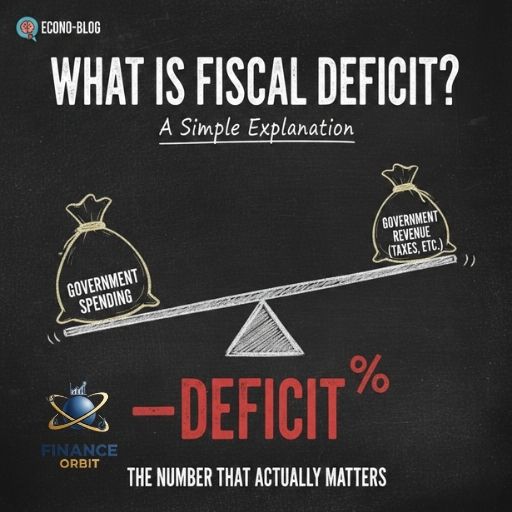
Description: Confused about fiscal deficit? Here's a simple, honest explanation of what it is, why it matters, and how it actually affects your life — no jargon, just clarity.
Let me start with something you've probably experienced.
You're watching the news or scrolling through headlines, and you see something like: "India's fiscal deficit reaches 5.8% of GDP" or "Government announces measures to control fiscal deficit."
Politicians debate it. Economists analyze it. Finance ministers make speeches about it.
And you nod along like you understand what that means.
But do you? Really?
If someone asked you right now to explain what fiscal deficit actually is, why it matters, and how it affects your daily life — could you do it clearly and confidently?
Most people can't. And that's not their fault. Economics has a special talent for taking simple concepts and wrapping them in jargon and percentages that make them sound far more complicated than they actually are.
But here's the truth: fiscal deficit is actually a simple concept. Once someone explains it in plain English — with real examples and without the economic jargon — it makes complete sense.
And understanding it matters. Not for sounding smart at dinner parties. But for actually understanding government policy, why interest rates change, why taxes go up or down, and what phrases like "austerity measures" and "stimulus spending" actually mean.
So let's do this. Simply. Clearly. Honestly. Let's break down what fiscal deficit is, why governments care about it, and why you should too.
What Is Fiscal Deficit? The Simplest Possible Definition
Fiscal deficit is the gap between what the government spends and what it earns in a given year.
That's it. That's the whole concept.
When a government spends more money than it collects (through taxes and other revenue), the difference is called the fiscal deficit.
Think of it like your personal budget:
Let's say you earn ₹50,000 per month. But you spend ₹60,000. The ₹10,000 gap? That's your personal deficit. You're spending more than you're earning.
The government works the same way. It has income (mostly from taxes). It has expenses (salaries, infrastructure, healthcare, defense, subsidies, pensions, everything). When expenses exceed income, there's a fiscal deficit.
The formula is embarrassingly simple:
Fiscal Deficit = Total Government Expenditure - Total Government Revenue
Or, rearranged:
Fiscal Deficit = What Government Spends - What Government Earns
That's it. No complicated mathematics. No advanced economics. Just spending minus income.
Breaking It Down: Government Revenue (What It Earns)
To understand the deficit, you need to understand both sides: what comes in, and what goes out.
The government's main sources of revenue:
1. Tax Revenue (The Biggest Source)
Direct taxes:
- Income tax (from individuals and corporations)
- Corporate tax (from company profits)
- Wealth tax, capital gains tax, etc.
Indirect taxes:
- GST (Goods and Services Tax)
- Customs duties (on imports)
- Excise duties (on specific goods like fuel, alcohol)
In most countries, tax revenue makes up 70-80% of total government income.
2. Non-Tax Revenue
- Profits from government-owned companies (like Indian Railways, public sector banks, oil companies)
- Interest earned on loans given to states or other countries
- Fees and licenses (passport fees, spectrum auction revenues, etc.)
- Dividends from investments
Example with simple numbers:
Let's say the government collects:
- ₹20 lakh crore in taxes
- ₹3 lakh crore in non-tax revenue
Total Revenue = ₹23 lakh crore
That's the money coming in.
Breaking It Down: Government Expenditure (What It Spends)
Now the other side — where the money goes.
The government's main areas of spending:
1. Revenue Expenditure (Day-to-Day Operations)
These are recurring costs — things the government has to pay regularly:
- Salaries and pensions — For government employees, military personnel, teachers, police, etc.
- Subsidies — Food subsidies, fertilizer subsidies, fuel subsidies
- Interest payments — On money the government has borrowed in the past
- Grants to states — Money transferred to state governments
- Operation and maintenance — Running government departments, schools, hospitals
2. Capital Expenditure (Long-Term Investments)
These are one-time or periodic investments that create assets:
- Infrastructure — Roads, highways, bridges, railways, airports, ports
- Defense equipment — Fighter jets, weapons systems, military infrastructure
- Healthcare and education infrastructure — Building hospitals, schools, universities
- Technology and digital infrastructure
Example with simple numbers:
Let's say the government spends:
- ₹18 lakh crore on revenue expenditure (salaries, subsidies, interest, operations)
- ₹10 lakh crore on capital expenditure (infrastructure, assets)
Total Expenditure = ₹28 lakh crore
That's the money going out.
Calculating the Fiscal Deficit: Putting It Together
Now we have:
- Total Revenue = ₹23 lakh crore
- Total Expenditure = ₹28 lakh crore
Fiscal Deficit = ₹28 lakh crore - ₹23 lakh crore = ₹5 lakh crore
The government is spending ₹5 lakh crore more than it's earning. That's the fiscal deficit.
But wait — you always hear it as a percentage of GDP. Why?
Because the absolute number (₹5 lakh crore) doesn't tell you much on its own. Is that a lot or a little? It depends on the size of the economy.
That's why fiscal deficit is expressed as a percentage of GDP:
If India's GDP is ₹100 lakh crore, then:
Fiscal Deficit as % of GDP = (₹5 lakh crore / ₹100 lakh crore) × 100 = 5%
This percentage tells you: "The government is spending 5% more than it earns, relative to the size of the entire economy."
A 5% deficit in a ₹100 lakh crore economy is very different from a 5% deficit in a ₹10 lakh crore economy. The percentage makes comparisons across countries and across time meaningful.
So the Government Spends More Than It Earns — Where Does the Extra Money Come From?
This is the critical question. If you spend ₹60,000 but only earn ₹50,000, where does the extra ₹10,000 come from?
You have to borrow it. The government does the same.
How governments cover fiscal deficit:
1. Borrowing from the Market (Most Common)
The government issues bonds (also called government securities or G-Secs in India, Treasury bonds in the US). These are essentially IOUs — promises to pay back the money with interest.
Who buys these bonds?
- Banks
- Insurance companies
- Mutual funds
- Foreign investors
- Individuals (you can buy government bonds)
When you hear "government borrowing increased," this is what it means — the government is issuing more bonds to raise money.
2. Borrowing from the Central Bank (Less Common, Risky)
The government can borrow directly from the Reserve Bank of India (or the Federal Reserve in the US, etc.). This is called monetizing the deficit or "printing money."
Why is this risky?
Because when the central bank creates new money to lend to the government, it increases the money supply without increasing the amount of goods and services in the economy. This often leads to inflation — too much money chasing too few goods.
Most countries have rules limiting or prohibiting direct central bank financing of deficits for this reason.
3. Using Foreign Exchange Reserves (Rare)
The government can tap into the country's foreign exchange reserves, but this is typically avoided because those reserves serve other important purposes (like stabilizing the currency).
The bottom line:
Most fiscal deficits are financed by borrowing from the market through bond issuance. The government goes into debt to cover the gap between spending and revenue.
Is Fiscal Deficit Always Bad?
This is where it gets more nuanced. The simple answer: it depends.
When Fiscal Deficit Can Be Good (Or at Least Justified)
During recessions or economic downturns:
When the economy is struggling, private spending (by consumers and businesses) falls. If the government also cuts spending to "balance the budget," the economy contracts further — more job losses, less income, worse recession.
In these situations, deficit spending can actually stabilize the economy. The government spends on infrastructure, social programs, stimulus payments — keeping money flowing through the economy, maintaining employment, and preventing a deeper collapse.
Example: During the 2008 financial crisis and the 2020 COVID pandemic, governments worldwide ran large fiscal deficits to support their economies. Many economists argue this prevented far worse outcomes.
For productive investments:
If the government borrows to build infrastructure that will boost economic growth — roads, ports, digital infrastructure, education — the future economic benefits might more than pay for the borrowing.
Think of it like taking a home loan: You go into debt to buy a house, but the house provides value (shelter) and potentially appreciates over time. The debt is serving a productive purpose.
When Fiscal Deficit Becomes a Problem
When it's too large for too long:
If the government consistently runs very high deficits (6%+, 8%+, 10%+ of GDP), the accumulated debt becomes unsustainable. Interest payments alone can eat up a huge portion of the budget, leaving less for actual services.
Greece's debt crisis in the 2010s is a cautionary tale — years of high deficits led to debt levels the country couldn't service, requiring international bailouts.
When it's spent unproductively:
If deficit spending goes to subsidies that don't create growth, to inefficient government operations, or to corruption and waste — you're accumulating debt without getting corresponding economic benefits.
When it causes inflation:
If deficit spending overheats the economy (too much demand, not enough supply), or if it's financed by money printing, inflation can spike. This erodes purchasing power and harms everyone, especially the poor.
When it crowds out private investment:
When the government borrows heavily from the market, it can drive up interest rates (more demand for loans = higher borrowing costs). Higher interest rates make it more expensive for businesses and individuals to borrow, potentially slowing private sector growth.
How Fiscal Deficit Affects Your Actual Life
Okay, so the government is running a deficit. So what? Why should you care?
More than you might think:
1. Interest Rates on Your Loans
When the government borrows heavily, it can push up interest rates in the economy. Your home loan, car loan, and personal loan interest rates are all affected by this.
High government borrowing → Higher interest rates → Your EMIs go up
2. Taxes Might Increase
If the deficit becomes unsustainable, the government eventually has to either cut spending or raise taxes to close the gap. Often, they raise taxes.
Income tax rates go up. GST rates increase. New taxes are introduced. This hits your wallet directly.
3. Inflation
If the government finances deficits by printing money, or if deficit spending overheats the economy, inflation rises. Your groceries, fuel, rent — everything becomes more expensive. Your money buys less.
4. Quality of Public Services
If too much of the budget goes to interest payments on past debt, less money is available for schools, hospitals, roads, and other services you rely on.
Countries with very high debt burdens often have to cut public services — sometimes dramatically.
5. Currency Value
Large, persistent fiscal deficits can weaken investor confidence in a country, potentially weakening the currency. A weaker rupee means imports (including oil) become more expensive, driving up costs throughout the economy.
6. Economic Growth and Jobs
On the flip side, appropriate deficit spending during downturns can support job creation and economic growth, which directly affects employment opportunities and wage growth.
What's a "Healthy" Fiscal Deficit?
There's no universally agreed-upon number, but general guidelines have emerged:
Developed economies:
- 3-4% of GDP is generally considered manageable
- Below 3% is seen as fiscally responsible in normal times
- Above 6% for extended periods raises concerns
Developing economies:
- Can often sustain slightly higher deficits (4-5%) because they have more growth potential
- But they also have less access to cheap borrowing, so sustainability is more fragile
India's targets:
- The Fiscal Responsibility and Budget Management (FRBM) Act originally targeted 3% of GDP
- In practice, India has often run deficits of 5-7%
- Post-COVID, the focus has been on gradually bringing the deficit down from pandemic highs
Context matters enormously: A 7% deficit during a severe recession with low inflation is very different from a 7% deficit during strong growth with high inflation.
Primary Deficit vs. Fiscal Deficit: A Quick Distinction
You'll sometimes hear about primary deficit. Here's what it means:
Primary Deficit = Fiscal Deficit - Interest Payments
In other words, it's the deficit excluding interest payments on past borrowing.
Why this matters:
Interest payments are the result of past decisions and past borrowing. You can't avoid paying them. The primary deficit tells you whether the government is still spending more than it earns on its current operations and investments — excluding the legacy burden of past debt.
A country could have a high fiscal deficit but a low or zero primary deficit, meaning the only reason for the deficit is paying interest on old debt, not new overspending.
Fiscal Deficit in the News: How to Read It Now
Now that you understand the concept, let's decode what you see in headlines:
"Government aims to reduce fiscal deficit to 5.1% of GDP"
Translation: The government plans to narrow the gap between spending and revenue so that it's borrowing 5.1% of the country's total economic output instead of the current higher level. They'll either increase revenue (taxes) or decrease spending (or both).
"Fiscal deficit exceeded target due to revenue shortfall"
Translation: The government collected less tax revenue than expected (maybe because the economy grew slower than projected), so the gap between spending and revenue was larger than planned.
"Opposition criticizes high fiscal deficit, warns of debt trap"
Translation: Political debate about whether the government is borrowing too much. The concern is that accumulated debt will become unsustainable, requiring painful future spending cuts or tax increases.
"Fiscal stimulus announced to counter recession"
Translation: The government is intentionally increasing spending (and therefore the deficit) to support the economy during a downturn. They're accepting higher borrowing now to prevent worse economic outcomes.
Revenue Deficit vs. Fiscal Deficit: Another Quick Distinction
One more term you'll encounter:
Revenue Deficit = Revenue Expenditure - Total Revenue
This measures whether the government is borrowing to fund day-to-day operations (salaries, subsidies, interest) rather than to invest in assets.
Why this matters:
- Borrowing to build infrastructure (fiscal deficit due to capital spending) creates assets that might generate future benefits
- Borrowing to pay salaries and subsidies (revenue deficit) doesn't create assets — it's funding consumption with debt, which is less justifiable
A country can have a fiscal deficit but no revenue deficit if all borrowing goes to capital expenditure. That's the healthier scenario.
| Term | What It Measures | Formula |
|---|---|---|
| Fiscal Deficit | Total gap between spending and revenue | Total Expenditure - Total Revenue |
| Fiscal Deficit (% of GDP) | Deficit relative to economy size | (Fiscal Deficit / GDP) × 100 |
| Primary Deficit | Deficit excluding interest payments | Fiscal Deficit - Interest Payments |
| Revenue Deficit | Gap in day-to-day operations | Revenue Expenditure - Total Revenue |
Real Example: India's Fiscal Deficit Over Time
Let's look at actual numbers to make this concrete (approximate figures):
India's Fiscal Deficit (as % of GDP):
| Year | Fiscal Deficit | Context |
|---|---|---|
| 2018-19 | 3.4% | Relatively controlled |
| 2019-20 | 4.6% | Rising due to slower growth |
| 2020-21 | 9.2% | COVID pandemic — massive stimulus spending |
| 2021-22 | 6.7% | Recovery phase |
| 2022-23 | 6.4% | Gradual consolidation |
| 2023-24 | 5.8% | Further reduction |
| 2024-25 (target) | 5.1% | Continued fiscal discipline |
What this tells us:
The deficit spiked dramatically during COVID (as it did globally) as governments borrowed heavily to support healthcare, provide relief to citizens, and prevent economic collapse.
Since then, India has been gradually reducing the deficit — "fiscal consolidation" — by increasing revenue (economic recovery means more tax collection) and controlling spending.
The long-term target is to bring it down to 3-4% as the economy stabilizes.
Common Questions People Have About Fiscal Deficit
Q: Can't the government just print money instead of borrowing?
Technically yes, but it usually leads to inflation. When you increase the money supply without increasing goods and services, prices rise. Most countries avoid this for good reason — hyperinflation in Zimbabwe and Venezuela are cautionary tales.
Q: Why not just cut spending to zero deficit?
Because during recessions, this makes things worse. If the government cuts spending when everyone else is also cutting spending, the economy contracts further. Sometimes temporary deficits are economically necessary.
Q: Is government debt the same as fiscal deficit?
No. The fiscal deficit is the gap in a single year. Government debt is the accumulated total of all past deficits minus any surpluses. Think of deficit as the yearly flow and debt as the total stock.
Q: Who does the government owe money to?
Mostly its own citizens and institutions — banks, insurance companies, mutual funds, and individuals who buy government bonds. Some debt is to foreign investors and institutions.
Q: What happens if a government can't pay its debt?
That's called sovereign default. It's rare for major economies but has happened (Greece, Argentina). It causes severe economic crisis, loss of access to credit markets, and often requires international bailouts with harsh conditions.
The Bottom Line
Fiscal deficit is simply the gap between what the government spends and what it earns in a year. When spending exceeds revenue, the difference is the fiscal deficit, usually expressed as a percentage of GDP.
The government covers this deficit by borrowing — mostly by issuing bonds that banks, institutions, and individuals buy.
A fiscal deficit isn't automatically good or bad:
- It can be useful during recessions to stabilize the economy
- It can be justified for productive investments in infrastructure
- But persistent large deficits lead to unsustainable debt, higher interest rates, potential inflation, and less money for public services
Understanding fiscal deficit helps you make sense of:
- Why your loan interest rates change
- Why taxes might increase
- Why inflation rises or falls
- What government spending priorities are
- Whether political claims about economic management are credible
It's one number trying to summarize the government's financial health. It doesn't tell you everything — but it tells you a lot.
And now when you see "Fiscal deficit reaches X% of GDP" in the news, you won't just nod along pretending to understand.
You'll actually know what it means. What caused it. What it implies. And why it matters to your life.
That's not just economic literacy. That's being able to understand the world you live in well enough to make informed decisions about it.
And fiscal deficit? That's a good place to start.
Comments
No comment yet. Be the first to comment