Understanding Supply and Demand in Daily Life: Why Everything You Buy Costs What It Costs (And Why It Changes)
By: Compiled from various sources | Published on Feb 27,2026
Category Beginner
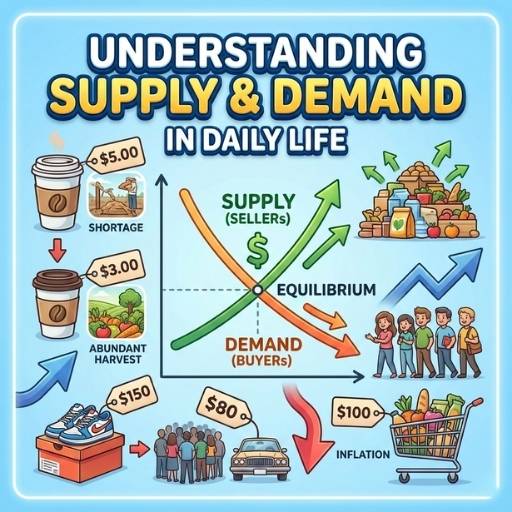
Description: Confused about supply and demand? Here's a simple, honest explanation of how it works in real life — why prices change and how it affects you daily.
Let me tell you what happened this morning.
You went to buy something. Maybe it was coffee. Maybe vegetables. Maybe you checked flight prices for an upcoming trip.
And you thought — "Wait, didn't this cost less last time? Why is it more expensive now?"
Or maybe you saw something on sale and wondered — "Why is this suddenly so cheap? Is something wrong with it?"
Or maybe you tried to book a hotel and saw the price jump ₹2,000 between yesterday and today for the exact same room.
And you probably felt some combination of confused, frustrated, and vaguely suspicious that someone was trying to rip you off.
Here's the truth: Most of the time, nobody is trying to cheat you. The price changed because supply or demand (or both) changed. And once you understand how supply and demand actually work, the entire economy starts making sense.
Why does an umbrella cost ₹50 on a sunny day and ₹200 when it starts raining? Supply and demand.
Why do flight tickets cost ₹3,000 if you book three months ahead and ₹15,000 if you book three days ahead? Supply and demand.
Why do tomatoes cost ₹20/kg in season and ₹80/kg off-season? Supply and demand.
Why does the exact same hotel room cost different amounts on different days? Supply and demand.
This isn't abstract economic theory. This is the invisible force shaping every price you pay, every day of your life.
So let's break it down. Simply. Clearly. With real examples from your actual life so you can finally understand why things cost what they cost — and why those costs keep changing.
What Are Supply and Demand? The Simplest Possible Explanation
Let's start with the absolute basics.
Supply = How much of something is available
Demand = How much people want it
Price = Where these two forces meet
That's it. That's the whole concept.
The fundamental principle:
When demand is high and supply is low → Prices go UP
When demand is low and supply is high → Prices go DOWN
Think of it like a tug-of-war:
- On one side: sellers who want the highest price possible
- On the other side: buyers who want the lowest price possible
- The rope settles at a point where both sides agree to trade
That settlement point is the market price — where the amount sellers want to sell equals the amount buyers want to buy.
Supply: How Much Exists and Can Be Sold
Supply isn't just "how much exists right now." It's how much sellers are willing and able to sell at different prices.
What affects supply:
1. Cost of Production
If something is expensive to make, producers need higher prices to make it worthwhile.
Example: Organic vegetables cost more to grow (no chemical fertilizers/pesticides, more labor, potentially lower yields). Farmers need higher prices to cover costs. Supply of organic vegetables at low prices is limited.
2. Number of Sellers
More sellers = more supply = lower prices (usually)
Example: One tea stall near a train station can charge ₹20 for tea. Ten tea stalls competing = prices drop to ₹10-12 because sellers compete for customers.
3. Technology and Productivity
Better technology = easier/cheaper to produce = more supply
Example: Smartphones used to be expensive because they were hard to manufacture. As production technology improved, supply increased massively, prices dropped.
4. Government Policies
Taxes, regulations, subsidies all affect how much producers can supply.
Example: Government subsidizes wheat production (pays farmers) → more farmers grow wheat → larger wheat supply → stable/lower wheat prices for consumers.
5. Natural Factors (for agricultural goods)
Weather, seasons, disasters affect supply of crops.
Example: Good monsoon → excellent harvest → abundant supply → vegetable prices drop. Drought → poor harvest → limited supply → prices spike.
6. Time Horizon
Some things can be produced quickly (bread). Others take years (fruit trees, buildings, oil refineries).
Example: If demand for apartments suddenly increases, you can't instantly create more apartments. Supply takes years to catch up. Meanwhile, prices rise.
Demand: How Much People Want to Buy
Demand isn't just "wanting" something. It's wanting it AND being able and willing to pay for it at various prices.
What affects demand:
1. Price of the Good Itself
Usually, as price rises, demand falls (people buy less). As price falls, demand rises (people buy more).
Example: When mangoes cost ₹200/kg, you might buy 1kg. When they drop to ₹60/kg in peak season, you buy 3kg.
2. Income Levels
When people have more money, they demand more goods (especially non-essentials).
Example: During Diwali bonus season, demand for electronics, clothes, jewelry increases because people have extra money to spend.
3. Prices of Related Goods
Substitutes: If the price of coffee rises, demand for tea might increase (people switch to the cheaper alternative).
Complements: If the price of cars falls, demand for petrol might increase (more people driving = more fuel needed).
4. Tastes and Preferences
Cultural trends, fashion, advertising all affect what people want.
Example: When a celebrity endorses a particular phone brand, demand for that brand spikes even if nothing about the phone changed.
5. Expectations About the Future
If people expect prices to rise, they buy more now. If they expect prices to fall, they wait.
Example: Rumors of petrol price increase → people rush to fill tanks → demand spike → long queues at pumps.
6. Number of Buyers
More potential buyers = higher demand
Example: A product launches in one city (limited demand). It launches nationwide (demand multiplies).
How Supply and Demand Work Together: Real-Life Examples
Let's see this in action with situations you've definitely experienced.
Example 1: Umbrella Prices on a Rainy Day
Normal sunny day:
- Supply: Lots of umbrellas available in shops
- Demand: Almost nobody wants an umbrella
- Result: Umbrellas sit on shelves. Shops might sell them at ₹50-100 just to clear inventory
Suddenly starts raining:
- Supply: Same number of umbrellas (can't instantly make more)
- Demand: EVERYONE suddenly wants an umbrella RIGHT NOW
- Result: Street vendors appear selling umbrellas for ₹200-300. People pay it because they need it immediately
The supply didn't change. The demand exploded. Price followed.
Nobody is being unethical (well, mostly). The vendor is responding to sudden scarcity relative to demand.
Example 2: Flight Ticket Prices
Booking 3 months in advance:
- Supply: Lots of empty seats available
- Demand: Few people booking this far ahead
- Result: Airlines offer low prices (₹3,000) to fill seats early
Booking 3 days before travel:
- Supply: Most seats already sold, only a few left
- Demand: People who need to travel urgently (business trips, emergencies)
- Result: Airlines charge high prices (₹15,000) because they know desperate buyers will pay
The same seat. Different prices based on when you buy it.
This is called dynamic pricing or yield management — adjusting prices based on real-time supply and demand.
Example 3: Vegetable Prices Through the Year
Peak season (abundant harvest):
- Supply: Tons of tomatoes flooding the market
- Demand: Normal (people eat the same amount of tomatoes regardless)
- Result: Tomatoes cost ₹20/kg. Farmers sometimes can't even sell all they grew
Off-season or after crop failure:
- Supply: Very few tomatoes available
- Demand: Same as always (people still want tomatoes for cooking)
- Result: Tomatoes cost ₹80-100/kg. Some restaurants temporarily stop serving tomato-based dishes
Same product. Wildly different prices. Supply changed, demand stayed constant.
Example 4: Hotel Room Prices
Tuesday night, off-season:
- Supply: Most rooms empty
- Demand: Very few travelers
- Result: Hotel charges ₹1,500/night, maybe offers additional discounts to fill rooms
Saturday night, holiday weekend:
- Supply: Same number of rooms
- Demand: Everyone wants to travel
- Result: Same hotel room costs ₹5,000/night. Booked solid weeks in advance
Same room. Same hotel. Different prices because demand changed.
This is why booking platforms show "only 2 rooms left at this price" — they're signaling that supply is limited relative to demand, pushing you to book before prices rise further.
Example 5: Concert/Event Tickets
Initial sale:
- Supply: Fixed (stadium holds 50,000 people, not more)
- Demand: Moderate (fans who plan ahead)
- Result: Official price ₹2,000
Popular artist, tickets selling fast:
- Supply: Decreasing rapidly (seats being bought)
- Demand: Increasing (FOMO kicks in)
- Result: Resale market prices jump to ₹5,000-10,000
Day of concert, unsold tickets:
- Supply: Whatever's left
- Demand: Drops (people who wanted tickets already have them)
- Result: Last-minute discounts, some tickets at below original price
The supply was always fixed. Demand fluctuated wildly. Prices followed.
The Price Mechanism: How Prices Balance Supply and Demand
Prices aren't arbitrary. They're signals that coordinate economic activity.
When prices rise, they signal:
To buyers: "This is getting scarce. Use less. Find substitutes."
To sellers: "This is profitable. Make more. Enter this market."
When prices fall, they signal:
To buyers: "This is abundant. Buy more if you want."
To sellers: "There's too much supply. Reduce production. Exit this market."
Example: The Onion Price Spike of 2019-2020 (India)
What happened:
- Unexpected heavy rains destroyed onion crops
- Supply plummeted
- Demand stayed the same (people need onions for cooking)
- Prices spiked from ₹20/kg to ₹150/kg in some cities
How the price mechanism responded:
Immediate effects:
- Consumers bought fewer onions, used substitutes, or went without
- Restaurants reduced onion use in dishes
- Some people started growing onions at home
Market responses:
- Traders imported onions from other countries
- Farmers in unaffected areas rushed to plant more onions
- Government released buffer stocks
Eventually:
- New harvest arrived (supply increased)
- Imports arrived (supply increased)
- Prices returned to normal
The price spike was painful, but it performed a function: It rationed scarce onions to those who needed them most, and it incentivized increasing supply through imports and new planting.
Common Situations Where Supply and Demand Affect You
Situation 1: Petrol/Gasoline Prices
Why they fluctuate:
- Global oil supply changes: OPEC production cuts, Middle East conflicts, new oil discoveries
- Global demand changes: Economic growth in China/India increases demand, recessions decrease it
- Currency exchange rates: India imports oil. Weak rupee = more expensive oil
- Taxes: Government taxes make up 40-50% of petrol price
You notice: Petrol was ₹95/liter last month, ₹102/liter this month. Supply or demand (or both) shifted.
Situation 2: Real Estate Prices
Why they vary by location:
- Supply: Limited land in city centers, abundant in suburbs. Construction takes years
- Demand: Everyone wants to live near jobs, schools, amenities
Result: Apartment in South Mumbai costs ₹50,000/sq ft. Similar apartment in a suburb costs ₹8,000/sq ft.
Why prices rise over time:
- Demand increases: Population grows, incomes rise, more people can afford homes
- Supply increases slowly: Can't create more land, construction takes time
- Result: Prices trend upward in growing cities
Situation 3: Job Market and Salaries
Yes, supply and demand determine your salary too.
High-demand skills + Low supply = High salaries
Example: AI/ML engineers in 2024. Every company wants them. Not enough people have the skills. Salaries are ₹20-50 lakh+ for experienced professionals.
Low-demand skills + High supply = Low salaries
Example: Basic data entry work. Many people can do it. Not much demand for it. Salaries are low.
Your career strategy should account for supply and demand: Develop skills that are in high demand and short supply.
Situation 4: Festival and Holiday Pricing
Diwali shopping:
- Demand for new clothes, electronics, sweets spikes
- Supply of sellers stays same or increases slightly
- Prices often rise (especially for services like tailors, caterers)
- BUT: Competition and sales can create discounts on some items
Off-season sales:
- Demand for winter clothes drops in summer
- Supply sits in warehouses
- Prices slashed to clear inventory
Situation 5: Food Delivery Surge Pricing
Friday night, 8 PM:
- Demand: Everyone ordering dinner
- Supply: Fixed number of delivery drivers
- Result: Swiggy/Zomato show surge pricing, longer wait times
Tuesday afternoon, 3 PM:
- Demand: Almost nobody ordering food
- Supply: Same number of drivers, mostly idle
- Result: Normal prices, instant delivery, often discounts to generate demand
When Supply and Demand Don't Work Freely: Government Intervention
Sometimes governments intervene because pure market outcomes seem unfair or harmful.
Price Ceilings (Maximum Price)
Government sets a maximum price below what the market would naturally set.
Example: Rent control
Intention: Keep housing affordable
Effects:
- Landlords can't charge market rates
- Reduces incentive to build/maintain rental housing
- Creates shortages (demand exceeds supply at controlled price)
- Often helps current renters, hurts people looking for apartments
Price Floors (Minimum Price)
Government sets a minimum price above what the market would naturally set.
Example: Minimum wage
Intention: Ensure workers earn a living wage
Effects:
- Workers can't be paid below the floor
- May reduce employment (some businesses can't afford to hire at that wage)
- Helps employed workers, may hurt job seekers
Example: Minimum Support Price (MSP) for crops
Intention: Protect farmers from price crashes
Effects:
- Government guarantees to buy crops at MSP
- Ensures farmer income stability
- Can distort market (farmers grow MSP crops even if others are more profitable)
Subsidies
Government pays part of the cost to keep prices low for consumers.
Example: LPG cylinder subsidy
- Market price: ₹1,100
- Subsidized price you pay: ₹800
- Government pays: ₹300
Effect: Keeps cooking gas affordable, but costs government money (taxpayer money ultimately)
Elasticity: Why Some Prices Change a Lot and Others Don't
Not all goods respond to supply and demand the same way.
Elastic Demand:
When price changes, demand changes A LOT.
Example: Luxury items, restaurant meals, branded clothes
If restaurant prices rise 20%, many people start cooking at home instead. Demand drops significantly.
Inelastic Demand:
When price changes, demand barely changes.
Example: Essential medicines, electricity, petrol (to an extent), salt
If insulin prices rise 20%, diabetics still buy it. They have no choice. Demand stays about the same.
Why this matters:
Sellers of inelastic goods have more pricing power. They can raise prices without losing many customers.
This is why:
- Medicine companies can charge high prices (you need the medicine)
- Utility companies have monopoly power (you can't just stop using electricity)
- Governments often regulate these industries (to prevent exploitation)
How Understanding Supply and Demand Helps You
1. Better Purchase Timing
Buy when: Supply is high and/or demand is low (off-season sales, end-of-month car sales, midweek hotel bookings)
Avoid buying when: Supply is low and/or demand is high (festival shopping, last-minute bookings, first day of sales)
2. Negotiate Better
If you know supply is abundant and demand is weak, you have leverage to negotiate lower prices.
Example: Buying a car at month-end when salespeople need to hit targets = more negotiating power.
3. Career Decisions
Develop skills where demand is high and supply is low. Avoid industries where supply far exceeds demand.
4. Understand Price Changes
When prices spike, you'll understand it's usually supply shortage or demand surge — not necessarily someone trying to cheat you.
5. Investment Decisions
Real estate, stocks, commodities — all follow supply and demand. Understanding this helps you make better investment timing decisions.
Common Misconceptions About Supply and Demand
Misconception 1: "Higher prices mean someone is being greedy"
Sometimes yes (monopoly exploitation). Often no (just supply and demand at work).
When tomatoes cost ₹100/kg after crop failure, farmers aren't being greedy. There genuinely aren't enough tomatoes.
Misconception 2: "Prices should be fair and stable"
"Fair" is subjective. Markets set prices based on scarcity and desire, not moral fairness.
Prices fluctuate because supply and demand fluctuate. That's how markets communicate information and coordinate activity.
Misconception 3: "Supply and demand only affect luxury goods"
No. They affect everything: food, water, housing, healthcare, labor, money itself (interest rates).
Misconception 4: "If something is expensive, it must be high quality"
Not necessarily. High price might just mean high demand or low supply. Quality is a separate consideration.
Diamond vs. water paradox: Diamonds are expensive but less useful than water. Water is cheap but essential. Why? Supply and demand, not intrinsic value.
The Bottom Line
Supply and demand are the invisible forces that determine almost every price you encounter.
Supply = How much is available Demand = How much people want it Price = Where these meet
The fundamental rules:
- High demand + Low supply = High price
- Low demand + High supply = Low price
- High demand + High supply = Moderate price
- Low demand + Low supply = Variable (depends on which force is stronger)
This explains:
- Why umbrella prices spike in rain
- Why flight tickets cost more at the last minute
- Why vegetables cost different amounts in different seasons
- Why hotel rooms cost different amounts on different days
- Why your skills command certain salaries
- Why some goods have stable prices and others fluctuate wildly
Understanding this helps you:
- Time purchases better
- Negotiate more effectively
- Make smarter career choices
- Understand economic news
- Recognize when price changes are market-driven vs. exploitation
Supply and demand aren't abstract economic theory. They're the reason the coffee at the airport costs ₹200 and the coffee at a roadside stall costs ₹10.
They're the reason concert tickets sell out in minutes and get resold for triple the price.
They're the reason your Uber costs ₹300 during surge pricing and ₹120 at normal times for the exact same ride.
Once you understand these forces, you stop feeling confused or cheated by price changes. You start seeing the patterns.
And seeing the patterns helps you make better decisions with your money, your career, and your life.
That's not just economics. That's understanding how the world actually works.
And that understanding is worth more than any economics textbook could ever teach you.
Comments
No comment yet. Be the first to comment