What Is Fintech and How It Disrupts Banking? — The Money Revolution Nobody Saw Coming
By: Compiled from various sources | Published on Mar 03,2026
Category Professional
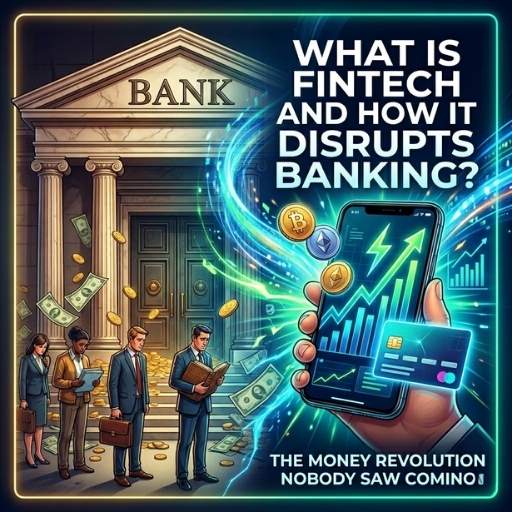
Description: Discover what fintech is and how it's disrupting traditional banking forever. From UPI to crypto — a simple, honest guide to the future of money for everyone.
Your Bank Is Quietly Becoming Obsolete — And Most People Have No Idea
Let me paint you a picture.
It is a Tuesday afternoon. A 19-year-old college student in Pune opens her phone, splits a restaurant bill with four friends, pays her monthly rent, invests two hundred rupees into a mutual fund, and checks her credit score — all in under four minutes. Without stepping into a bank. Without filling a single form. Without talking to a single human being in a suit behind a glass counter.
Meanwhile, a 45-year-old small business owner in Atlanta receives an instant loan approval for his struggling café — not from a bank that took three weeks to reject him last year — but from an app that analyzed his transaction history and approved him in 48 hours.
And a first-generation immigrant sending money home to her family in Lagos does it in seconds, paying a fraction of the fee a traditional bank would have charged her.
None of this is science fiction. All of this is happening right now. Today. And it is happening because of one word that has quietly rewritten the rules of how money works in the modern world.
Fintech.
If you have heard the word but never really understood what it means, why it matters, and how it is changing literally everything about banking and money — this is the guide I wish someone had handed me a few years ago. No finance degree required. No complicated jargon. Just honest, clear, fascinating talk about the biggest money revolution of our lifetime.
So What Exactly Is Fintech?
Let us start at the very beginning because the word gets thrown around so casually that most people either assume they already understand it or feel too embarrassed to admit they do not.
Fintech is simply a combination of two words — Financial Technology. At its core, it refers to any technology that is used to deliver financial services in a faster, cheaper, smarter, or more accessible way than traditional banks and financial institutions have done historically.
That is it. That is the whole idea.
But within that simple definition lives an extraordinary universe of innovation that is touching every corner of how we earn, spend, save, invest, borrow, and transfer money.
Think about it this way. Traditional banking has existed for hundreds of years. The basic model — you walk into a building, hand your money to an institution, they store it and lend it to others, you get a small interest in return — has not fundamentally changed since the Medici family was running banks in Renaissance Italy.
Fintech looked at that centuries-old model and asked a very simple question.
What if we could do all of this better?
Faster. Cheaper. More transparent. More accessible to people who traditional banks have historically ignored or excluded. More personalized. More in your pocket and less behind a marble counter.
The answer to that question is the entire fintech industry — and it is currently worth trillions of dollars and growing faster than almost any other sector on the planet.
A Quick History — How Did We Get Here?
Understanding where fintech came from makes it a lot easier to understand where it is going.
| Era | What Happened |
|---|---|
| 1950s | Credit cards invented — Diners Club launches the first general-purpose card |
| 1960s–70s | ATMs introduced — you no longer need a teller to withdraw cash |
| 1980s–90s | Online banking begins — early internet allows basic account access from home |
| Late 1990s | PayPal launches — digital payments between individuals become possible |
| 2007–2008 | iPhone launches + Global Financial Crisis — trust in banks collapses, tech innovation explodes |
| 2009 | Bitcoin created — the concept of decentralized money enters the world |
| 2010s | Explosion of fintech startups — mobile payments, digital lending, robo-advisors, neobanks |
| 2016 | UPI launches in India — transforms an entire nation's payment behavior almost overnight |
| 2020–present | COVID-19 accelerates digital adoption globally — fintech becomes mainstream everywhere |
The 2008 financial crisis was arguably the single biggest catalyst for modern fintech. When big banks collapsed and millions of people lost their savings, homes, and trust — a generation of young, talented, tech-savvy people decided that the old financial system was broken and set out to build something better.
The smartphone was the vehicle. And they drove it straight through the walls of traditional banking.
The Big Ways Fintech Is Disrupting Traditional Banking
This is the heart of it. Let us go through exactly how fintech is changing banking — category by category — in ways that are immediately relevant to your daily life.
1. Payments — From Standing in Line to Tapping Your Phone
This is the most visible and widely felt disruption. And nowhere in the world has it been more dramatic than in India.
Before UPI — Unified Payments Interface — launched in 2016, paying someone in India meant cash, cheques, or a clunky NEFT transfer that could take hours. Today, India processes over 10 billion UPI transactions every single month. Street vendors accept UPI. Auto rickshaw drivers accept UPI. Temple donation boxes accept UPI. A country that was predominantly cash-based transformed into one of the world's most advanced digital payment economies in under a decade.
In the USA, platforms like Venmo, Cash App, Zelle, and Apple Pay have made peer-to-peer payments as simple as sending a text message. The idea of writing a cheque to split dinner feels almost comically outdated to anyone under 35.
What this disrupts: Traditional banks used to earn significant fees from wire transfers, demand drafts, and payment processing. Fintech made most of these transactions free or nearly free — and infinitely faster. Banks lost a major revenue stream and scrambled to catch up.
2. Lending — Getting a Loan Without Begging a Bank Manager
Traditional bank loans are notoriously slow and exclusionary. You need a credit history. You need collateral. You need to fill mountains of paperwork. You need to wait weeks for approval. And if you are a small business owner, a freelancer, a young person without credit history, or someone from a rural area — your chances of approval from a traditional bank are often depressingly low.
Fintech lending completely changed this equation.
Companies like Lending Club in the USA, and platforms like KreditBee, MoneyTap, and Lendingkart in India use alternative data — your transaction history, your phone usage patterns, your social data, your GST filings, your digital footprint — to assess your creditworthiness in ways that traditional CIBIL or FICO scores never could.
The result? Loans approved in hours instead of weeks. Loans available to people who traditional banks turned away. Loans at competitive interest rates without requiring you to own property as collateral.
Buy Now Pay Later — BNPL — is another fintech lending innovation that has exploded globally. Services like Afterpay, Klarna, LazyPay, and Simpl allow consumers to purchase something today and pay in installments — without the complex process of applying for a credit card. For younger consumers who are wary of traditional debt, this model has become enormously popular.
3. Investing — From Rich People's Clubs to Everyone's Phone
For most of human financial history, serious investing was the exclusive domain of the wealthy. You needed a stockbroker, significant capital, and a level of financial knowledge that most ordinary people simply did not have.
Fintech demolished that gatekeeping completely.
In India: Platforms like Zerodha, Groww, and Kuvera made stock market investing and mutual fund investing accessible to first-time investors with amounts as small as five hundred rupees. Zerodha alone has over 10 million active clients — most of them young, first-time investors who would never have approached a traditional brokerage firm.
In the USA: Robinhood popularized commission-free stock trading and fractional shares — meaning you can buy a piece of an Amazon or Apple share even if you cannot afford the full price. Robo-advisors like Betterment and Wealthfront use algorithms to build and manage personalized investment portfolios for a fraction of what a human financial advisor would charge.
The investment world — once reserved for people with enough money and connections to access it — is now genuinely available to a 22-year-old in Jaipur with a smartphone and a hundred rupees to spare.
4. Neobanks — Banking Without a Single Physical Branch
This one is perhaps the most direct challenge to traditional banking's very existence.
A neobank — also called a digital bank or challenger bank — is a bank that operates entirely online with no physical branches. No marble lobbies. No queues. No fixed hours. Just an app on your phone that does everything a traditional bank does — and usually does it faster, cheaper, and with significantly better user experience.
Global examples:
- Revolut, Monzo, and Starling in the UK
- Chime, Current, and Varo in the USA
- Jupiter, Fi Money, and Niyo in India
These neobanks offer instant account opening, zero or minimal fees, real-time spending notifications, smart budgeting tools, international transfers at far better exchange rates than traditional banks, and customer service that actually responds promptly.
For the roughly 1.4 billion unbanked adults globally — people who have no access to traditional banking infrastructure — neobanks and mobile-first financial services represent the first real opportunity to participate in the formal financial system. In India, the Jan Dhan Yojana combined with fintech innovation has brought banking access to hundreds of millions of people who were previously entirely excluded.
5. Insurance Tech (Insurtech) — Insurance That Actually Makes Sense
Traditional insurance is notoriously opaque, slow, and frustrating. Policies are difficult to understand. Claims take forever. Premiums feel disconnected from individual behavior.
Fintech's entry into insurance — called insurtech — is changing this significantly.
Companies like Acko and Digit in India, and Lemonade and Oscar in the USA, are using technology to make insurance purchasing instant, policies genuinely understandable, and claims processing dramatically faster.
Lemonade, for example, uses AI to process certain insurance claims in as little as three seconds. Acko offers pay-per-use micro-insurance products — meaning you can insure your car only for the days you actually drive it.
For consumers who have historically found insurance confusing and the claims process adversarial, these technology-driven innovations are genuinely transformative.
6. Cryptocurrency and Blockchain — The Most Radical Disruption of All
No conversation about fintech disrupting banking is complete without talking about cryptocurrency — and specifically the technology underneath it called blockchain.
Cryptocurrency is digital money that exists independently of any government or central bank. Bitcoin, Ethereum, and thousands of other cryptocurrencies operate on decentralized networks where transactions are verified by a distributed network of computers rather than a central authority like a bank or government.
Why is this so disruptive to traditional banking?
Because the entire premise of traditional banking is that you need a trusted intermediary — a bank — to hold your money and verify your transactions. Cryptocurrency and blockchain technology essentially say: what if you did not need that intermediary at all? What if the technology itself could be the trusted third party?
This idea — called decentralized finance or DeFi — is still evolving and still volatile. The crypto market's dramatic price swings and numerous scams and frauds have rightfully made many people cautious. But the underlying technology of blockchain has applications that go far beyond cryptocurrency — supply chain management, medical records, voting systems, and yes, banking infrastructure.
Major banks that dismissed Bitcoin in 2012 as a fad are now spending billions developing their own blockchain infrastructure. That tells you everything you need to know about how seriously the financial establishment is taking this disruption.
7. RegTech — Technology That Makes Compliance Smarter
This one is less visible to everyday consumers but enormously important to how the financial system functions.
RegTech — regulatory technology — uses AI and machine learning to help financial institutions manage compliance, detect fraud, prevent money laundering, and meet regulatory requirements more efficiently.
Traditional compliance was a manual, expensive, error-prone process. RegTech automates it — making financial systems safer, more transparent, and better protected against fraud and manipulation. For consumers this means better protection of their financial data and faster detection of suspicious activity on their accounts.
India's Fintech Revolution — A Special Story Worth Telling
India deserves its own section here because what has happened to financial technology in India over the last decade is genuinely one of the most extraordinary economic transformation stories in the world.
The combination of three things created a perfect storm for fintech adoption in India:
JAM Trinity — Jan Dhan, Aadhaar, Mobile.
Jan Dhan accounts brought banking access to hundreds of millions of previously unbanked Indians. Aadhaar created a unique digital identity infrastructure. And the explosion of cheap smartphone data — driven by Jio's entry in 2016 — put the internet in the hands of hundreds of millions of first-time users simultaneously.
UPI was built on top of this foundation and what it achieved is genuinely historic. India now processes more real-time digital payments than the USA, UK, and Germany combined. That is not a typo. One country, with enormous rural poverty and historical infrastructure challenges, built the world's most advanced real-time payment system.
Indian fintech startups have attracted billions in global investment. Companies like Paytm, PhonePe, Razorpay, CRED, PolicyBazaar, and Zerodha have become household names. And the regulatory framework — the Reserve Bank of India's relatively progressive approach to fintech sandboxes and innovation — has helped India become one of the top three fintech markets globally.
For rural India especially, fintech has been genuinely life-changing. A farmer in Bihar can now receive government subsidy payments directly into a digital account, pay for seeds and fertilizers digitally, and get crop insurance processed in days instead of months. That is not incremental improvement. That is a generational leap.
How Traditional Banks Are Fighting Back
Traditional banks are not sitting quietly and watching fintech eat their lunch. They are responding — some more effectively than others.
| Traditional Bank Response | What It Looks Like |
|---|---|
| Building their own apps | Most major banks now have reasonably functional mobile apps with digital payment features |
| Acquiring fintech startups | Large banks are buying fintech companies to absorb their technology and talent |
| Partnering with fintechs | Rather than competing, many banks now partner with fintech firms to offer better services |
| Launching digital-only subsidiaries | HDFC's PayZapp, SBI YONO, JPMorgan's Finn — digital arms of traditional banks |
| Investing in blockchain | Major global banks are developing their own blockchain and digital currency infrastructure |
| Improving customer experience | The pressure from fintech has forced traditional banks to significantly upgrade their UX |
The honest truth is that traditional banks have enormous advantages that fintech startups lack — massive existing customer bases, deep regulatory relationships, established trust, and vast balance sheets. The future is likely not one where fintech destroys banks completely but rather one where the two force each other to evolve in ways that ultimately benefit consumers.
The Risks and Downsides of Fintech — Because It Is Not All Good News
I would be doing you a disservice if I only told you the exciting parts. Fintech comes with real risks that every user should understand.
Data Privacy and Security
Fintech apps know an enormous amount about you. Your spending patterns, your income, your location, your social connections, your habits — all of it is data that these companies collect, analyze, and in many cases monetize. Data breaches in fintech companies can expose extraordinarily sensitive financial information.
Predatory Lending
The same technology that makes loans accessible to underserved populations can also be used to offer high-interest, predatory loans to financially vulnerable people who do not fully understand the terms. Digital lending scams have caused real harm to borrowers in both India and other emerging markets.
Cryptocurrency Volatility and Fraud
The crypto space remains a wild west with significant risks. Price collapses, exchange failures, scam projects, and outright fraud have cost investors billions. Anyone putting real money into cryptocurrency must understand that they can lose everything.
Digital Exclusion
For all fintech's promises of financial inclusion, a significant portion of the population — elderly people, those without smartphones, those in areas with poor internet connectivity — risk being further excluded as physical banking infrastructure shrinks in response to digital adoption.
Regulatory Gaps
Fintech has moved faster than regulators in many countries. This creates consumer protection gaps where users of certain platforms may not have the same legal protections they would have with a traditional bank.
What Fintech Means for You Personally — Practical Takeaways
Understanding fintech is not just intellectually interesting. It has direct, practical implications for how you manage your money today.
Use fintech tools to your advantage:
- If you are not already using a digital payment app — UPI in India, Venmo or Zelle in the USA — start now. The convenience and cost savings are real.
- Explore low-cost investing platforms if you have been putting off starting your investment journey. The barrier to entry has never been lower.
- Compare digital lenders if you need a loan — you may find significantly better rates and faster approval than traditional banks.
- Check out neobank options if your traditional bank charges excessive fees or offers poor interest rates.
Protect yourself:
- Never share OTPs, PINs, or passwords with anyone — fintech fraud is real and increasingly sophisticated.
- Read the terms and conditions of any BNPL or digital loan product carefully before using it.
- Be extremely cautious about cryptocurrency investments — only invest money you can genuinely afford to lose entirely.
- Use two-factor authentication on every financial app you use.
Stay informed:
- The fintech landscape changes fast. New regulations, new products, and new risks emerge regularly.
- Follow reliable financial news sources to stay updated on changes that could affect your money.
The Future of Fintech — Where Is All This Heading?
The honest answer is that nobody knows exactly — and anyone who tells you they do is selling something. But there are clear trends that are already visible and accelerating.
Central Bank Digital Currencies (CBDCs): Governments and central banks worldwide are developing their own digital currencies. India's Digital Rupee and China's Digital Yuan are already in pilot stages. CBDCs represent the government's response to crypto — the benefits of digital currency with central bank backing and stability.
Embedded Finance: Financial services are increasingly being built directly into non-financial apps. The day when you buy something on an e-commerce platform and get instant insurance, financing, and a cashback reward — all without leaving the app — is already here in many markets and will only become more seamless.
AI-Powered Personal Finance: Imagine a financial assistant that knows your spending patterns, anticipates your needs, automatically moves money between accounts to maximize returns, warns you about upcoming cash flow problems, and negotiates better rates on your behalf. This is not far off.
Open Banking: Regulations in many countries are requiring banks to share customer data — with the customer's permission — with third-party apps. This means your financial data can power personalized services across multiple platforms simultaneously, creating a genuinely integrated financial life rather than siloed accounts at different institutions.
Final Thoughts — The Money Revolution Is Already Here and It Is For Everyone
Here is what I want you to walk away understanding.
Fintech is not a trend for tech-savvy young people in big cities. It is not something that only matters to investors and startup founders. It is not just about cryptocurrency or stock trading apps.
Fintech is the fundamental reimagining of how money works — who has access to it, how it moves, who controls it, and what it costs to use the financial system.
A vegetable vendor in Varanasi accepting UPI payments on her phone is part of the fintech revolution. A teenager in Texas investing fifty dollars in an index fund through an app is part of the fintech revolution. An immigrant sending money home without losing 10 percent to bank fees is part of the fintech revolution.
This revolution is messy. It has risks. It has bad actors and genuine failures alongside its extraordinary successes. But the direction of travel — toward a more accessible, more efficient, more democratized financial system — is unmistakable.
The best thing you can do is understand it, use it wisely, protect yourself from its risks, and recognize that the future of money is already here.
It is just not evenly distributed yet. But fintech is working on that too.
Frequently Asked Questions (FAQs)
Q1. What is fintech in simple terms? Fintech stands for financial technology. It refers to any technology that makes financial services — payments, lending, investing, insurance, banking — faster, cheaper, more accessible, or smarter than traditional methods. It includes everything from UPI and mobile banking apps to cryptocurrency and robo-advisors.
Q2. How is fintech different from traditional banking? Traditional banking operates through physical infrastructure, manual processes, and established institutions that have existed for decades or centuries. Fintech operates through technology — apps, algorithms, and digital infrastructure — to deliver financial services faster, with less paperwork, lower costs, and often greater accessibility to people traditional banks have historically excluded.
Q3. Is fintech safe to use? Generally yes, when used with appropriate caution. Reputable fintech platforms in regulated markets have strong security measures. However, fintech fraud does exist, cryptocurrency carries significant risk, and digital lending scams are a real problem. Always use strong passwords, enable two-factor authentication, and research any platform thoroughly before entrusting it with your money.
Q4. What is UPI and why is it a fintech revolution? UPI — Unified Payments Interface — is India's real-time payment system that allows instant money transfers between bank accounts through a smartphone. It transformed India from a predominantly cash economy to one of the world's leading digital payment markets, processing over 10 billion transactions monthly. It is arguably the most successful fintech deployment in history.
Q5. What is a neobank? A neobank is a bank that exists entirely digitally — no physical branches. It operates through an app and offers banking services like accounts, debit cards, money transfers, and sometimes loans and investments. Examples include Revolut, Chime, and Jupiter. They typically offer better rates and lower fees than traditional banks.
Q6. How does fintech affect ordinary people? Fintech affects ordinary people through cheaper and faster payments, more accessible loans, lower-cost investing, better insurance products, improved currency exchange rates for international transfers, and greater financial access for people who traditional banks historically ignored. Most people in India and the USA are already using fintech products daily whether they realize it or not.
Q7. What is cryptocurrency and is it part of fintech? Yes, cryptocurrency is a major part of fintech. Cryptocurrency is digital money — like Bitcoin or Ethereum — that operates on decentralized networks without requiring a bank or government to verify transactions. It is the most radical disruption fintech offers to traditional banking. It carries significant risks including price volatility, regulatory uncertainty, and fraud, and should be approached with considerable caution.
Q8. Will fintech replace traditional banks entirely? Almost certainly not in the near future. Traditional banks have massive advantages — established trust, regulatory frameworks, large balance sheets, and existing customer bases. The more likely outcome is continued convergence — traditional banks adopting fintech innovations while fintech companies mature and take on more bank-like characteristics. The winners will be consumers who benefit from both competing to serve them better.
Q9. What is Buy Now Pay Later (BNPL) and is it a good idea? BNPL is a fintech lending product that lets you purchase something immediately and pay in installments — often interest-free if paid on time. It is convenient but carries risk. Missing payments typically triggers fees or interest charges, and BNPL can encourage spending beyond your means. Used responsibly for planned purchases you can afford, it is a useful tool. Used carelessly, it can create debt problems quickly.
Q10. How can teenagers and young people benefit from fintech? Fintech has dramatically lowered the barriers to financial participation for young people. Investing apps allow starting with very small amounts. Digital budgeting tools help build money management habits early. BNPL products make large purchases manageable. Neobanks offer accounts with minimal fees perfect for students. The key for young people is to use these tools to build good financial habits — saving, investing early, staying out of unnecessary debt — rather than using easy access to credit irresponsibly.
Comments
sahoosatyam22
March 20,2026
So nice 👍