Future of Digital Payments: UPI, CBDC, Crypto — The Money Revolution That Is Already Here
By: Compiled from various sources | Published on Mar 28,2026
Category Professional
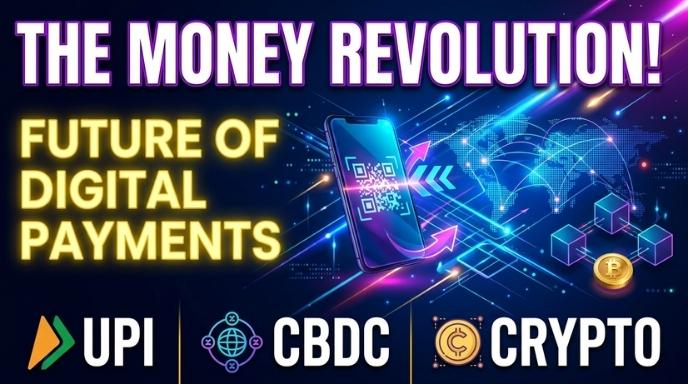
Meta Description: Explore the future of digital payments — UPI, CBDC, and crypto explained simply. Discover how money is changing and what it means for your everyday life.
The Way You Pay for Things Is Changing Faster Than Almost Anything Else in Your Life
Let me start with something that my grandfather said to me a few years ago that I have never forgotten.
He was standing at a small chai stall outside a bus station in Gujarat. The chai wala — an elderly man running a two-burner operation on a folding table — held up a small printed QR code when my grandfather reached into his pocket for cash.
My grandfather looked at the QR code. Looked at his phone. Opened PhonePe. Scanned. Paid twenty rupees in four seconds.
He turned to me and said — quietly, almost to himself — "My father never owned a bank account his entire life. I had one account my whole life that I visited in person every month. And this man selling chai on the street just received money from my phone in four seconds."
Three generations of relationship with money. Transformed completely. Standing at a tea stall.
That moment captures something profound about what is happening to payments globally right now. Not just in India. Not just in the technology sector. Everywhere. For everyone. The way money moves is undergoing the most fundamental transformation in centuries — and most people are living inside that transformation without fully understanding what is driving it, where it is going, or what it means for their financial lives.
This guide is going to change that.
We are going to talk about three forces that are reshaping digital payments simultaneously — UPI, the system that turned India into a global payments laboratory. CBDC, the government-backed digital currencies that central banks worldwide are developing right now. And Crypto, the decentralized money revolution that started with Bitcoin and has since grown into something far more complex and consequential.
No jargon. No technical complexity for its own sake. Just honest, clear, genuinely useful understanding of where your money is going — literally and figuratively.
Setting the Stage — Why Payments Are Having Their Biggest Moment in History
Before we go deep into the three pillars, let us understand why this moment is so significant.
For most of human history, money moved slowly. Physically. Expensively. Through intermediaries who charged for the privilege. A wire transfer between banks in different countries could take three to five days and cost significant fees. Sending money to a family member in another state meant either handing them cash, writing a cheque, or paying a bank for a demand draft.
The infrastructure was old. The thinking was old. The technology was twentieth century sitting inside twenty-first century needs.
Then three things happened almost simultaneously that created the conditions for a complete reinvention.
Smartphones became ubiquitous. In India alone, over 700 million people now carry a smartphone with internet access. In the USA the number is over 270 million. Globally over 6 billion people have mobile phone access. The payment terminal that once required a physical bank branch or an ATM machine is now in everyone's pocket.
Internet became cheap. Jio's entry into the Indian market in 2016 dropped data costs so dramatically that internet access transformed from a middle-class urban privilege into a near-universal utility. Similar democratization happened across Southeast Asia, Africa, and Latin America. Cheap internet is the invisible infrastructure underneath every digital payment revolution.
Trust in traditional financial institutions declined. The 2008 global financial crisis, recurring banking scandals, predatory lending practices, and the obvious inefficiency of legacy systems created an audience genuinely receptive to alternatives. When the old system fails people visibly enough, they are willing to try something new.
These three forces converged. And the result is what we are living through right now.
Part One — UPI: How India Built the World's Most Advanced Payment System
What UPI Is and Why the World Is Paying Attention
Unified Payments Interface. Four words that do not sound like a revolution. But what those four words represent is genuinely one of the most remarkable financial infrastructure achievements in history.
UPI is a real-time payment system developed by the National Payments Corporation of India and launched in 2016. It allows anyone with a bank account and a smartphone to send or receive money instantly — to any other UPI-enabled bank account — twenty-four hours a day, seven days a week, three hundred and sixty-five days a year. Including holidays. Including 2 AM on a Sunday.
For free.
No transaction fees for the sender. No delay. No intermediary taking a percentage. Just instant, free money movement between any two bank accounts in India.
The numbers that followed are staggering.
In 2016, UPI processed approximately 9 million transactions. By 2023, that number was 117 billion transactions in a single year. India now processes more real-time digital payments than the United States, United Kingdom, Germany, and France combined. Not slightly more. Significantly more.
A country that was predominantly cash-based as recently as 2015 became the world leader in real-time digital payments in under a decade.
Why UPI Works So Well — The Architecture Behind the Magic
UPI's success is not accidental. It is the result of genuinely thoughtful infrastructure design built on three foundational principles.
Interoperability. Every UPI payment works across every bank and every payment app. PhonePe, Google Pay, Paytm, BHIM, Amazon Pay — they all run on the same underlying UPI rail. You can send money from your PhonePe account to someone's Google Pay account without a second thought. This interoperability is what made universal adoption possible. Compare this to the USA where Venmo, Cash App, and Zelle users largely cannot transact across those platforms — a fragmentation that significantly limits adoption.
The VPA system. Instead of sharing bank account numbers and IFSC codes, UPI introduced the Virtual Payment Address — a simple identifier like yourname@bankname that links to your bank account. You never share your actual account details. The VPA is easy to remember, easy to share, and keeps sensitive financial information private.
The JAM trinity foundation. Jan Dhan bank accounts provided the financial infrastructure for the unbanked. Aadhaar provided verified digital identity linked to those accounts. Mobile internet provided the access. UPI was built on top of this pre-existing foundation — which is why adoption happened so fast. The pipes were already laid.
UPI in 2026 — Where It Is Going
UPI in 2026 is no longer just a domestic Indian payment system. It is actively becoming a global standard.
UPI One World was launched for foreign visitors to India — allowing international tourists to use UPI without an Indian bank account by linking it to their international cards. The experience of arriving in India and immediately being able to pay at chai stalls, auto rickshaws, and street markets is already a reality for visitors from several countries.
International UPI corridors have been established with Singapore, UAE, Bhutan, Nepal, Sri Lanka, France, and several other countries — allowing real-time cross-border payments between UPI and local payment systems. The vision of a world where sending money internationally is as easy as sending a text message within India is actively being built, corridor by corridor.
Credit on UPI — the ability to link credit lines, credit cards, and buy-now-pay-later products directly to UPI flows — is expanding what the system can do beyond simple bank-to-bank transfers.
UPI for feature phones. UPI 123Pay allows feature phone users without smartphones to use UPI through IVR calls — extending digital payment access to rural populations still using basic phones.
The most remarkable thing about UPI in 2026 is not what it has achieved. It is that it is still accelerating.
What the Rest of the World Is Learning From UPI
Central banks and payment authorities worldwide are studying UPI as a blueprint. The EU's SEPA Instant Credit Transfer. Brazil's PIX system which processed over 150 billion transactions in 2023. Australia's New Payments Platform. The UK's Faster Payments system.
All of these are variations on the same foundational insight that UPI demonstrated — that real-time, interoperable, low-cost or free digital payment infrastructure is possible to build, transformative when built well, and adopted explosively when the barriers to entry are low enough.
UPI did not just transform Indian payments. It gave the world a proof of concept that is actively reshaping payment policy everywhere.
Part Two — CBDC: When Governments Enter the Digital Money Game
What a Central Bank Digital Currency Actually Is
Central Bank Digital Currency. CBDC. This is the term you are going to hear increasingly often over the next five years and it represents something genuinely significant about where government-backed money is heading.
A CBDC is a digital version of a country's official currency — issued and backed directly by the central bank rather than by commercial banks. It is not cryptocurrency. It is not a stablecoin. It is the digital equivalent of the physical notes in your wallet, except it exists purely electronically and is issued by the same institution that issues those physical notes.
The simplest way to think about it: a CBDC is digital cash. With the same government guarantee as physical cash. But existing and moving in digital form.
In India, the Reserve Bank of India launched the Digital Rupee — officially called the e-Rupee — in pilot phases beginning in late 2022. The pilot has been progressively expanding across more banks, more cities, and more use cases throughout 2023, 2024, and into 2026.
In China, the Digital Yuan — or e-CNY — is the most advanced CBDC deployment in the world, already used by hundreds of millions of people across dozens of cities for retail payments, government disbursements, and salary payments.
In the USA, the Federal Reserve has been studying a digital dollar with significant political debate around implementation. The European Central Bank is developing a digital euro. Over 130 countries — representing more than 98 percent of global GDP — are actively exploring or developing CBDCs as of 2026.
This is not a niche technology experiment. This is the global financial system preparing for its next form.
Why Central Banks Want Digital Currencies
Understanding the motivation behind CBDCs helps you understand both their design and their implications.
Efficiency and cost reduction. Physical cash is expensive to produce, distribute, secure, and manage. Digital currency eliminates most of those costs while preserving the government guarantee that makes currency trustworthy.
Financial inclusion. CBDCs can be designed to work without a traditional bank account — potentially reaching the unbanked populations that even UPI-linked bank account requirements exclude.
Faster cross-border payments. International money transfers today are slow, expensive, and routed through a complex chain of correspondent banks. CBDC-to-CBDC cross-border transfers between countries could happen instantly at near-zero cost — transforming international remittances and trade settlement.
Monetary policy implementation. CBDCs give central banks tools they do not currently have — the ability to implement negative interest rates directly on digital currency holdings, time-limited stimulus payments that expire if not spent, targeted disbursements that can only be used for specific purposes.
Competition with private digital money. The rise of cryptocurrencies and private stablecoins represents a potential challenge to government monetary sovereignty. CBDCs are partly a response — a government-backed digital alternative that maintains central bank control over the money supply.
The Digital Rupee — India's CBDC Journey
India's e-Rupee has two forms that serve different purposes.
The wholesale CBDC is used for interbank settlement — large financial institution transactions that currently go through the RBI's existing settlement systems. The wholesale Digital Rupee makes these settlements faster, cheaper, and more transparent.
The retail CBDC is what ordinary people use. Accessible through a digital wallet provided by participating banks, the retail e-Rupee works like a digital version of physical currency. You load it from your bank account. You spend it by scanning QR codes or transferring to other e-Rupee wallets. Transactions are settled immediately and the e-Rupee balance is a direct liability of the Reserve Bank of India — not of your commercial bank.
That last point matters more than it sounds. Your bank deposit is technically a liability of your commercial bank — if your bank fails, your deposit is at risk up to insurance limits. Your e-Rupee balance is a liability of the central bank itself, which cannot fail in the same way. In terms of safety, central bank digital currency is the safest possible form of money.
What Makes CBDC Different From UPI or Bank Transfers
This is the question most people have and it is a genuinely good one. If UPI already allows instant digital payments — why do we need a CBDC on top of it?
The distinction is in what is actually being transferred.
When you send money via UPI, you are sending a bank balance — a commercial bank liability — from one account to another through the UPI rail. The transfer is recorded as an accounting entry at both banks and settled through interbank systems.
When you send e-Rupee, you are transferring actual digital currency — a central bank liability — directly from one wallet to another. There is no commercial bank intermediary processing the transfer. The money itself moves, not just the accounting record.
This distinction enables several things UPI cannot do. Offline transactions — e-Rupee is being designed to work without internet connectivity, which is crucial for rural areas with poor connectivity. Programmable money — e-Rupee can potentially carry conditions about how and when it can be spent. And direct central bank to citizen transfers — government payments can go directly into citizens' e-Rupee wallets without routing through commercial banks.
The Privacy Question — The Elephant in the CBDC Room
Here is the part of the CBDC conversation that generates the most genuine debate and deserves honest treatment.
Physical cash is private. When you hand someone a hundred rupee note, no record of that transaction exists anywhere. No government database. No corporate data trail. The transaction is between you and the recipient.
Digital currency — by its nature — leaves a record. Every e-Rupee transaction is recorded somewhere. The central bank knows when you spent what, where, and how much.
This creates legitimate privacy concerns that are not paranoid or fringe. Governments and central banks across the world are wrestling with how to design CBDCs that maintain the efficiency and programmability advantages of digital money while preserving reasonable financial privacy for citizens.
Different countries are making different design choices. Some CBDC designs include anonymity thresholds — transactions below a certain amount are recorded but not linked to individual identity, similar to how small cash transactions are treated. Others build in privacy by design with zero-knowledge proofs that verify payment validity without revealing transaction details.
The honest answer is that the privacy architecture of CBDCs is still being designed — and the choices made in that design will have profound implications for financial freedom and government power that extend far beyond payment convenience.
Part Three — Crypto: The Decentralized Money Experiment That Will Not Go Away
What Crypto Actually Is — Beyond the Price Charts
Cryptocurrency is the most misunderstood financial technology of the twenty-first century — simultaneously overhyped by its most enthusiastic proponents and dismissed too casually by its most vocal critics.
Let me give you the honest version.
Cryptocurrency is digital money that operates on decentralized networks — meaning no single government, central bank, company, or person controls it. Transactions are verified by a distributed network of computers using cryptographic proof rather than a trusted intermediary like a bank.
Bitcoin — launched in 2009 by the pseudonymous Satoshi Nakamoto — was the first implementation of this idea. Its foundational innovation was solving the double-spend problem for digital money without requiring a trusted third party. Before Bitcoin, you could not send someone a digital file of value without a bank or payment processor confirming you had not already sent that same value to someone else. Bitcoin solved this with blockchain technology — a distributed public ledger that records every transaction transparently and immutably.
Ethereum extended this further by adding programmability — smart contracts that execute automatically when predetermined conditions are met, without any human intermediary needing to oversee or approve the execution.
From these two foundations emerged an enormous ecosystem — thousands of cryptocurrencies, decentralized finance protocols, non-fungible tokens, decentralized exchanges, stablecoins, and layer-two scaling solutions.
The Genuine Use Cases That Survive the Hype
Here is the honest assessment of where cryptocurrency actually delivers real-world value in 2026 beyond speculation.
Cross-border remittances.
This is probably the clearest, most immediately impactful real-world use case for cryptocurrency. A migrant worker in the USA sending money to their family in India or the Philippines through traditional channels pays fees of five to eight percent of the transfer amount and waits one to three business days. The same transfer through cryptocurrency-based remittance services can happen in minutes for fees of under one percent.
For the hundreds of millions of families globally who depend on remittances, this difference is not academic. It is meaningful money — potentially thousands of dollars a year — staying with families rather than being captured by financial intermediaries.
Financial access in weak-currency countries.
In countries experiencing severe currency devaluation — Venezuela, Argentina, Turkey, Nigeria, Zimbabwe — cryptocurrency has provided genuine financial refuge for ordinary people watching their savings evaporate in real time. The ability to hold wealth in Bitcoin or dollar-pegged stablecoins has been a genuine financial lifeline for people in economies where the local currency is actively destroying value.
Stablecoins for digital dollar access.
Stablecoins — cryptocurrencies pegged to stable assets like the US dollar — have become a major use case for people in developing markets who want access to dollar-denominated savings and payments without going through traditional banking. USDT and USDC allow people globally to hold and transact in effective dollars through their smartphones regardless of whether their local banking system provides dollar access.
Decentralized Finance (DeFi).
DeFi protocols allow lending, borrowing, and earning yield on digital assets without banks or financial institutions as intermediaries. For people excluded from traditional financial services, DeFi represents genuine alternative access to financial tools. For sophisticated users, DeFi offers yield opportunities and financial flexibility unavailable through traditional banking.
The Genuine Risks That Also Deserve Honest Treatment
Equally honest accounting of crypto requires acknowledging the very real risks that have caused very real harm.
Extreme volatility. Bitcoin has experienced price declines of seventy to eighty percent multiple times in its history. Anyone who invested significant savings near a market peak and needed to sell during a downturn experienced devastating losses. Cryptocurrency is a genuinely high-risk asset and treating it as a savings vehicle or stable store of value carries serious financial danger.
Fraud and scams. The crypto ecosystem has been plagued by outright fraud at scale. Exchange collapses — most notably FTX in 2022 which destroyed billions in customer funds through fraud — rug pulls in DeFi protocols, fake token launches, and elaborate social engineering scams have caused enormous cumulative harm to retail investors who did not have the expertise to evaluate risks accurately.
Regulatory uncertainty. The regulatory treatment of cryptocurrency varies dramatically by country and continues to evolve. India has imposed thirty percent tax on crypto gains plus one percent TDS on transactions — one of the most restrictive tax regimes globally. The USA has seen SEC enforcement actions against major exchanges and ongoing debate about which cryptocurrencies qualify as securities. Regulatory changes can dramatically affect the value and usability of specific cryptocurrencies overnight.
Environmental concerns. Bitcoin's proof-of-work mining consensus mechanism consumes enormous amounts of electricity — comparable to the energy consumption of entire countries. While Ethereum's 2022 transition to proof-of-stake reduced its energy consumption by over ninety-nine percent, Bitcoin's energy intensity remains a genuine environmental concern that affects its social and regulatory acceptability.
Where Crypto and Traditional Finance Are Converging in 2026
The most important development in the crypto landscape in 2026 is not any specific price movement or new token. It is the ongoing convergence between cryptocurrency and traditional finance — a blurring of boundaries that is changing both ecosystems simultaneously.
Bitcoin spot ETFs launched in the USA in 2024 and attracted enormous institutional investment — bringing Bitcoin exposure into traditional retirement portfolios and brokerage accounts for the first time. Major banks are offering crypto custody and trading services to institutional clients. Payment networks are integrating stablecoin settlement into their infrastructure. Central bank digital currencies are borrowing design concepts from cryptocurrency while rejecting its decentralization.
The clean separation between "crypto" and "traditional finance" that existed in 2017 is dissolving. What is emerging is a financial system that incorporates both — traditional institutions using blockchain technology for efficiency gains, and crypto protocols gaining legitimacy and access through regulatory compliance and institutional adoption.
How These Three Forces Interact — The Bigger Picture
Here is what I find most fascinating about the three-way intersection of UPI, CBDC, and cryptocurrency — and what most commentary misses by looking at each in isolation.
They are not competing with each other as much as they are competing with the same thing. The old, slow, expensive, exclusionary architecture of twentieth century finance.
UPI demonstrated that real-time, free, interoperable digital payments are not just possible but massively preferred when well-implemented. It created an expectation globally that payments should be instant and free — an expectation that makes every legacy payment system look unacceptably inadequate by comparison.
CBDC is governments responding to that expectation while retaining monetary sovereignty and the infrastructure for modern monetary policy. It is the institutionalization of the insight that UPI demonstrated — that digital money can be better money.
Cryptocurrency — particularly through stablecoins and DeFi — is providing financial services to the billions of people that even well-designed government systems leave out, while simultaneously applying competitive pressure that pushes traditional and government financial systems to innovate faster than they would on their own.
The likely future is not one where any single one of these wins completely. It is a layered financial system where UPI-style payment rails handle domestic instant payments, CBDCs provide government-backed digital currency for programmable and cross-border use cases, and cryptocurrency provides decentralized financial services for use cases that governments and banks do not or cannot serve well.
What All of This Means for Your Daily Financial Life
Let us bring this out of the macro and into the personal — because all of this global transformation eventually shows up in how you manage your money every day.
If you are in India:
UPI is already your daily payment reality and will only deepen. The Digital Rupee will gradually become a payment option alongside UPI — useful particularly if you want the safety of central bank money without commercial bank intermediary risk. Cryptocurrency remains legally usable for investment in India but under heavy tax treatment — thirty percent on gains with no offsetting of losses across different cryptocurrencies, making it a challenging environment for active crypto trading though long-term holding remains viable.
If you are in the USA:
Your payment system is catching up — slowly. Zelle, Venmo, and Cash App have brought real-time peer-to-peer payments to mainstream use but the interoperability and universal merchant acceptance that UPI achieved in India is still missing. Bitcoin ETFs have made crypto exposure accessible through regular brokerage accounts. A digital dollar remains in development. The US payments landscape in 2026 is more fragmented than India's but moving in the same direction.
For cross-border needs:
If you send money internationally — to family, for business, for freelance work — the combination of stablecoin-based transfers and expanding UPI international corridors is creating genuinely better options than traditional wire transfers. Worth exploring for your specific corridor before defaulting to expensive legacy options.
For savings and investment:
The key principle for crypto in your personal financial life remains the same regardless of the enthusiasm around you. Only allocate what you can afford to lose entirely. Understand what you are buying before buying it. Treat it as speculative exposure within a diversified portfolio — not as a savings vehicle or retirement strategy.
A Simple Side-By-Side Comparison
| Feature | UPI | CBDC (e-Rupee) | Cryptocurrency |
|---|---|---|---|
| Who controls it | NPCI / Government regulated | Central Bank (RBI) | Decentralized / No single controller |
| What it transfers | Commercial bank deposits | Central bank digital currency | Blockchain-native tokens |
| Speed | Instant | Instant | Varies: seconds to minutes |
| Cost | Free | Free / Near free | Low to moderate (varies by network) |
| Privacy | Moderate — bank records exist | Low — central bank records | Variable — public blockchain |
| Stability | Stable (INR-denominated) | Stable (INR-denominated) | Highly volatile (except stablecoins) |
| Internet required | Yes (mostly) | Designed for offline too | Yes |
| Government backing | Regulated, bank-backed | Direct central bank liability | None |
| Cross-border use | Expanding | In development | Yes, globally |
| Best use case | Domestic instant payments | Government payments, programmable money | Cross-border, DeFi, stores of value |
Final Thoughts — The Future of Money Is Not Coming. It Is Already Here.
My grandfather at that chai stall was not witnessing the future of money. He was witnessing the present — a present that arrived faster than anyone predicted and that billions of people are now simply living inside without necessarily understanding how it works or where it is heading.
The transformation of payments is not going to slow down. The interoperability of digital payment systems will increase. CBDCs will move from pilot to mainstream in more and more countries. Cryptocurrency will continue to mature — shedding some of its speculative excess as institutional adoption deepens and regulatory frameworks clarify. The boundaries between these three systems will continue to blur as the underlying technologies and business models converge.
What this means for you is both simple and significant.
Understanding these systems — not at a technical level but at a strategic one — gives you the ability to make better decisions about where you hold money, how you send it, what financial infrastructure you build your life and business on, and how you think about the emerging alternatives to systems you may have always taken for granted.
The chai wala with his QR code already understood the most important thing. The technology works. It is accessible. It is here.
The only question is how thoughtfully you use it.
Frequently Asked Questions (FAQs)
Q1. What is the difference between UPI and CBDC? UPI is a payment rail — a system for transferring commercial bank deposits between accounts instantly. CBDC is a form of money — digital currency issued directly by the central bank. When you pay via UPI you are moving money that lives in your commercial bank account. When you pay with e-Rupee CBDC you are spending digital currency that is a direct liability of the Reserve Bank of India rather than your commercial bank. The difference is subtle but significant — CBDC carries central bank safety while UPI transfers commercial bank money through a central infrastructure.
Q2. Is cryptocurrency legal in India in 2026? Yes, cryptocurrency is legal to own and trade in India in 2026. It is not legal tender — merchants are not required to accept it as payment. Gains from cryptocurrency are taxed at thirty percent with no loss offsetting permitted across different cryptocurrencies, and a one percent TDS applies to transactions above certain thresholds. The regulatory environment remains restrictive compared to many other countries but outright prohibition has not been implemented despite periodic legislative discussion.
Q3. Can UPI be used internationally? Yes and the international reach is expanding significantly. UPI payment corridors have been established with Singapore, UAE, Bhutan, Nepal, Sri Lanka, France, Mauritius, and several other countries allowing UPI payments to and from these markets. UPI One World allows foreign visitors to India to use UPI through their international cards. The NPCI has stated its ambition to make UPI usable globally and new corridors are being added regularly.
Q4. What is a stablecoin and how is it different from Bitcoin? A stablecoin is a cryptocurrency designed to maintain a stable value — typically pegged to a fiat currency like the US dollar. USDT and USDC are the largest stablecoins and are each worth approximately one US dollar regardless of broader crypto market movements. Bitcoin by contrast has no fixed value and fluctuates dramatically based on market forces. Stablecoins are used primarily for transactions, cross-border transfers, and preserving dollar-equivalent value in crypto form — not for speculative appreciation.
Q5. What is the Digital Rupee and how is it different from money in my bank account? The Digital Rupee or e-Rupee is a CBDC issued directly by the Reserve Bank of India. Money in your regular bank account is a commercial bank liability — it is money the bank owes you, held in the bank's reserves and protected by deposit insurance up to certain limits. The Digital Rupee is a direct RBI liability — the central bank itself owes you that money, which carries effectively zero default risk. In practice both work for everyday payments but the CBDC offers stronger safety guarantees.
Q6. Should I invest in cryptocurrency? This is a personal financial decision that depends entirely on your individual risk tolerance, financial situation, investment timeline, and understanding of what you are investing in. The honest framework is this — only invest money you can afford to lose completely, treat it as high-risk speculative exposure rather than savings or a primary investment, understand the specific cryptocurrency you are buying rather than investing based on hype, and keep crypto exposure to a small percentage of your overall portfolio if you choose to participate. Nobody can reliably predict crypto price movements and anyone claiming they can is either mistaken or selling something.
Q7. Will cash become obsolete because of digital payments? Not in the near future and probably not completely in the longer term either. Cash use has declined dramatically in markets like India and Sweden but shows remarkable persistence globally — particularly among elderly populations, lower-income populations with limited digital access, and in transactions where privacy is valued. Most central banks explicitly state that CBDCs are designed to complement cash rather than replace it. The realistic trajectory is a world where digital payments handle the vast majority of transactions while cash remains available as a backup and privacy-preserving option for those who choose it.
Q8. What is DeFi and is it safe to use? Decentralized Finance — DeFi — refers to financial services including lending, borrowing, trading, and yield-earning that operate through smart contracts on blockchain networks without traditional financial intermediaries. It offers genuine financial access and sometimes attractive yields unavailable through traditional banking. It also carries significant risks including smart contract vulnerabilities that have been exploited for billions in losses, the complexity of managing private keys and digital assets safely, high volatility of underlying assets, and limited or no recourse if something goes wrong. DeFi is appropriate only for users who deeply understand the specific protocols they are using and are prepared for the possibility of complete loss.
Q9. How will CBDCs affect financial privacy? CBDC design has significant privacy implications that are actively debated among policymakers and civil liberties advocates. Unlike physical cash which is anonymous, most CBDC designs create transaction records accessible to the central bank. Different countries are making different design choices — some include anonymity thresholds for small transactions, others use privacy-preserving cryptographic techniques to limit data exposure, and others build in comprehensive transaction surveillance. The privacy characteristics of any specific CBDC depend entirely on the design choices made by its issuing central bank and the legal framework governing data use — making it essential to understand the specific design of your country's CBDC as it develops.
Q10. What is the future of cross-border payments with these technologies? Cross-border payments are being transformed simultaneously by all three technologies described in this guide. UPI international corridors are enabling instant low-cost transfers between India and partner countries. CBDC-to-CBDC settlement agreements between central banks — several of which are in active development — promise to make international transfers as fast and cheap as domestic ones. Cryptocurrency and stablecoins already provide near-instant, low-cost international value transfer for users willing to manage digital assets. The combined effect is a rapid obsolescence of the expensive, slow correspondent banking system that has dominated international money movement for decades — with meaningful benefits for the hundreds of millions of people who send and receive international remittances.
Comments
No comment yet. Be the first to comment