Future of Digital Payments: UPI, CBDC, Crypto — The Money Revolution Happening Right Now
By: compiled from various sources | Published on Apr 09,2026
Category Professional
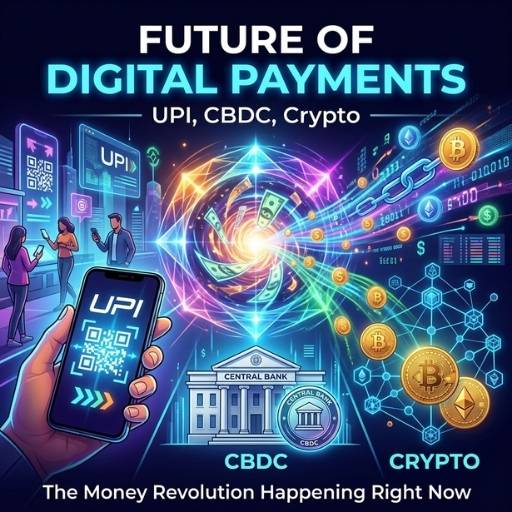
Description: Explore the future of digital payments — UPI, CBDC, and crypto explained simply. Discover how money is changing and what it means for your everyday life in 2026.
The Way Money Moves Has Changed More in the Last Ten Years Than in the Previous Hundred
Let me start with something my uncle told me recently.
He runs a small hardware shop in Ahmedabad. Nothing fancy. Nuts, bolts, pipes, fittings. The kind of shop that has existed in Indian bazaars for generations, running entirely on cash, handwritten ledgers, and relationships built over decades.
Two years ago he put up a UPI QR code at his counter because his nephew — me — insisted. He was skeptical. His customers were older. The shop was traditional. He did not think it would matter.
Last month he told me that sixty percent of his transactions are now digital. His fifteen-year-old regular customer who fixes things around the neighborhood pays via UPI. The contractor who used to settle monthly cash accounts now pays instantly after every delivery. Even his seventy-year-old vendor from the wholesale market sends payment confirmations on WhatsApp.
He said something that stayed with me.
"I did not change. The money changed around me."
That sentence captures exactly what is happening globally right now. Money itself — how it is created, how it moves, who controls it, what form it takes — is changing at a pace and scale that most people are living inside without fully understanding.
Three forces are driving this change simultaneously. UPI and the real-time payment infrastructure it represents. CBDCs — Central Bank Digital Currencies — the government response to a digital-first world. And cryptocurrency — the decentralized money experiment that refuses to go away and keeps finding new relevance.
This guide explains all three clearly. No economics degree required. No jargon for its own sake. Just honest, useful understanding of where your money is going — in every sense of that phrase.
Part One — UPI: The Payment Revolution That Proved Everyone Wrong
What UPI Is and Why the Numbers Are Staggering
When the National Payments Corporation of India launched UPI in 2016, the skepticism was loud. India was predominantly cash-based. Digital literacy was limited. Banking infrastructure in rural areas was inadequate. The idea that a unified digital payment system would transform a nation of 1.4 billion people — many without consistent internet access — seemed optimistic at best.
The skeptics were spectacularly wrong.
By 2024, India was processing over 100 billion UPI transactions annually. Monthly transaction volumes regularly exceed 18 billion individual payments. India now processes more real-time digital payments than the United States, United Kingdom, Germany, and France combined.
Read that again. One country. More digital transactions than four of the world's largest economies combined.
The chai wala accepts UPI. The vegetable vendor accepts UPI. Temple donation boxes accept UPI. Auto rickshaw drivers display QR codes. Street food stalls in tier-3 cities run on PhonePe and Google Pay. A payment system designed for smartphones became universal in a country where smartphone penetration was far from universal when it launched.
Why UPI Actually Works — The Design Decisions That Made It
UPI's success was not accidental. Several specific design decisions created the conditions for explosive adoption.
Interoperability was non-negotiable. Every UPI payment works across every bank and every app. PhonePe users send money to Google Pay users without friction. BHIM, Paytm, Amazon Pay, WhatsApp Pay — all running on the same underlying rail. This interoperability prevented the fragmented ecosystem that has limited adoption in markets like the USA where Venmo, Cash App, and Zelle users largely cannot transact across platforms.
It was free. No transaction fees for consumers. No friction from cost. When using the system costs nothing and the alternative — cash — requires physical handling, ATM trips, and change management — the digital option wins naturally.
It connected to existing bank accounts. UPI did not require people to open new accounts or trust new financial institutions. It sat on top of existing banking relationships while removing the complexity of sharing account numbers and IFSC codes. A simple Virtual Payment Address — yourname@bankname — replaced all of that.
The JAM Trinity was the foundation. Jan Dhan accounts had already banked hundreds of millions of previously unbanked Indians. Aadhaar provided verified digital identity. Jio's entry in 2016 made mobile data essentially free. UPI launched into infrastructure that was ready for it — which is why adoption happened so fast.
Where UPI Is Going in 2026 and Beyond
UPI in 2026 is no longer just an Indian domestic payment system. It is actively becoming a global standard.
International corridors now connect UPI to payment systems in Singapore, UAE, France, Bhutan, Nepal, Sri Lanka, and several other countries. The vision — instant, free international transfers as simple as domestic UPI payments — is being built corridor by corridor.
UPI One World allows international visitors to India to use UPI immediately on arrival without an Indian bank account. UPI 123Pay extends the system to feature phone users without smartphones, reaching rural populations that the original app-based system excluded.
Credit on UPI — linking credit lines and buy-now-pay-later products directly to UPI flows — is expanding the system from a payment rail into a complete financial services platform.
The most remarkable thing about UPI's trajectory is that it is still accelerating. The first hundred billion transactions took eight years. The next hundred billion will take significantly less.
Part Two — CBDC: When Governments Build Digital Money
What a Central Bank Digital Currency Actually Is
Here is the simplest honest explanation of CBDC.
Physical cash — the notes in your wallet — is a direct liability of your country's central bank. The Reserve Bank of India issues rupee notes. The Federal Reserve issues dollar bills. When you hold cash, you are holding a claim directly on the central bank — not on any commercial bank.
A CBDC is digital cash with the same property. Digital currency issued directly by the central bank, representing a direct central bank liability, existing purely in electronic form.
It is not cryptocurrency. It is not a stablecoin. It is the government's own digital money — with the same sovereign guarantee as physical notes, just in a form that travels through digital infrastructure rather than physical hands.
India's Digital Rupee — officially the e-Rupee — launched in pilot phases in late 2022 and has been progressively expanding across more banks, cities, and use cases throughout 2023, 2024, and into 2026. China's Digital Yuan is the most advanced CBDC deployment globally, already used by hundreds of millions of people. Over 130 countries representing more than 98 percent of global GDP are actively exploring or developing CBDCs.
This is not a niche experiment. This is the global financial system preparing for its next form.
Why Central Banks Are Building Digital Currencies
Understanding the motivation makes the design and implications clearer.
Efficiency and cost reduction. Physical cash is genuinely expensive — printing, distribution, security, handling, replacement. Digital currency eliminates most of those costs while preserving the central bank guarantee that makes money trustworthy.
Financial inclusion. CBDCs can be designed to work without traditional bank accounts — potentially reaching populations that banking infrastructure has historically excluded. An e-Rupee wallet accessible through a basic phone with no bank account requirement extends financial access further than any previous instrument.
Programmable money. This is the capability that makes CBDCs genuinely transformative beyond simple digitization. Digital currency can carry conditions — government direct benefit transfers that can only be spent on food, healthcare, or specific categories. Stimulus payments that expire if not spent within a defined period. Agricultural subsidies that flow directly to farmers without intermediary leakage.
Monetary policy tools. CBDCs give central banks mechanisms they currently lack — the ability to implement policies directly at the currency level rather than working through commercial banks as intermediaries.
Responding to private digital money. The rise of cryptocurrencies and private stablecoins challenges government monetary sovereignty. CBDCs are partly a response — maintaining central bank control over the monetary system in a digital-first world.
The Digital Rupee Specifically — What It Is and How It Works
India's e-Rupee has two distinct forms serving different purposes.
The wholesale CBDC handles interbank settlement — large financial institution transactions currently processed through RBI's existing systems. The wholesale Digital Rupee makes these settlements faster, more efficient, and more transparent.
The retail CBDC is what individuals use. Distributed through participating banks as digital wallets, the retail e-Rupee works like a digital version of physical currency. You load it from your bank account. You spend it by scanning QR codes or transferring to other e-Rupee wallets. Transactions settle instantly.
The crucial distinction from regular bank deposits — your e-Rupee balance is a direct RBI liability, not a commercial bank liability. If your bank fails, your bank deposit is at risk up to insurance limits. Your e-Rupee balance is backed by the central bank itself, which cannot fail in the same way. The safest possible form of money.
The Privacy Question Nobody Wants to Answer Directly
Here is the honest conversation about CBDCs that most official communications carefully avoid.
Physical cash is private. You give someone a hundred rupee note and no record of that transaction exists anywhere. No government database. No data trail.
A CBDC transaction is recorded. The central bank knows when you spent what, where, and how much. The implications of that surveillance capability are genuinely significant — not in a paranoid way, but in a legitimate privacy and civil liberties way.
Different countries are making different design choices. Some CBDC designs include anonymity thresholds — small transactions are recorded but not linked to individual identity. Others use privacy-preserving cryptographic techniques. Others build comprehensive transaction records into the core design.
The privacy architecture of CBDCs is still being determined. And the choices made will have consequences for financial freedom that extend far beyond payment convenience. This is a conversation worth paying attention to regardless of your position on it.
Part Three — Crypto: The Decentralized Experiment That Will Not Stop Evolving
What Cryptocurrency Is — The Honest Version
Cryptocurrency is digital money that operates on decentralized networks — meaning no single government, central bank, company, or person controls it. Transactions are verified by distributed networks of computers using cryptographic proof rather than trusted intermediaries like banks.
Bitcoin launched in 2009 solved a fundamental problem — how do you send digital value directly to someone without a bank confirming you have not already sent that value to someone else? The answer was blockchain — a distributed public ledger recording every transaction transparently and permanently.
Ethereum extended this by adding programmability. Smart contracts — code that executes automatically when predetermined conditions are met — without any human intermediary needed.
From these foundations grew an enormous ecosystem. Thousands of cryptocurrencies. Decentralized finance protocols. Stablecoins pegged to fiat currencies. Blockchain infrastructure serving purposes far beyond payments.
Where Cryptocurrency Actually Delivers Real Value in 2026
Let me be direct about this because the crypto space has historically suffered from both excessive hype and excessive dismissal.
Cross-border remittances. This is the clearest, most immediately measurable use case. Sending money internationally through traditional banking costs five to eight percent in fees and takes one to three business days. Cryptocurrency-based remittance services do the same transfer in minutes for under one percent. For the hundreds of millions of families depending on international remittances, that difference is significant real money staying with families rather than captured by intermediaries.
Stablecoins as dollar access. In countries with currency instability or restricted dollar access, stablecoins — cryptocurrencies pegged to the US dollar like USDT and USDC — provide a practical way to hold dollar-denominated value through a smartphone. This is genuinely transformative in economies where local currency is actively losing value.
DeFi — Decentralized Financial Services. Protocols that allow lending, borrowing, and earning yield on digital assets without banks as intermediaries. For people excluded from traditional financial services, DeFi provides alternative access to financial tools that traditional banking has historically reserved for those already inside the system.
Institutional investment asset. Bitcoin spot ETFs launched in the USA in 2024, bringing Bitcoin exposure into mainstream investment portfolios through regulated financial products. Institutional adoption has matured significantly — Bitcoin is increasingly treated as a portfolio diversification asset rather than purely a speculative instrument.
The Genuine Risks — Equally Honest
Extreme volatility. Bitcoin has experienced price declines of seventy to eighty percent multiple times. Anyone who treats cryptocurrency as a savings vehicle or stable store of value without understanding this volatility runs serious financial risk.
Fraud and scams. Exchange collapses, fraudulent projects, social engineering scams, and rug pulls have caused enormous cumulative harm. The crypto ecosystem's relative lack of regulatory protection means retail participants bear risks that traditional financial system participants are protected from.
Regulatory complexity in India. India imposes thirty percent tax on crypto gains with no loss offsetting permitted across different cryptocurrencies, plus one percent TDS on transactions. This creates significant friction for active crypto trading in India — though long-term holding remains legal and viable within the tax framework.
Environmental concerns for Bitcoin specifically. Bitcoin's proof-of-work mining consumes electricity comparable to entire countries. Ethereum's 2022 transition to proof-of-stake reduced its energy consumption by over ninety-nine percent, but Bitcoin's energy intensity remains a genuine concern affecting its regulatory and social acceptability.
How All Three Connect — The Bigger Picture
Here is what makes the current moment in payments genuinely unprecedented.
UPI, CBDC, and cryptocurrency are not really competing with each other. They are all competing with the same thing — the slow, expensive, exclusionary architecture of twentieth century finance.
UPI proved that instant, free, interoperable payments are not just technically possible but explosively preferred when well-implemented. That demonstration changed global expectations permanently. People who have used UPI cannot understand why any payment system should be slower or more expensive.
CBDC is governments absorbing that lesson while preserving monetary sovereignty. It is the institutionalization of the UPI insight — money can be digital, instant, and better without abandoning central bank stability.
Cryptocurrency provides financial services to people and use cases that even well-designed government systems cannot or will not serve — genuinely decentralized, genuinely borderless, genuinely accessible to anyone with internet regardless of citizenship, banking status, or government permission.
The realistic future is all three coexisting in a layered financial system. UPI-style rails handling domestic instant payments. CBDCs providing programmable government-backed digital currency for specific use cases. Cryptocurrency serving cross-border needs, DeFi applications, and the users who specifically value decentralization.
A Simple Comparison
| Feature | UPI | CBDC | Cryptocurrency |
|---|---|---|---|
| Who controls it | NPCI, government regulated | Central Bank directly | Decentralized, no single controller |
| What moves | Commercial bank deposits | Central bank digital currency | Blockchain-native tokens |
| Speed | Instant | Instant | Seconds to minutes |
| Cost | Free | Free or near-free | Low to moderate |
| Privacy | Moderate | Low — central bank records | Variable — public blockchain |
| Stability | Stable — INR denominated | Stable — INR denominated | Highly volatile except stablecoins |
| Internet required | Yes, mostly | Designed for offline too | Yes |
| Cross-border | Expanding rapidly | In development | Yes, globally available |
| Best use case | Domestic instant payments | Government transfers, programmable money | Remittances, DeFi, store of value |
What This Means for Your Daily Financial Life
Let us bring the macro down to the personal.
If you are in India:
UPI is already your daily reality. The Digital Rupee will become a payment option alongside UPI — particularly useful for government benefit disbursements and programmable financial applications. Cryptocurrency remains legally usable for investment under India's tax framework — thirty percent on gains, one percent TDS on transactions — making it most viable as a long-term holding rather than active trading.
If you are in the USA:
Your payment infrastructure is catching up. Zelle and Venmo have brought real-time peer-to-peer payments to mainstream use but the universal merchant acceptance and interoperability that UPI achieved is still developing. Bitcoin ETFs have made crypto exposure accessible through conventional brokerage accounts. A digital dollar is in research and development. The US landscape is more fragmented but moving toward convergence.
For anyone sending money internationally:
The combination of expanding UPI international corridors, maturing crypto remittance services, and developing CBDC cross-border frameworks is creating genuinely better options than traditional wire transfers for most corridors. Research your specific corridor — some routes are already dramatically better through new infrastructure.
For savings and investment:
The foundational principle for crypto in any personal financial plan remains unchanged. Only allocate what you can afford to lose entirely. Understand what you are buying. Keep crypto exposure as a small, informed portion of a diversified financial position — never as a primary savings vehicle.
Final Thoughts — Money Is Not What It Was. And That Is Mostly Good News.
My uncle's hardware shop in Ahmedabad is a more useful lens for understanding this moment than any central bank white paper or crypto whitepaper.
He did not adopt digital payments because he understood blockchain technology or monetary policy theory. He adopted them because they were faster, easier, and better than what came before. His customers adopted them for the same reasons. The technology succeeded because the experience it delivered was genuinely superior.
That is ultimately the test every payment technology has to pass — not technical elegance, not ideological purity, not regulatory approval alone. Does it make moving money faster, cheaper, safer, and more accessible for real people in real situations?
UPI passed that test dramatically. It changed a nation.
CBDCs are attempting to pass it at a government level — bringing the benefits of digital money into the sovereign monetary system while managing the risks that purely private digital money introduces.
Cryptocurrency passes it in specific use cases — particularly cross-border payments and financial access for underserved populations — while failing it in others due to volatility, complexity, and fraud risk.
The future of digital payments is not one winner. It is a mature financial system that incorporates the best of all three — instant domestic payments, sovereign digital currency, and decentralized financial services — each serving the use cases it is genuinely best suited for.
That system is being built right now. You are already living in the early stages of it.
Understanding it clearly — which you now do — puts you ahead of most people navigating their financial lives in 2026.
Frequently Asked Questions (FAQs)
Q1. What is the main difference between UPI and CBDC? UPI is a payment rail — infrastructure for moving commercial bank deposits instantly between accounts. CBDC is a form of money — digital currency issued directly by the central bank. When you pay via UPI you are transferring money held in your commercial bank account. When you pay with the Digital Rupee you are spending currency that is a direct RBI liability — backed by the central bank itself rather than your commercial bank. UPI moves existing money faster. CBDC creates a new, safer form of digital money.
Q2. Is cryptocurrency legal in India in 2026? Yes, cryptocurrency is legal to own and trade in India. It is not legal tender — merchants cannot be compelled to accept it. Gains are taxed at thirty percent with no cross-asset loss offsetting permitted, and one percent TDS applies to qualifying transactions. The regulatory environment is restrictive but outright prohibition has not been implemented. Most viable for long-term holding within the tax framework.
Q3. Will CBDCs replace cash? Not in the foreseeable future and likely not completely even long-term. Most central banks including the RBI explicitly state that CBDCs are designed to complement physical cash rather than replace it. Cash continues to serve populations with limited digital access, provides genuine transaction privacy, and functions during infrastructure failures. The realistic trajectory is a world where digital payments handle the vast majority of transactions while cash persists as a backup option.
Q4. What is a stablecoin and why does it matter? A stablecoin is a cryptocurrency designed to maintain stable value — typically pegged to the US dollar. USDT and USDC are the largest, each worth approximately one dollar. Unlike Bitcoin which fluctuates dramatically, stablecoins maintain purchasing power while providing crypto infrastructure benefits — instant global transfer, blockchain transparency, DeFi access. They are increasingly important for cross-border payments and as a dollar access mechanism in markets with currency instability.
Q5. How does UPI work internationally? UPI international corridors allow real-time payment between UPI and partner country payment systems. Established corridors include Singapore, UAE, France, Bhutan, Nepal, and Sri Lanka with more being added regularly. The NPCI is actively pursuing global UPI expansion as a strategic priority. UPI One World allows foreign visitors in India to use UPI through international cards without an Indian bank account.
Q6. Should I invest in cryptocurrency? Only with money you can genuinely afford to lose entirely, after understanding specifically what you are buying, and as a small portion of a diversified financial position. Cryptocurrency is a high-risk speculative asset with genuine volatility risk, fraud risk, and regulatory risk. It has also delivered significant returns for long-term holders through multiple cycles. The honest answer is that informed, risk-appropriate, small-allocation exposure to cryptocurrency is defensible for some investors while any significant allocation of savings or emergency funds is genuinely dangerous.
Q7. What is the Digital Rupee and how do I use it? The Digital Rupee or e-Rupee is India's CBDC — digital currency issued directly by the Reserve Bank of India. It is distributed through participating banks as digital wallets. You load e-Rupee from your bank account, spend it by scanning QR codes or transferring to other e-Rupee wallets, and it settles instantly. It is currently in expanding pilot phases accessible through select banks. The key advantage over regular bank money is that e-Rupee is backed directly by the RBI rather than your commercial bank — the safest possible form of digital money.
Comments
No comment yet. Be the first to comment