What Causes a Recession? — The Economic Storm Nobody Sees Coming Until It Is Already Here
By: compiled from various sources | Published on Apr 17,2026
Category Intermediate
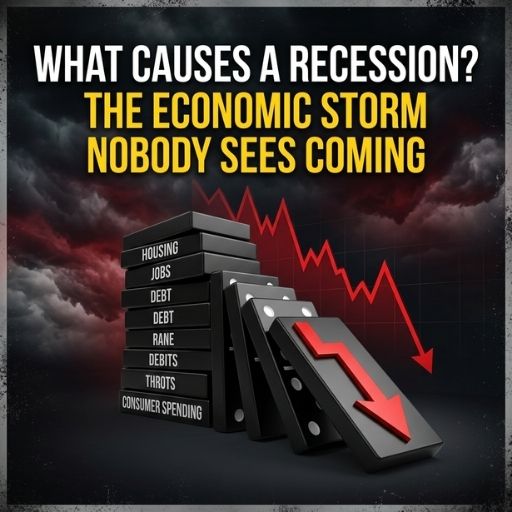
Description: Understand what causes a recession in simple terms — from demand shocks to debt crises. A real, honest guide to how economies collapse and what it means for you.
Every Recession Arrives With Warnings That Everyone Ignored Until It Was Too Late.
Let me start with something that most economics textbooks bury in technical language but that is genuinely worth understanding in plain terms.
In 2006, several economists, analysts, and a handful of investors were loudly warning that the US housing market was built on a foundation that could not hold. They pointed to mortgage lending standards that had collapsed entirely. They pointed to financial products built on those mortgages that nobody fully understood. They pointed to price-to-income ratios in housing markets that had no historical precedent and no rational justification.
The mainstream response was essentially — do not worry about it. The fundamentals are sound. The experts in charge understand the system. This time is different.
Two years later, the global financial system nearly collapsed. The 2008 recession destroyed trillions of dollars of wealth, eliminated millions of jobs, triggered a wave of home foreclosures that displaced families across America, contracted economies globally, and left scars on employment and wealth that took a decade to heal in many communities.
The warnings had been visible. The causes had been building for years. And yet the recession arrived as a shock to most people because understanding what actually causes economic contractions — what specific forces and dynamics push a growing economy into reverse — is not knowledge that gets widely shared or clearly explained.
This guide changes that.
Not with complicated economic jargon. Not with academic theory that requires a postgraduate degree to follow. With honest, clear, genuinely useful understanding of what recessions are, what causes them, how they develop, and what they mean for your actual life.
What a Recession Actually Is — The Definition That Matters
Let us start with precision because this word gets used loosely in ways that create confusion.
The traditional technical definition of a recession is two consecutive quarters of negative GDP growth — meaning the total economic output of a country shrinks for six months in a row. This is the definition most commonly cited in media and policy discussion.
The National Bureau of Economic Research in the USA — the body officially responsible for dating US recessions — uses a broader definition. It defines a recession as a significant decline in economic activity that is spread across the economy and lasts more than a few months, visible in GDP, income, employment, industrial production, and retail sales simultaneously.
The NBER definition captures something important that the two-quarter rule misses. A recession is not just about one number going negative. It is about a broad, sustained deterioration across multiple measures of economic health simultaneously. Employment falls. Incomes decline. Consumer spending contracts. Business investment pulls back. Industrial output shrinks. All of these things tend to happen together — and their interaction with each other is precisely what makes recessions self-reinforcing once they begin.
In India, the Ministry of Statistics and Programme Implementation tracks GDP growth. India has not experienced a technical recession in decades by the two-quarter definition — but it has experienced significant economic slowdowns where growth fell far below the rates needed to absorb new workers into the labor market, creating effectively recessionary conditions for large portions of the population even when headline GDP remained positive.
Understanding recessions in the Indian context requires looking beyond the technical definition to what economic slowdowns mean for employment, rural income, small business survival, and the purchasing power of ordinary households.
The Core Mechanism — Why Economies Contract
Before the specific causes, understanding the fundamental mechanism of recession makes every specific cause easier to understand.
Modern economies run on spending. Consumer spending. Business investment spending. Government spending. Export revenues. When any significant component of total spending falls sharply, the businesses that depended on that spending see their revenues fall. They respond by cutting costs — which means reducing investment, reducing inventory, and most painfully, reducing employment.
When employment falls, incomes fall. When incomes fall, consumer spending falls further. When consumer spending falls further, business revenues fall further. More layoffs. More income loss. More spending cuts.
This is the self-reinforcing downward spiral that defines a recession. Economists call it the negative multiplier effect — each unit of spending reduction generates additional spending reduction through the economy as it ripples through supply chains, employment, and consumer confidence.
The critical insight is that recessions do not require a total collapse in spending. They require a significant enough reduction in spending that the self-reinforcing contraction mechanism gains momentum faster than natural economic stabilizers can absorb it.
What causes that initial significant spending reduction? Several things. Sometimes one at a time. Sometimes several simultaneously. Here are the major causes — each worth understanding clearly.
Cause 1 — Demand Shocks: When Spending Collapses Suddenly
A demand shock is any event that causes a sudden, significant fall in spending across a broad portion of the economy simultaneously.
The COVID-19 pandemic of 2020 is the most dramatic demand shock in modern economic history. Overnight, entire sectors of consumer spending — travel, hospitality, restaurants, entertainment, retail — went to near zero as lockdowns were implemented globally. The sudden simultaneous collapse of demand across multiple sectors triggered the sharpest economic contraction recorded since the Great Depression.
In a matter of weeks, unemployment in the USA went from historic lows to levels not seen since the 1930s. GDP contracted at annualized rates exceeding thirty percent in some quarters. India's GDP contracted by approximately twenty-four percent in the first quarter of the 2020-21 financial year — the worst single-quarter contraction in the country's modern economic history.
Demand shocks can also come from more gradual forces. A significant fall in consumer confidence — triggered by job insecurity fears, political instability, or financial market turmoil — can cause households to pull back spending simultaneously even without any specific triggering crisis. The confidence channel matters enormously. Economies run partly on expectation. When a critical mass of people simultaneously decide the future looks uncertain enough to warrant spending less and saving more, their collective decision creates the economic deterioration they feared.
Cause 2 — Supply Shocks: When Production Becomes Impossible or Unaffordable
Supply shocks hit economies from the production side rather than the demand side. They make it suddenly more expensive or more difficult to produce goods and services — driving up prices, reducing output, and often triggering the kind of stagflation — simultaneous high inflation and economic stagnation — that is particularly difficult for policymakers to address.
The 1973 oil embargo is the historical example every economics student learns. OPEC countries cut oil production and implemented an embargo against countries supporting Israel in the Yom Kippur War. Oil prices quadrupled almost overnight. Since oil is an input into virtually every aspect of modern economic production — manufacturing, transportation, heating, agriculture — the price shock rippled through the entire economy. The result was the worst recession the US had experienced since the Great Depression at that point, accompanied by inflation that made the recession particularly painful.
The 2022 energy price shock following Russia's invasion of Ukraine produced similar supply shock dynamics in Europe — energy prices spiked dramatically, manufacturing costs rose, and several European economies contracted or came close to contraction despite strong demand conditions.
Supply shocks are particularly difficult to address through standard monetary and fiscal policy tools because the usual recession response — stimulating demand through lower interest rates and government spending — worsens inflation when the problem is supply-side rather than demand-side. Policymakers face a genuine dilemma between fighting recession and fighting inflation simultaneously.
Cause 3 — Financial Crises and Credit Contractions
This is arguably the most dangerous recession cause because financial crises can transform manageable economic slowdowns into catastrophic depressions through the destruction of credit — the lifeblood of modern economic activity.
Modern economies are built on credit. Businesses borrow to invest and expand. Consumers borrow to buy homes, cars, and durable goods. Banks borrow from each other and from central banks to fund their lending. This interlocking credit system functions normally when confidence in its stability is maintained — and collapses with extraordinary speed when that confidence breaks.
The 2008 Global Financial Crisis demonstrated exactly how rapidly credit-driven recessions can develop. The immediate trigger — rising defaults on US subprime mortgages — was itself a significant problem. But the catastrophic amplification came from the financial system's structure. Those mortgages had been packaged into complex financial instruments — mortgage-backed securities, collateralized debt obligations — and distributed throughout the global financial system in ways that made it impossible to determine which institutions held how much risk.
When the losses started materializing, nobody knew where they were concentrated. Banks stopped trusting each other. Interbank lending — the daily lending between banks that keeps the financial system functioning — froze. Credit availability contracted sharply across the entire economy. Businesses that could not access credit could not fund operations. Consumers who could not access credit could not maintain spending. The credit contraction transformed a housing market correction into a global recession.
India has experienced its own credit contraction dynamics. The NBFC — Non-Banking Financial Company — crisis that began in 2018 with the collapse of IL&FS created a significant credit contraction in India's economy. NBFCs had become a major source of credit to sectors including real estate, microfinance, and small business. When the IL&FS collapse triggered a confidence crisis in NBFC debt, credit to these sectors contracted sharply — contributing to economic slowdown that was already visible before the COVID pandemic arrived.
Cause 4 — Asset Bubble Collapses
Asset bubbles — periods when the prices of financial assets or real estate rise far beyond what underlying economic fundamentals can justify — are not themselves recessions. But their collapse frequently triggers them.
The mechanism works through several channels simultaneously. Wealth destruction — when asset prices collapse, the wealth that households and businesses believed they held disappears. People who felt wealthy enough to spend freely pull back as their net worth falls. Businesses that used appreciated assets as collateral for loans find their collateral value has evaporated — triggering margin calls and credit contractions. Financial institutions that held inflated assets on their balance sheets face solvency questions.
The Japanese asset bubble collapse of the early 1990s is one of history's most instructive examples. Japanese real estate and equity markets had reached extraordinary valuations through the 1980s — Tokyo real estate alone was theoretically worth more than all US real estate at the bubble's peak. When the bubble burst, Japanese banks were left with enormous portfolios of bad loans collateralized against assets that had lost most of their value. Japan entered a period economists call the Lost Decade — a decade of economic stagnation, deflation, and persistent recession despite aggressive policy response. Some argue the lost decade never fully ended.
The psychological dimension of bubble collapses matters as much as the mechanical one. Bubbles build on narratives — stories about why asset prices should be high and will continue rising. When the narrative breaks, confidence collapses with similar speed. The belief that sustained the bubble becomes the disbelief that accelerates the crash.
Cause 5 — Interest Rate Shock and Monetary Policy Errors
Central banks raise interest rates to fight inflation — making borrowing more expensive, which reduces spending and investment, which reduces price pressure. This is intentional economic cooling. Done carefully, it prevents economies from overheating without triggering recession. Done aggressively or too late, it can tip economies into contraction.
The Federal Reserve's aggressive interest rate increases of 2022 and 2023 — raising the federal funds rate from near zero to over five percent in approximately eighteen months — represented one of the most aggressive monetary tightening cycles in decades. The explicit goal was reducing inflation that had reached forty-year highs. The risk being managed was triggering a recession through the rate increases themselves.
The transmission mechanism from interest rates to recession is straightforward. Higher rates make mortgages more expensive — reducing home purchases and construction. Higher rates make business loans more expensive — reducing investment. Higher rates make consumer credit more expensive — reducing spending. Higher rates make carrying debt more expensive — potentially triggering defaults that cascade through the financial system.
The historical record of central banks engineering "soft landings" — successfully reducing inflation through rate increases without triggering recession — is not encouraging. The difficulty of calibrating policy precisely enough to cool without contracting makes monetary policy error a genuine and recurring recession cause.
Cause 6 — External Shocks and Trade Disruptions
For highly integrated economies — and virtually all modern economies are highly integrated — external shocks transmitted through trade and financial linkages can trigger domestic recessions regardless of domestic economic health.
Trade disruptions reduce export revenues for producing countries while raising costs for importing countries. The US-China trade war that escalated significantly in 2018 and 2019 created genuine economic damage for both economies and for third-country supply chains caught between them. Manufacturing investment decisions were delayed globally as businesses waited to understand the new trade environment.
For India — an economy with significant trade dependencies and a large diaspora sending remittances — external shocks matter significantly. Global oil price spikes directly affect India's import bill and inflation. Global financial market turmoil affects capital flows to Indian markets and the rupee's exchange rate. A global trade slowdown affects Indian IT service exports and manufacturing export demand.
The interconnectedness that makes global trade enormously beneficial in expansion — access to larger markets, specialized production, cheaper inputs — becomes a transmission mechanism for economic pain when major trading partners experience downturns.
Why Recessions Are Self-Reinforcing — The Psychology Nobody Talks About Enough
Here is the dimension of recession causation that economic analysis frequently underweights.
Recessions are as much psychological events as mechanical ones. Expectations — what businesses, consumers, and investors believe about the near future — shape behavior, and behavior shapes the economic reality that confirms or denies those expectations.
When households believe a recession is coming, they increase savings and reduce spending to prepare. That reduced spending reduces business revenues. Businesses then reduce investment and hiring to manage lower revenues. Lower employment and lower business investment confirm households' recession fears — triggering further spending reduction.
The recession that people feared becomes the recession they created through their collective protective response.
This is why consumer confidence surveys — which measure what households believe about economic prospects — are genuinely useful recession predictors. Not because confidence causes recessions directly but because confidence is a leading indicator of the behavioral changes that translate economic stress into actual contraction.
Business confidence works through the same mechanism. When business leaders become pessimistic about near-term demand — for any reason, rational or otherwise — they delay investment decisions. Delayed investment means lower orders for capital goods producers. Lower orders mean reduced employment in capital goods industries. Reduced employment means reduced consumer spending. The pessimism that started as a precaution becomes a cause through the behavior it triggers.
Understanding this psychological dimension explains why government communication during economic stress matters so much. Credible, clear communication that maintains confidence — when the underlying economic fundamentals justify it — genuinely reduces the risk of confidence-driven recessions. It also explains why political instability, which undermines confidence in governance competence, creates real economic risk beyond its direct policy effects.
How Recessions End — The Recovery Mechanism
Understanding what ends recessions illuminates what causes them and what makes some worse than others.
Monetary policy response — Central banks cut interest rates to make borrowing cheaper, stimulating investment and consumer spending. The US Federal Reserve cut rates dramatically in response to both the 2008 crisis and the 2020 pandemic contraction. The RBI similarly cuts the repo rate during Indian economic downturns to provide liquidity and stimulate credit.
Fiscal policy response — Governments increase spending or cut taxes to inject demand into contracting economies. The US stimulus packages of 2008-2009 and the pandemic-era relief packages of 2020-2021 represented historically significant fiscal interventions. India's government spending programs during economic slowdowns similarly attempt to substitute government demand for private sector demand that has contracted.
Natural inventory adjustment — Businesses that cut production during recessions eventually deplete inventories to the point where restocking becomes necessary regardless of demand conditions. This inventory restocking creates a natural floor that limits how far production can fall.
Pent-up demand release — Consumers who deferred major purchases during recession eventually cannot defer them indefinitely. When confidence stabilizes, this pent-up demand releases in a burst of spending that accelerates recovery.
The severity and duration of recessions correlate strongly with their cause. Demand shock recessions — like the 2020 pandemic contraction — can recover relatively quickly when the shock is removed and stimulus is applied. Financial crisis recessions — like 2008 — recover slowly because rebuilding damaged credit systems and balance sheets takes years. Supply shock recessions are difficult to resolve through standard policy tools. Structural recessions driven by fundamental economic transformation — like Japan's post-bubble stagnation — can persist for decades.
What Recessions Mean for Ordinary People — The Part That Actually Matters
Here is the section that most economics writing buries in technical discussion but that deserves to come forward.
Recessions are not just numbers going negative on a GDP report. They are people losing jobs they depended on. Families losing homes they built their lives around. Small businesses that owners spent decades building closing permanently. Young people entering the workforce during contractions who carry the career scars of poor early employment conditions for years or decades afterward — a phenomenon researchers call the scarring effect.
Job loss is the most direct and most damaging recession effect. Unemployment rates rise in recessions and the psychology of job loss extends far beyond the immediate income disruption. The mental health consequences of involuntary unemployment — documented extensively in research — rival the effects of serious illness. The employment effects of recessions are not distributed equally. Lower-income workers, workers in vulnerable sectors, informal economy workers, and younger workers consistently bear disproportionate recession employment risk.
In India, where the informal economy employs the majority of workers, recessions and economic slowdowns hit in ways that do not fully appear in official statistics. The migrant worker who loses urban employment and returns to rural areas. The small vendor whose customers have stopped spending. The daily wage laborer whose work simply disappears during contractions. These workers have no unemployment insurance, no formal safety net, and no access to the credit that could bridge an income gap.
Debt becomes dangerous in recessions. Borrowers who took on manageable debt during growth periods find that debt unmanageable when income falls. Mortgage defaults. Small business loan defaults. Personal credit defaults. These cascading defaults amplify the financial damage of recessions and create consequences that outlast the technical recession period by years.
Recessions reshape industries permanently. Businesses that close during recessions often do not reopen when recovery comes. Their workers develop new skills and move to different sectors. Their physical locations get converted. The competitive landscape of entire industries can shift during recessions in ways that outlast the economic cycle.
Protecting Yourself — What Individuals Can Actually Do
Most recession preparedness advice is generic to the point of uselessness. Here is the specific, honest version.
Emergency fund depth matters more during economic uncertainty. The standard advice of three to six months of expenses is a floor, not a ceiling. Workers in cyclically sensitive industries — manufacturing, real estate, hospitality, luxury retail — should target six to twelve months given their higher recession layoff risk.
Debt reduction before downturns significantly reduces recession vulnerability. Variable rate debt — loans with interest rates that rise as central banks raise rates — is particularly dangerous during the inflationary periods that often precede recessions. Paying down high-interest debt in growth periods reduces the debt burden that becomes crushing during income disruptions.
Skill diversification reduces employment concentration risk. Workers whose entire income depends on one employer in one industry have maximum recession exposure. Developing skills that are valuable across multiple sectors or industries provides genuine employment resilience that no other preparation strategy can replace.
Investment during recessions, while psychologically difficult, is historically rewarding. Equity markets typically reach their recession lows before economic data confirms recovery — making the apparent bottom of a recession feel like the worst time to invest while being historically among the best. Investors who maintained or increased equity exposure during the 2008-2009 trough and the 2020 crash earned extraordinary returns in the subsequent recoveries.
Final Thoughts — Recessions Are Predictable in Their Nature, Unpredictable in Their Timing
Here is the honest summary of everything this guide has covered.
Recessions happen for understandable, analyzable reasons. Demand collapses. Supply shocks drive costs beyond what economies can absorb. Financial systems built on excessive leverage or mispriced risk eventually correct violently. Asset bubbles return to fundamental values. Monetary policy miscalibrations cool economies too aggressively. External shocks transmit through trade and financial linkages. And across all of these mechanical causes, psychology amplifies whatever stress already exists through the self-fulfilling dynamics of confidence collapse.
None of these causes are random. None of them appear without warning signals that informed observers can identify. And yet recessions reliably surprise most people because the warning signals are inconvenient, because the systems in place have strong interests in maintaining optimism, and because "this time is different" is the most reliably dangerous phrase in economics.
Understanding what causes recessions does not protect you from them. Economies are too complex, too interconnected, and too driven by human psychology to predict with precision. What understanding them does is make you a more prepared, more thoughtful participant in economic cycles — someone who recognizes warning signs, manages personal finances with appropriate resilience, and does not mistake a period of growth for a permanent condition.
Because in economics as in everything else, the storm that nobody saw coming was almost always visible to anyone who was looking carefully.
Now you know what to look for.
Frequently Asked Questions (FAQs)
Q1. What is the official definition of a recession? The most widely cited technical definition is two consecutive quarters of negative GDP growth — meaning economic output shrinks for six months straight. The US National Bureau of Economic Research uses a broader definition — a significant decline in economic activity spread across the economy lasting more than a few months, visible simultaneously in GDP, income, employment, industrial production, and retail sales. The NBER definition better captures the broad economic deterioration that makes recessions genuinely damaging beyond any single data point.
Q2. What is the difference between a recession and a depression? A recession is a significant but temporary economic contraction typically lasting from a few months to roughly two years. A depression is a severe, prolonged economic contraction — typically defined by unemployment rates above twenty-five percent, GDP declines of ten percent or more, and duration extending multiple years. The Great Depression of the 1930s remains the defining historical example. The 2008-2009 crisis was frequently described as a potential depression that was prevented from reaching that severity through aggressive government intervention — suggesting the line between severe recession and depression is partly about policy response rather than purely economic dynamics.
Q3. Can recessions be predicted? Not with precision — but leading indicators provide meaningful early warning signals. Yield curve inversions — when short-term interest rates exceed long-term rates — have preceded most US recessions historically. Declining consumer confidence surveys signal behavioral changes before they appear in economic data. Rising credit delinquency rates indicate financial stress building in household balance sheets. Narrowing corporate profit margins signal business stress. No single indicator reliably predicts every recession, but multiple indicators deteriorating simultaneously substantially increases recession probability assessments.
Q4. How long do recessions typically last? Post-World War II US recessions have lasted between two and eighteen months, with an average of approximately ten months. The 2020 pandemic recession lasted only two months technically — the sharpest contraction and fastest recovery on record, aided by unprecedented fiscal and monetary stimulus. The 2008 Great Recession lasted approximately eighteen months. In general, financial crisis-driven recessions last longer than demand shock or monetary policy-driven recessions because repairing damaged credit systems takes significantly longer than removing the immediate cause of a demand collapse.
Q5. What is stagflation and why is it particularly difficult to address? Stagflation is the simultaneous occurrence of high inflation and economic stagnation or recession. It is particularly difficult to address because the standard policy responses to each problem contradict each other. Recession normally calls for stimulative policy — lower interest rates, higher government spending — to boost demand and employment. Inflation normally calls for restrictive policy — higher interest rates, reduced government spending — to cool demand and reduce price pressure. When both occur simultaneously, policymakers cannot apply either standard response without worsening the other problem. The 1970s oil shock stagflation remains the defining modern example of why supply-shock recessions are among the hardest economic conditions to navigate.
Q6. How do recessions affect different groups differently? Recessions distribute economic pain unevenly and consistently along predictable lines. Lower-income workers face higher layoff risk — they are more concentrated in cyclically sensitive industries and less protected by seniority or specialized skills. Younger workers entering the labor market during recessions face career-long earnings penalties from poor starting conditions. Informal economy workers lose income without any unemployment insurance buffer. Indebted households face amplified stress as income falls while debt obligations continue. Geographically, regions concentrated in recession-sensitive industries suffer more than diversified urban economies. The same recession that causes modest disruption for a white-collar professional in a stable sector can be economically catastrophic for an informal sector worker or a small business owner in a vulnerable industry.
Q7. What causes a recession to become a depression? The transition from severe recession to depression typically involves financial system damage that removes the normal recovery mechanisms. When banks become insolvent rather than merely stressed — holding loans against assets that have lost most of their value — credit creation collapses completely rather than merely contracting. Without credit, businesses cannot invest regardless of interest rates. Consumer spending cannot recover regardless of confidence restoration. Government fiscal stimulus faces practical limits in its ability to fully substitute for private sector credit activity. The Great Depression was characterized by banking system collapse — thousands of bank failures destroyed the credit system — combined with policy errors including premature austerity and trade protectionism that extended and deepened the contraction beyond what the initial shock would have caused.
Comments
No comment yet. Be the first to comment