How Government Budgets Impact Your Daily Life — What Nobody Bothers to Explain in Plain Language
By: compiled from various sources | Published on Apr 21,2026
Category Intermediate
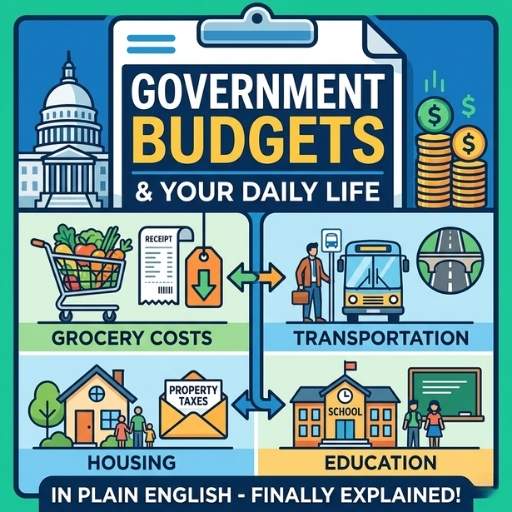
Description: Discover how government budgets impact your daily life — from grocery prices to school fees and fuel costs. A simple, honest breakdown everyone needs to read.
That Boring Budget Announcement You Skipped? It Just Decided Your Grocery Bill.
Let me tell you about a conversation that happened in my family during the 2023 Union Budget announcement.
My mother was in the kitchen making chai. My father was watching the Finance Minister's speech on television. My younger sister was on her phone, completely uninterested. I was somewhere in between — half watching, half scrolling.
The Finance Minister announced changes to import duties on certain electronic components. My father nodded. My mother continued making chai. My sister did not look up.
Six weeks later, my sister came home upset because the price of the laptop she had been saving for had dropped by four thousand rupees. She wanted to know why — if she had waited a bit longer before saving she could have bought it sooner.
My father pointed at the television.
She had been in the same room when the decision was made that affected her. She had not connected the two moments because nobody had explained to her that they were the same moment.
That gap — between budget announcements and their effects on real daily life — is what this guide is about.
Because the government budget is not background noise for people who care about policy. It is the most consequential financial document produced in your country every year. It decides what you pay for fuel, what your child's school gets funded, whether your hospital has medicine, whether your tax bill goes up or down, and whether the economy your job depends on grows or contracts.
Understanding it — not at an economist's level, just at a genuinely informed adult's level — changes how you navigate your own financial life and how you participate in the democratic decisions that shape it.
What a Government Budget Actually Is — The Simple Version
Here is the explanation that most civics classes skip over in their rush to get to complicated things.
A government is a very large household. It earns income — primarily through taxes — and it spends that income on things the country collectively needs. The budget is its annual plan for how much it expects to earn and exactly how it plans to spend it.
Where the government earns money: Income tax from individuals. Corporate tax from businesses. Goods and Services Tax — GST in India, sales tax in the USA — on transactions. Customs duties on imported goods. Excise duties on specific products. Fuel taxes. The government also borrows money when its spending exceeds its income — creating what is called a fiscal deficit.
Where the government spends money: Building and maintaining infrastructure — roads, bridges, railways, airports. Funding schools, universities, and educational programs. Running hospitals and public health systems. Paying salaries of government employees. Subsidizing fuel, food, and fertilizers for farmers and low-income households. Funding defense and national security. Servicing the debt it has previously borrowed. Welfare programs and direct benefit transfers.
Every rupee and every dollar that flows through this system eventually reaches you. Sometimes directly. Sometimes through the price of something you buy. Sometimes through the quality of a service you use. Sometimes through the job market your income depends on.
That is the connection. Now let us follow it through every part of your daily life.
Your Grocery Bill — The Most Direct Budget Connection
This is where budget decisions are most immediately and most universally felt — by every person regardless of income, occupation, or geography.
Indirect taxes on goods directly change prices.
GST rate changes announced in budget-related policy decisions move directly to retail prices. When the government reduces GST on packaged food items, grocery prices fall within weeks. When GST on processed foods increases, your monthly grocery bill goes up before you have even read the explanation.
Import duties determine what imported goods cost.
India imports significant quantities of edible oils — palm oil, sunflower oil, soybean oil. When global prices spike and the government reduces import duties to keep domestic prices manageable, you see the relief at the grocery store. When import duties are maintained or increased, you pay the global price directly.
Agricultural subsidies affect the price of fresh produce.
Fertilizer subsidies keep farming costs manageable for small farmers. When those subsidies are maintained generously, farming costs stay contained and food prices at the vegetable market stay reasonable. When subsidies are cut or reduced, farmers face higher input costs. They either absorb those costs — reducing their own already thin margins — or pass them on. You see the result in onion prices, tomato prices, and every vegetable that went through a farm to reach your kitchen.
The fuel cost multiplier.
This is the mechanism most people understand least but that affects grocery prices most broadly. Petrol and diesel prices are significantly composed of central excise duty and state VAT — both government decisions. When fuel costs rise, transportation costs rise. Every vegetable, every packaged good, every product that moves from farm or factory to your local market becomes more expensive to transport.
The person who noticed fuel prices went up by five rupees per litre rarely connects that directly to the fact that rice at their local shop went up by two rupees per kilogram a month later. But the connection is direct and consistent.
Your Tax Bill — The Most Personal Budget Decision
Every year, people across India and the USA wait for budget announcements with genuine financial stakes. Because the income tax changes announced in the budget determine how much of your own earned money you actually keep.
Income tax slab changes.
The basic exemption limit — the income level below which no tax is owed — is set by budget decisions. When it rises, more people pay no tax and taxpayers at every level keep more of their income. India's 2023 Union Budget raised the basic exemption limit under the new tax regime to three lakh rupees and made income up to seven lakh rupees effectively tax-free through rebates. Millions of middle-class taxpayers had more money in their pockets every month as a direct result of a single budget announcement.
When tax rates increase or new surcharges are added, the reverse happens. The same salary buys less because more of it goes to the government.
Deductions and exemptions.
Section 80C in India — which allows up to one and a half lakh rupees of tax deductions through investments in PPF, ELSS, life insurance, and other instruments — was created by a budget and can be modified or removed by one. Millions of Indians structure their entire annual financial planning around this single provision. When it changes, financial plans change with it.
The new versus old tax regime choice.
India's introduction of a new tax regime — lower rates but fewer deductions — alongside the old regime with higher rates but more deduction options has created a genuine annual decision for millions of taxpayers. Which regime benefits you depends on your specific financial situation. Budget modifications to either regime change that calculation every year.
Your Fuel and Electricity Bills — Monthly Budget Impact
These are the bills that arrive every month with reliable regularity — and both are significantly shaped by government budget decisions.
Petrol and diesel prices.
In India, approximately fifty to sixty percent of what you pay at the petrol pump consists of central excise duty and state VAT — both government-controlled taxes. When the central government cut excise duty on petrol by five rupees per litre and on diesel by ten rupees per litre in November 2021, the relief was immediate and nationwide. When duties are increased — as they were during the COVID period to maintain government revenue — prices rise with equal immediacy.
For a family with two vehicles filling up once a week, the difference between high and low fuel duties can easily be several thousand rupees per year. This is not trivial.
LPG cooking gas.
The price of the cooking gas cylinder that sits in most Indian kitchens is directly connected to government subsidy decisions. When the government subsidizes LPG strongly, the cylinder you buy from your local dealer is significantly cheaper than its market price — the government is covering the difference. When subsidies are reduced, the market price passes through to your bill.
The Pradhan Mantri Ujjwala Yojana — which provided free LPG connections to poor households — was funded by a budget decision. It genuinely transformed the lives of rural women who previously cooked on wood and dung, with significant consequences for their health and their time.
Electricity tariffs.
State government budgets determine electricity subsidies. Agricultural electricity is heavily subsidized in most Indian states — farmers often pay a small fraction of actual cost. Domestic consumers in lower income brackets frequently receive subsidized rates. These subsidies come from state budget allocations. When those allocations are cut, utilities increase tariffs to cover the shortfall — and your electricity bill rises.
Your Child's Education — How Budget Allocations Shape Opportunity
If you are a parent, this section carries particular weight. Because the quality of your child's education — the infrastructure of their school, the availability of their teachers, the affordability of their college — is directly determined by how much the government chooses to allocate to education in its annual budget.
Government school quality.
Public school infrastructure — buildings, furniture, libraries, laboratories, sports facilities, toilets — depends entirely on budget allocation. When education spending is generous and well-directed, government schools improve. When allocation is inadequate relative to enrollment growth and inflation, quality stagnates or declines.
For the majority of Indian families who send their children to government schools because private schools are unaffordable, this is not an abstract policy concern. It is the condition of the classroom their child sits in every day.
Teacher recruitment and retention.
Teacher salaries and the funding for vacant positions are budget items. When education budgets are constrained, teacher vacancies go unfilled. Classrooms become overcrowded. The teacher-to-student ratio that determines how much individual attention each child receives gets worse.
Scholarship programs.
Schemes like the Post-Matric Scholarship for SC/ST students, the National Means-cum-Merit Scholarship, and numerous state-level scholarship programs exist because budget allocations fund them. When those allocations are adequate, deserving students from low-income families get educational opportunities their families cannot independently fund. When allocations are cut or releases are delayed — as scholarship disbursement delays have been a documented problem in India — those students face genuine hardship.
Higher education fees.
Government universities and colleges are subsidized — keeping fees far below the actual cost of education because the government covers the difference through budget allocation. When that allocation shrinks, universities raise fees to compensate. The ripple effect reaches families who were relying on affordable government higher education as the path to their children's professional futures.
Your Healthcare — Budgets and Bodies
Here is where budget decisions move from financial to genuinely physical — affecting the health outcomes of real people in ways that can be the difference between manageable illness and catastrophic suffering.
Public hospital funding.
Government hospitals in India serve the majority of the population that cannot afford private healthcare. Their equipment, their medicine supplies, their staffing levels, and their physical conditions are determined by budget allocation. A well-funded government hospital has functioning diagnostic equipment, adequate medicine stocks, sufficient doctors and nurses, and hygienic conditions. An underfunded one sends patients home because it ran out of basic supplies or cannot schedule surgeries because equipment is broken.
Medicine prices.
Budget decisions on import duties for pharmaceutical raw materials and on pricing regulations directly affect what medicines cost at retail. When import duties on active pharmaceutical ingredients are reduced, medicine production costs fall and retail prices may follow. When the government expands the list of price-controlled medicines under the Drug Price Control Order, patients pay less for essential medications.
For a diabetic patient buying insulin every month, or a cardiac patient on multiple daily medications, price movements of even twenty percent are significant portions of household budgets.
Ayushman Bharat and insurance schemes.
The Pradhan Mantri Jan Arogya Yojana — which provides health coverage of up to five lakh rupees to economically vulnerable families — exists entirely because the government chose to allocate budget money to fund it. Without that allocation, millions of families facing serious illness would have no financial protection and no realistic access to the hospital treatments they need.
Your Job and Salary — The Budget's Indirect Employment Effect
This connection is the least visible and perhaps the most significant.
Infrastructure spending creates employment chains.
When the government allocates significant capital expenditure to infrastructure — roads, railways, airports, urban development, housing — construction companies hire workers, equipment manufacturers receive orders, material suppliers expand operations, and local economies around construction sites become more active. The 2023-24 Union Budget's capital expenditure allocation of ten lakh crore rupees represented a significant injection into this employment chain.
Corporate tax rates affect hiring decisions.
When corporate taxes are reduced — as happened in India in 2019 when the government cut the corporate tax rate significantly — companies retain more earnings. Some invest those retained earnings in expansion — which means hiring. Some distribute them as dividends. Some retain them as buffers. The relationship between corporate tax cuts and employment is not perfectly direct but the capacity for business investment is genuinely affected by what the government takes in tax.
The fiscal deficit and interest rates.
When the government borrows heavily to fund a large fiscal deficit, it competes with private borrowers for available capital. This tends to push up interest rates — making home loans more expensive, making business loans more expensive, making every form of credit costlier. Your EMI on a home loan is not unrelated to how much the government has been borrowing.
Direct Benefit Transfers — Budget Money in Your Bank Account
This one is the most visible and most direct connection for many Indian households — the money that the government puts directly into beneficiaries' accounts through various schemes.
PM-KISAN provides direct income support of six thousand rupees annually to small and marginal farmers — in three installments of two thousand rupees each — funded directly by the Union Budget. When the budget allocates adequately and the administrative systems function properly, farmers receive this money in their accounts on schedule. When budget allocation is squeezed, transfers may be delayed or reduced.
MGNREGA — the rural employment guarantee scheme — provides employment at minimum wages to rural households who demand work. The scheme's scale and effectiveness is directly determined by budget allocation. Higher allocation means more work-days available, better enforcement of the guarantee, and more income support for rural households during agricultural off-seasons.
LPG subsidy transfers, PM Awas Yojana housing support, scholarship disbursements — all of these represent budget money flowing directly to household accounts, supporting real families' real financial situations in ways that are immediately visible in their bank passbooks.
The Fiscal Deficit — Why Government Borrowing Affects Your Financial Future
Here is the concept that most budget coverage mentions but rarely explains clearly enough to be useful.
When the government spends more than it collects in taxes, it borrows the difference. That gap is the fiscal deficit, measured as a percentage of GDP.
Why you should care about the number:
The government does not borrow from thin air. It borrows from financial markets — issuing bonds that banks, insurance companies, and foreign investors buy. When government borrowing is heavy, it absorbs significant portions of available savings in the financial system. This reduces the capital available for private sector borrowing and tends to push up interest rates.
Higher interest rates on your home loan. More expensive business credit that constrains hiring and expansion. Higher cost of carrying any debt — personal, business, or government.
A persistent fiscal deficit also creates future tax burden. The government has to repay what it borrows — with interest. And the money to do that comes from future tax revenues — meaning future taxpayers, including you, pay for today's deficit spending.
When deficit spending is justified:
Not all deficit spending is harmful. Government borrowing that funds genuinely productive investment — infrastructure that increases economic productivity, education that expands human capital, health programs that reduce illness-driven productivity losses — can generate economic returns that exceed the borrowing cost. The quality of what the deficit funds matters as much as the deficit size.
Final Thoughts — The Budget Is Personal, Whether You Treat It That Way or Not
My sister learned something the day my father pointed at the television. Not an economics lesson — something more valuable. She learned that decisions made in rooms that seem remote from daily life are not remote at all. They are present in every purchase she makes, every bill she receives, every opportunity she can or cannot access.
The government budget is the most consequential financial document that affects your life that most people never read, never understand, and rarely connect to their daily experience.
You do not need to read the full budget document. You do not need to understand every tax provision or spending line. What you need is the foundational understanding that these decisions are happening, that they affect you in specific and traceable ways, and that understanding those ways makes you a more capable navigator of your own financial life.
When fuel prices change — look at what changed in excise duty. When your tax refund is larger — understand which provision created that. When your child's government school gets new facilities — recognize the budget allocation that funded it. When interest rates rise — understand the fiscal deficit that contributed.
The connections are real. They are traceable. And following them — from the Finance Minister's speech to the price of chai at your local stall — is one of the most genuinely useful things any citizen can learn to do.
Because that boring budget announcement? It was never boring.
It was always personal.
Frequently Asked Questions (FAQs)
Q1. How does the Union Budget affect ordinary people directly? The Union Budget affects ordinary people through changes in income tax slabs and exemptions, GST rate modifications on goods and services they buy, fuel excise duty changes that ripple through transportation and grocery costs, education and healthcare allocation that determines quality of public services, subsidy decisions on cooking gas and food, and direct benefit transfers that put money into eligible households' bank accounts. Almost every aspect of daily financial life has some connection to budget decisions made annually.
Q2. Why do vegetable prices change after budget announcements? The connection is usually indirect but real. Budget changes to fuel duties affect transportation costs — and since vegetables travel from farms to markets through diesel-powered trucks, fuel cost increases translate to higher delivery costs that vendors pass to consumers. Changes to import duties on competing food products affect domestic supply and pricing. Changes to agricultural input subsidies affect farmers' costs which eventually reach retail prices. The chain from budget decision to vegetable price is several steps long but consistent.
Q3. What is the fiscal deficit and why does it matter to individuals? The fiscal deficit is the gap between what the government spends and what it collects in revenue — covered by borrowing. It matters to individuals because heavy government borrowing tends to push up interest rates in the broader economy, making home loans, car loans, and business credit more expensive. A persistent deficit also creates future tax burden — someone has to repay government debt with interest, and that someone is ultimately taxpayers. Deficit spending on productive investments can generate returns that justify the borrowing; deficit spending on current consumption creates pure future burden.
Q4. How does the budget affect school fees at government colleges? Government colleges and universities are subsidized — the government covers the gap between actual education costs and the fees students pay. When budget allocation to higher education is generous, fees stay low and accessible. When allocation shrinks, universities face pressure to increase fees or cut services to cover costs. The affordability of government higher education — which serves the majority of Indian students who cannot afford private institutions — is directly dependent on adequate budget allocation to the education sector.
Q5. Do budget decisions affect job availability? Yes, through multiple channels. Capital expenditure on infrastructure creates direct employment in construction and related industries while building assets that increase broader economic productivity. Corporate tax policy affects business profitability and investment capacity. Interest rate environments shaped by fiscal deficit levels affect business borrowing costs and therefore investment and hiring decisions. Government welfare and employment schemes like MGNREGA directly create employment for rural households. The employment effects of budget decisions are real but take time to materialize — which makes the connection less immediately visible than direct price effects.
Comments
No comment yet. Be the first to comment