Why People Stay Broke Despite Earning Well — The Real Reasons Your Salary Is Never Enough
By: compiled from various sources | Published on May 07,2026
Category Beginner
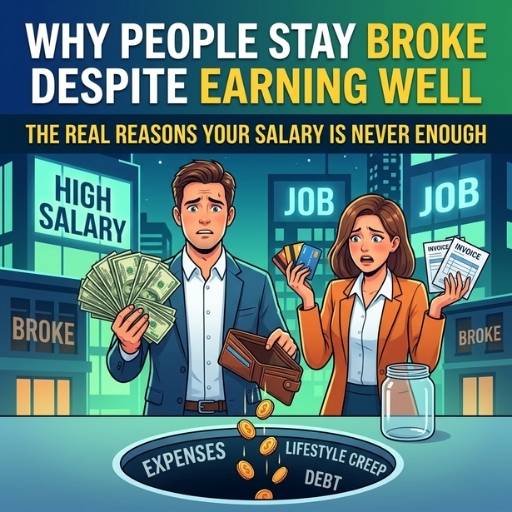
Description: Discover why people stay broke despite earning well. An honest, eye-opening guide to the real psychological and behavioral reasons income rarely solves financial problems.
The Most Dangerous Financial Lie Is the One You Tell Yourself Every Month.
Let me describe someone you might recognize.
He earns well. By any objective measure — relative to his city, his peer group, his parents' generation — his income is genuinely good. He has a respectable job title, a salary that places him comfortably in the upper-middle-income bracket, and a lifestyle that looks, from the outside, like the definition of having made it.
He is also, quietly and consistently, broke. Not destitute. Not unable to pay bills. But perpetually at zero — every month ending with roughly the same account balance as the month before, no meaningful savings accumulating, no investment portfolio growing, no financial cushion forming. Just income arriving and income disappearing in an endless cycle that leaves him exactly where he started twelve months ago, year after year.
And every year he tells himself the same thing. Next year I will earn more. When I earn more, I will save more. The problem is the income. When the income is higher, the savings will follow.
Next year comes. The income is higher. The savings are the same.
If you recognized yourself in that description — even partially, even uncomfortably — this guide is for you. Not because you need to be told to budget. Not because you do not know what a SIP is. But because the reason you are financially stuck despite earning well is almost certainly not what you think it is. And until you understand the real reason, no budgeting system, no salary increase, and no financial planning tool will fix it.
The Core Illusion — Why More Money Does Not Automatically Mean More Wealth
Here is the fundamental truth that the personal finance industry consistently soft-pedals because it is uncomfortable and because acknowledging it would reduce the market for its products.
Income and wealth are not the same thing.
Income is money that arrives. Wealth is money that stays. And the gap between those two things — enormous for some people, negligible for others at identical income levels — is almost entirely determined by behavior, psychology, and habits rather than by the income number itself.
Research by Thomas Stanley and William Danko — published in The Millionaire Next Door — found consistently that the highest income earners were frequently not the wealthiest people in their communities. The wealthiest people were often those with moderate incomes and systematic saving habits sustained over decades. Meanwhile, people with genuinely high incomes — doctors, lawyers, senior executives — were frequently living paycheck to paycheck because their spending had expanded to absorb every income increase.
Stanley and Danko called this being "big hat, no cattle" — the appearance of wealth without its substance. The expensive car. The large house. The private school fees. The business-class flights. The restaurant tabs that look like salary slips. All of it purchased on current income, none of it building the asset base that produces genuine financial security.
This is not a moral failing. It is a predictable consequence of specific psychological and social mechanisms operating on human beings in modern consumer societies. Understanding those mechanisms is the beginning of escaping them.
Reason 1 — Lifestyle Inflation: The Invisible Tax on Every Raise
Lifestyle inflation is the most pervasive and least discussed reason that income increases fail to produce wealth increases. It operates quietly, automatically, and feels entirely reasonable at every individual step.
Here is how it works.
You earn forty thousand rupees per month. You live within forty thousand rupees per month. You receive a promotion and your salary increases to sixty thousand rupees per month. Suddenly twenty thousand rupees of additional monthly income is available. Do you save it?
In theory, yes. In practice, almost never — at least not fully.
The new salary creates new social expectations. A person earning sixty thousand rupees drives a different car than a person earning forty thousand rupees. Lives in a different neighborhood. Eats at different restaurants. Takes different vacations. Wears different clothes. Not because these things are necessary improvements to their actual quality of life. Because the social context they now inhabit — the colleagues at the new income level, the neighborhood they now live in, the identity they now associate with — comes with implicit expectations about consumption.
Each individual lifestyle upgrade seems reasonable. A better apartment because you can now afford it. A nicer car because the old one needs replacing anyway. A more expensive holiday because you worked hard this year. Each decision makes sense on its own terms. But the cumulative effect of all of them is that the twenty-thousand-rupee raise produces approximately zero additional saving — because all twenty thousand rupees of new income has been absorbed by new spending.
This cycle repeats with every salary increase. The person earns more and more over a career while building less and less financial security because every incremental income gain is immediately absorbed by an incrementally expanded lifestyle.
The solution is not to refuse all lifestyle improvements. It is to create a deliberate rule about income increases — committing in advance to directing a specific percentage of every raise to savings before allowing the remainder to expand lifestyle. Fifty percent of every raise to savings is a common and effective rule. It allows lifestyle to improve while ensuring that income growth actually builds wealth.
Reason 2 — Social Comparison: Living Someone Else's Financial Life
Here is the specific mechanism that makes lifestyle inflation so automatic and so difficult to resist.
Human beings do not evaluate their financial situations in absolute terms. We evaluate them in comparative terms — relative to the people around us, the people we aspire to be like, and increasingly the curated presentations of financial success we encounter on social media.
This comparison instinct is not vanity. It is evolutionary — social standing in human groups has historically had genuine survival implications, and the monitoring of relative status is deeply wired into human psychology. But in a modern consumer society, this ancient social monitoring mechanism gets weaponized by marketing, by status signaling through consumption, and by the specific distortion of social media.
Your reference group — the set of people against whose lifestyle you implicitly measure your own — determines your spending far more than your income does. A person earning eighty thousand rupees per month who works with people earning two hundred thousand rupees per month will consistently overspend relative to their income in the unconscious effort to not feel left behind by their reference group. A person earning the same eighty thousand rupees who lives in a neighborhood of people earning thirty thousand rupees will consistently feel financially comfortable and will save significantly more.
Social media has made this comparison problem dramatically more severe by expanding the effective reference group from the people you actually know to a global network of highlight reels. The Instagram feeds, the LinkedIn posts about promotions and business class upgrades, the vacation photos from places you have not been yet — all of it creates a relentless stream of upward social comparison that distorts the sense of what normal financial life looks like.
The practical response involves two things simultaneously. First, consciously auditing your reference group — identifying whose financial choices you are unconsciously benchmarking against and evaluating whether that comparison is serving your actual interests. Second, reducing consumption of social media content specifically designed to trigger consumption through comparison — which means most aspirational lifestyle content.
Reason 3 — The EMI Trap: Affordability Confused With Wisdom
Here is one that is especially significant in the current Indian economic context.
The expansion of consumer credit — personal loans, car loans, home appliance financing, buy-now-pay-later schemes, credit card EMI options — has fundamentally changed the relationship between earning and spending for a generation of Indian consumers. Things that once required saving before purchase can now be purchased immediately and paid for over time.
This is genuinely useful for some purchases in some circumstances. A home loan that enables you to live in a property while paying for it over twenty years makes rational financial sense — because the property provides real value throughout the payment period and potentially appreciates.
But the logic of "I can afford the EMI" has been dangerously extended to purchases that have no rational financial justification on EMI terms. The television that costs thirty thousand rupees and is available on zero-cost EMI for twelve months. The phone upgrade that is three months ahead of any genuine need because the new model is available on a no-cost EMI scheme. The holiday funded by a personal loan because the experience is important and the monthly payment seems manageable.
Each individual EMI is manageable. The cumulative EMI burden — when a person has simultaneously committed to twelve different monthly payments for depreciating consumer goods — consumes a large portion of take-home income in advance, leaving genuinely little flexibility for either genuine savings or genuine emergencies.
The insidious aspect of the EMI trap is that it disguises the real cost of purchases. A phone that costs forty-five thousand rupees does not feel like a forty-five-thousand-rupee decision when it is framed as a three-thousand-seven-hundred-fifty-rupee monthly payment. The psychological weight of forty-five thousand rupees would trigger meaningful consideration. The psychological weight of three thousand seven hundred fifty rupees does not — even though the total cost is identical and the financial consequence is the same.
Reason 4 — Invisible Spending: The Budget Leaks That Drain Accounts
Most people have a reasonably accurate sense of their large spending categories. They know approximately what they spend on rent, on groceries, on the car loan. What they consistently and dramatically underestimate is the aggregate of small, regular, semi-invisible spending that accumulates to significant monthly amounts.
Subscriptions are the clearest contemporary example. Streaming platforms — Netflix, Amazon Prime, Disney Plus, Spotify, YouTube Premium. Cloud storage. Software subscriptions. News platforms. Fitness apps. Health and wellness subscriptions. Productivity tools. Food delivery memberships. Every individual subscription costs between a hundred and a thousand rupees per month. Together they often total three thousand to eight thousand rupees per month — money leaving the account every month for services that are often barely used.
The specific psychological mechanism that makes subscriptions so financially dangerous is that they are set up once and then effectively become invisible. The money leaves automatically. There is no moment of decision at the moment of payment. The inertia of the automatic payment sustains subscriptions well beyond the point where a conscious decision would have cancelled them.
Food delivery is another category where the gap between perceived and actual spending is consistently dramatic. The two-hundred-rupee delivery fee on a four-hundred-rupee meal does not feel significant in the moment. But ordering delivery three times per week represents a spending pattern of over five thousand rupees per month on delivery fees alone — money that funds neither the food nor any form of enjoyment, but simply the convenience of not cooking.
A monthly bank statement review — with genuine attention to categories rather than just totals — typically reveals three to five significant spending categories that the account holder would not have identified if asked to estimate their spending. This revelation is uncomfortable and genuinely useful.
Reason 5 — The Absent Financial Architecture: No System, No Result
Here is the structural reason that complements all the psychological ones.
People who stay broke despite earning well almost universally share one characteristic — they manage their finances reactively rather than architecturally. Money arrives. They pay what needs to be paid. They spend on what they want to spend on. They save whatever is left over, if anything. They repeat the cycle indefinitely.
The fundamental problem with this approach is that in any month where spending reaches the income level — which happens frequently for the reasons described throughout this guide — the leftover that was supposed to become savings is zero. And in months where an unexpected expense occurs, the savings is negative — the account is drawn down or debt is taken on.
Reactive financial management produces zero accumulation because it relies on willpower and surplus rather than architecture. And willpower is reliably defeated by the combined pressure of lifestyle inflation, social comparison, EMI commitments, and invisible spending.
Architectural financial management works differently. Before any discretionary spending occurs, specific amounts are automatically transferred to savings and investment accounts. These transfers are not optional and they are not "what I feel like saving this month." They are predetermined commitments — architectural features of the financial system — that operate regardless of whether the month feels comfortable or tight.
The person who automatically transfers twenty thousand rupees to savings on the day their salary arrives and then manages their life within the remaining amount will consistently accumulate wealth. The person who intends to save twenty thousand rupees but manages their whole salary first and saves what remains will consistently save nothing — because the behavioral mechanisms described throughout this guide reliably consume the remainder.
This is not discipline. It is design. The difference between the person who saves and the person who does not is frequently not greater willpower or greater commitment. It is the presence or absence of automatic systems that remove discretionary decision-making from the saving process.
Reason 6 — Financial Avoidance: The Ostrich Problem
This one is the most psychologically understandable and the most financially damaging.
Financial avoidance — the pattern of not looking at bank statements, not tracking spending, not calculating actual net worth, not confronting the actual numbers of one's financial situation — is driven by financial shame and financial anxiety. Looking at the numbers is uncomfortable when the numbers do not match the life narrative. Not looking avoids the discomfort.
But not looking does not change the numbers. It just removes the awareness that would make addressing them possible.
The person who avoids their financial reality cannot manage it. They cannot identify which spending categories are consuming disproportionate income. They cannot make informed decisions about trade-offs. They cannot track whether they are making progress toward financial goals. They are navigating without instruments in fog — which guarantees that the direction of travel is determined by habit and impulse rather than intention.
Financial avoidance is self-reinforcing in a specific way. The longer it is maintained, the larger the gap between perceived and actual financial situation tends to grow — because unmonitored spending continues and often escalates while the avoider maintains a vague optimism about an underlying financial situation they are not examining. When the avoider eventually is forced to confront reality — by a genuine financial crisis, a loan rejection, a tax notice — the gap between perceived and actual is often more severe than any of the individual choices that created it would have seemed to justify.
The response to financial avoidance is not shame and punishment. It is compassionate, honest confrontation — looking at the numbers without self-judgment, identifying the specific patterns driving the gap between income and wealth, and making specific, achievable changes without requiring comprehensive transformation from day one.
Reason 7 — The Future Bias Against Your Future Self
Here is the final reason and the one that is most purely psychological.
Human beings are systematically biased against the interests of their future selves. The psychological distance of future experience — the difficulty of genuinely feeling the consequences of today's decisions as they will eventually be felt — makes present spending feel real and future savings feel abstract.
Spending one thousand rupees today on something that brings immediate pleasure is psychologically vivid. The one thousand rupees not in the retirement account thirty years from now — the compounded cost of that single decision — is so psychologically abstract that it exerts essentially no behavioral force in the moment.
This present bias — the systematic overweighting of immediate experience relative to future consequence — is the psychological engine behind virtually every reason described throughout this guide. Lifestyle inflation happens because present enjoyment feels more real than future security. Social comparison drives spending because present social status feels more immediately important than future financial independence. EMI purchases feel rational because the present benefit of having the thing is psychologically more vivid than the future burden of paying for it.
Understanding present bias suggests a specific and counterintuitive response. Rather than trying to feel the future more vividly — which is difficult and unreliable — design financial systems that produce the right outcomes without requiring you to feel them. Automatic savings. Pre-committed investment. Structures that make future-oriented decisions at moments when present bias is weaker and lock in those decisions so that present bias cannot reverse them in the heat of the moment.
What Actually Changes Things — The Practical Response
Here is the honest summary of what actually produces different outcomes for people who earn well but stay broke.
One — automate before you can spend. Transfer to savings on the day income arrives. Not from what is left. From the first allocation.
Two — audit your subscriptions quarterly. Cancel everything you have not actively used in sixty days. The friction of re-subscribing if you genuinely need it is worth the savings from eliminating what you no longer value.
Three — institute a deliberate pause on non-essential EMI purchases. Before committing to any EMI for a non-essential item, calculate the full cost. Wait seventy-two hours. Most impulse EMI purchases do not survive seventy-two hours of honest consideration.
Four — choose your reference group consciously. Spend time with people whose financial values align with building wealth rather than displaying income. The social environment you inhabit shapes your spending more than any budget.
Five — look at the numbers honestly, monthly. Not to punish yourself. To know. Knowing is the prerequisite for managing.
Six — direct a fixed percentage of every salary increase to savings before it reaches your spending account. Never let a raise become fully absorbed by lifestyle before saving has claimed its share.
Final Thoughts — The Problem Was Never the Income
The person I described at the beginning of this guide — earning well, perpetually broke, waiting for the income that will finally make the difference — will wait forever if the waiting is for the income.
Because the income was never the problem. The income was the raw material. The problem was everything that determined what happened to it after it arrived — the social pressures, the psychological biases, the absent architecture, the invisible spending, the future-self who was systematically deprioritized in favor of the present-self who wanted things now.
None of those problems are solved by earning more. They travel with you through every income level, consuming each new amount as effectively as they consumed the last.
What solves them is understanding them clearly enough to design around them. Not with discipline — discipline runs out. With architecture. With automation. With honest accounting. With the specific, unglamorous, genuinely effective work of building a financial system that produces wealth despite the entirely predictable ways that human psychology works against it.
That work is available to you at exactly the income level you are at right now.
Not when you earn more. Now.
Frequently Asked Questions (FAQs)
Q1. Why do high earners often have less savings than moderate earners? High earners tend to experience stronger lifestyle inflation — the expansion of spending to match and often exceed income growth — because higher income brings higher-status social environments with higher implicit consumption expectations. They also tend to take on more debt for status consumption because their income makes larger payments manageable in isolation. Moderate earners with systematic saving habits tend to live in social environments with lower consumption expectations and are less exposed to the reference group pressure that drives high-income lifestyle inflation.
Q2. What is lifestyle inflation and how do I stop it? Lifestyle inflation is the automatic expansion of spending as income increases — upgrading housing, transportation, dining, and consumption generally whenever more money becomes available. The most effective way to prevent it is pre-committing to saving a specific percentage of every income increase before allowing the remainder to reach your spending account. This is not about refusing all lifestyle improvements — it is about ensuring that income growth builds wealth rather than being entirely absorbed by expanded consumption.
Q3. How do I know if I am in the EMI trap? Add up all your current monthly EMI obligations — home loan, car loan, personal loans, credit card EMIs, buy-now-pay-later commitments. If the total exceeds thirty-five to forty percent of your monthly take-home income, you are in significant EMI pressure that is constraining your financial flexibility. If you have ongoing EMIs for consumer goods that have already depreciated significantly or that you would not purchase at full price today, you are in the classic EMI trap — paying for past consumption with present income.
Q4. What is the most important financial habit for breaking the broke-despite-earning cycle? Automatic savings before spending is the single most impactful financial habit. The specific mechanism — transferring a predetermined amount to a savings or investment account automatically on the day income arrives — removes the saving decision from the domain of willpower and places it in the domain of architecture. Every other financial improvement is built more easily on top of this foundation than without it.
Q5. How does social media affect financial behavior? Social media creates relentless upward social comparison by exposing users to carefully curated presentations of others' financial lives that systematically overrepresent consumption, travel, and status spending while underrepresenting saving, investment, and financial discipline. This distorts the sense of normal financial behavior in ways that drive spending to maintain social comparability with reference groups that exist primarily as presentation rather than reality. Reducing social media consumption of aspirational lifestyle content and actively curating feeds toward content that reflects financial values aligned with building wealth rather than displaying income produces measurable behavioral improvements.
Comments
ashakhandale
May 31,2026
9763369327
ashakhandale
May 31,2026
9762902098
ashakhandale
May 31,2026
9763369327