How to Build a Multi-Asset Portfolio (Equity, Gold, Debt) — The Honest Guide to Investing Across All Asset Classes
By: compiled from various sources | Published on May 19,2026
Category Professional
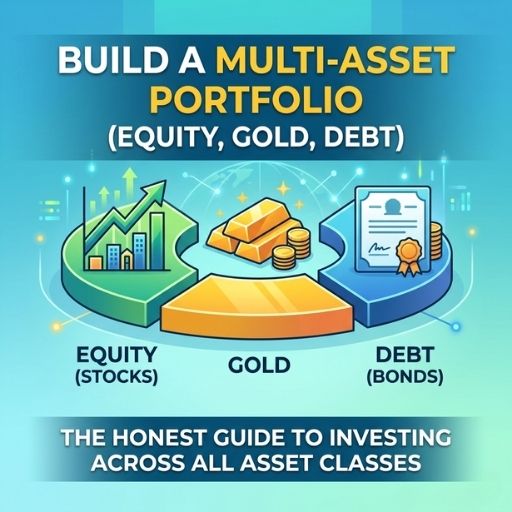
Description: Learn how to build a multi-asset portfolio with equity, gold, and debt in 2026. A real, practical guide to diversified investing for every Indian investor.
Putting Everything in One Place Is Not Investing. It Is Hoping.
Let me tell you about two investors whose stories I have been watching unfold over the past few years.
The first investor — let us call him Rahul — put essentially all of his investable savings into equity mutual funds in early 2020. He had read enough to know that equity delivers the best long-term returns. He was young. He was willing to take risk. He went all in.
March 2020 arrived. Indian markets crashed nearly forty percent in a matter of weeks as COVID-19 panic spread globally. Rahul's portfolio lost thirty-eight percent of its value in less than six weeks. He panicked. He redeemed everything near the bottom. He missed the extraordinary recovery that followed. He did not return to investing for eighteen months — convinced that the market was rigged or unpredictable or both.
The second investor — let us call her Priya — had built a multi-asset portfolio. Sixty percent in equity mutual funds. Twenty percent in gold — partly physical, partly Sovereign Gold Bonds. Twenty percent in debt — a mix of PPF and short-duration debt funds.
March 2020 arrived. Priya's equity dropped similarly to Rahul's — roughly thirty-eight percent of that sixty percent allocation. But her gold surged — gold rose significantly during the COVID crisis as investors fled to safety. Her debt held steady. Her total portfolio declined approximately fifteen to seventeen percent. Painful but manageable. She did not panic. She actually rebalanced — selling some of the gold that had risen and buying more equity at depressed prices. By the end of 2020, her portfolio had not just recovered but exceeded its pre-COVID value.
Same market. Same crash. Completely different outcomes — not because of different stock picks or different timing but because of different portfolio architecture.
That is what multi-asset investing does. And this guide shows you exactly how to build it.
What Multi-Asset Investing Actually Is
Let us start with a definition that is more useful than the textbook version.
A multi-asset portfolio is a collection of investments across different asset classes — equity, gold, debt, and sometimes real estate or other alternatives — that are combined specifically because they behave differently from each other under different economic conditions.
The operative word is differently.
If all your investments rise and fall at exactly the same time in exactly the same proportion, owning multiple investments provides no actual diversification — just the illusion of it. Real diversification comes from owning assets whose behavior is genuinely distinct — not just different names but different underlying economic drivers.
Equity — ownership of businesses — does well when the economy is growing, corporate profits are rising, and investor confidence is strong. It does poorly when recession hits, profits fall, or confidence collapses.
Gold — a physical store of value — does well when inflation rises, when currency values are uncertain, when geopolitical stress is elevated, and when investors are frightened. It does poorly when real interest rates are high and when economic optimism is strong.
Debt — lending money to governments and corporations for fixed returns — provides stability and income regardless of equity market conditions, protects capital during market crashes, and becomes more valuable when interest rates fall.
These three behave differently because they are driven by different economic forces. Combining them means that almost regardless of what economic environment you are in, some portion of your portfolio is doing well — reducing the total portfolio's volatility without proportionally reducing its long-term return potential.
The Three Asset Classes — Understanding What You Are Actually Buying
Before allocation percentages and rebalancing strategies, you need to genuinely understand what each asset class is and what it actually does.
Equity — Owning Businesses and Their Future Profits
When you buy an equity mutual fund or a stock, you are buying ownership in real businesses. Their future profits, their future growth, their future dividends — all of that belongs to you in proportion to your ownership. When those businesses grow and prosper, your investment grows. When they struggle, your investment suffers.
This connection to real economic activity is what gives equity its long-term return advantage. Over sufficiently long periods — fifteen years or more — Indian equity markets have historically delivered twelve to fifteen percent annual returns. That compounding turns modest monthly investments into substantial wealth over a working lifetime.
The cost of these returns is volatility — the willingness to watch your investment value drop thirty to fifty percent during market downturns without selling. This is genuinely psychologically difficult. Most people who fail at equity investing do not fail because they chose bad funds. They fail because they could not tolerate the volatility when it arrived.
Gold — The Fear Asset That Protects When Markets Panic
Gold has been a store of value for thousands of years — not because of its industrial utility but because of universal human recognition of its value. In modern portfolio terms, gold's primary role is protection during the specific circumstances that hurt equity most severely.
During currency crises, geopolitical shocks, high inflation periods, and genuine financial system stress — gold tends to rise precisely because investors seek assets that hold value outside the financial system. The 2008 financial crisis, the COVID crash, the 2022 Russia-Ukraine war — in each case gold provided meaningful positive returns at the moment equity was collapsing.
Gold does not generate income. It does not pay dividends. It does not grow through retained earnings. Over very long periods it provides returns roughly equivalent to inflation — preserving purchasing power but not building real wealth in the way equity does. Its portfolio value is entirely in its behavior during specific crisis conditions and its low correlation with equity.
Debt — The Stability Layer That Lets You Sleep
Debt instruments — government bonds, corporate bonds, fixed deposits, PPF, debt mutual funds — are loans you make to borrowers in exchange for fixed interest payments. The principal is returned at maturity. The interest is paid periodically.
Debt's primary portfolio role is capital preservation and stability. When equity is crashing, high-quality debt holds its value — providing psychological comfort and, more importantly, providing the capital you can deploy into equity at depressed prices.
Debt also provides liquidity in ways that equity cannot reliably provide — you can access the money when needed without selling equity at a potentially poor time.
The cost of debt's stability is its return — typically seven to eight percent in Indian instruments, compared to equity's twelve to fifteen percent over long periods. Too much debt in a long-term portfolio significantly reduces the wealth-building potential. Too little provides insufficient stability during market crises.
Building Your Allocation — The Core Decision
Here is the decision that matters more than which specific fund you choose within each category.
How much equity, how much gold, how much debt?
This allocation decision — sometimes called the strategic asset allocation — determines approximately ninety percent of your portfolio's behavior over time. Individual fund selection within each category accounts for the remaining ten percent.
The primary inputs to your allocation decision are time horizon and genuine risk tolerance.
Time Horizon — How Long Before You Need the Money
This is the single most important input. Money you will not need for twenty or more years can tolerate — and should embrace — far more equity than money you will need in five years.
| Time Horizon | Suggested Equity Range | Gold Range | Debt Range |
|---|---|---|---|
| Less than 3 years | 0 – 20% | 5 – 10% | 70 – 95% |
| 3 to 5 years | 20 – 40% | 10 – 15% | 45 – 70% |
| 5 to 10 years | 40 – 65% | 10 – 15% | 20 – 50% |
| 10 to 20 years | 60 – 75% | 10 – 15% | 10 – 30% |
| 20 years or more | 70 – 80% | 5 – 10% | 10 – 25% |
These ranges are starting points, not prescriptions. Your specific situation — income stability, existing assets, family obligations, and genuinely honest assessment of how you respond to losses — all modify these ranges.
Genuine Risk Tolerance — Not the Survey Answer but the Real Answer
Risk tolerance surveys ask how you would respond to a thirty percent portfolio decline. Most people answer optimistically — they imagine themselves calmly holding through the decline and continuing to invest.
Reality is often different. When a portfolio that represents years of savings declines thirty percent in six weeks — as happened in March 2020 — the psychological experience is genuinely distressing in ways that are difficult to fully anticipate in advance.
The honest test of your real risk tolerance is not how you answer a survey question. It is how you behaved during the last significant market decline you experienced. If you panic-sold in 2020, your real risk tolerance is lower than you thought. If you continued investing and perhaps increased your contributions, your real risk tolerance is higher.
Calibrate your equity allocation to your real risk tolerance — the behavior you have actually demonstrated rather than the behavior you believe you are capable of.
The Specific Instruments — What to Actually Buy
Knowing that you want sixty percent equity, fifteen percent gold, and twenty-five percent debt is one thing. Knowing specifically what to buy within each category is another.
Equity — The Implementation
For most Indian investors building a multi-asset portfolio, equity allocation is best implemented through mutual funds rather than direct stock selection. Direct stock selection requires research capability, time, and emotional discipline that most people underestimate the difficulty of.
Within equity mutual funds, the simplest and most evidence-supported approach is index funds — funds that track the Nifty 50, the Nifty 500, or other broad market indices at very low cost. The expense ratios on index funds from major Indian AMCs are now below 0.2 percent annually — dramatically lower than actively managed funds which typically charge 1 to 1.5 percent.
A simple equity implementation for a long-term investor:
Seventy percent of the equity allocation in a Nifty 500 index fund — providing broad Indian market exposure. Twenty percent in a midcap index fund — for higher growth potential. Ten percent in an international fund — providing currency and geographic diversification outside Indian markets.
This simple three-fund equity implementation covers the full Indian market with international diversification at minimal cost.
For investors who prefer active management — and there are legitimate reasons to prefer it in certain market segments — choosing consistently performing funds in categories where active managers have demonstrated persistent alpha, such as midcap and smallcap segments, is more defensible than active management in large-cap where beating the index after costs is difficult.
Gold — Three Ways to Own It
Gold can be owned in India through three primary instruments, each with different characteristics.
Physical gold — coins, bars, jewelry — provides tangible ownership but comes with making charges on jewelry, storage costs, purity risks, and the illiquidity of selling physical metal. For portfolio purposes, physical gold is the least efficient form.
Sovereign Gold Bonds (SGBs) — government-issued bonds denominated in grams of gold — are the most attractive gold investment instrument for Indian investors. They provide the price return of gold plus an additional 2.5 percent annual interest, are completely tax-free on maturity if held for the eight-year tenor, and carry zero storage or safety risk as they are government-backed. The primary limitation is the eight-year holding period — they can be traded on exchanges but liquidity is limited.
Gold ETFs and Gold Mutual Funds — exchange-traded or mutual fund vehicles that track gold prices — provide immediate liquidity without physical storage requirements. They do not provide the additional interest component of SGBs but are available to invest in at any time without waiting for SGB issuance windows.
For most investors, a combination of SGBs for the core gold allocation — purchased during issuance windows — and Gold ETFs for additional liquidity makes the most practical sense.
Debt — The Spectrum of Options
The debt category in an Indian portfolio has multiple options across the risk-return spectrum.
PPF — Public Provident Fund — the highest priority debt instrument for most Indian investors. Currently providing approximately 7.1 percent annual return, completely tax-exempt at all stages — contribution, accumulation, and maturity — with a fifteen-year tenure that enforces long-term discipline. The Section 80C deduction makes the effective pre-tax return significantly higher than the stated rate for investors in the thirty percent bracket.
Short-duration debt mutual funds — professionally managed funds investing in bonds with one to three year maturities. These provide returns modestly above bank fixed deposits with better liquidity and reasonable credit quality in top-rated funds.
Government securities funds or Gilt funds — funds investing only in central government bonds with zero credit risk. They carry interest rate risk — their value falls when interest rates rise — but provide the highest credit quality in the debt universe.
Bank fixed deposits — the most familiar debt instrument for Indian investors, providing guaranteed principal and interest but with tax on interest at your marginal rate, reducing the effective post-tax return compared to debt mutual funds where indexation benefits on long-term capital gains improve effective returns.
For most multi-asset investors, the debt allocation is most efficiently implemented as PPF at the maximum annual contribution limit of 1.5 lakh rupees, with additional debt allocation in short-duration debt mutual funds or FDs depending on the investor's specific tax situation.
Rebalancing — The Practice That Actually Makes the Portfolio Work
Here is the element of multi-asset portfolio management that is most consistently underestimated and most practically important.
Rebalancing is the periodic process of restoring your portfolio to its target allocation after market movements have caused it to drift.
Here is how drift happens. You start with sixty percent equity, fifteen percent gold, twenty-five percent debt. Over the following two years, equity markets deliver strong returns while debt returns are modest. Your equity allocation has drifted to seventy-two percent of the portfolio. Your debt has shrunk to eighteen percent. Your portfolio is now taking more risk than you intended and your debt buffer against a market downturn is thinner than your target.
Rebalancing brings you back to sixty-fifteen-twenty-five. This means selling some equity — which has grown — and buying debt and possibly gold — which have grown less or declined. This feels counterintuitive because you are selling what is working and buying what is not.
But this is precisely what makes rebalancing valuable — it enforces the discipline of buying low and selling high at the portfolio level, regardless of what feels comfortable in the moment. The investors who bought equity in March 2020 by selling gold that had risen — as Priya did in our opening story — were doing exactly this.
When to rebalance:
Two approaches are commonly used. Calendar-based rebalancing — once per year, on a specific date, restore to target allocation regardless of how far drift has occurred. Threshold-based rebalancing — restore to target whenever any asset class drifts more than five percentage points from its target. Both approaches work reasonably well. The most important factor is actually executing the rebalance rather than debating the optimal trigger.
The tax consideration in rebalancing:
In India, selling equity mutual fund units held for more than one year triggers long-term capital gains tax at twelve and a half percent above one lakh rupees of gains annually. Selling debt funds triggers short or long-term gains depending on holding period. The tax cost of rebalancing is real and should be considered — but it should not prevent rebalancing when the allocation has drifted significantly, because the risk management value of rebalancing exceeds the tax cost in most circumstances.
The Multi-Asset Fund Option — For Those Who Want One Solution
For investors who find the three-separate-fund approach too complex to manage, SEBI-regulated multi-asset allocation funds provide a single-fund solution.
Multi-asset allocation funds are required by regulation to maintain at least ten percent in each of equity, debt, and gold — with the remainder allocated according to the fund manager's assessment of current conditions. They provide automatic rebalancing within the fund, eliminating the manual rebalancing requirement.
The tradeoff is control — you delegate the specific allocation decisions to the fund manager rather than maintaining them yourself. Different multi-asset funds take very different approaches to allocation — some are more aggressive, some more conservative — making selection important.
For investors prioritizing simplicity, a single multi-asset allocation fund provides genuine diversification with minimal management requirement. For investors who want control over their specific allocation and are willing to manage the three-component portfolio themselves, separate implementation typically provides better customization and potentially lower cost.
A Practical Starting Portfolio by Life Stage
Young professional — 25 to 35 years old, long time horizon:
Equity 70% — Nifty 500 index fund 50%, Midcap index fund 10%, International fund 10% Gold 15% — Sovereign Gold Bonds 10%, Gold ETF 5% Debt 15% — PPF maximum contribution, remainder in short-duration debt fund
Mid-career — 35 to 50 years old, medium time horizon:
Equity 60% — Nifty 500 index fund 40%, Midcap index fund 10%, International fund 10% Gold 15% — Sovereign Gold Bonds 10%, Gold ETF 5% Debt 25% — PPF maximum contribution, additional short-duration debt fund
Pre-retirement — 50 to 60 years old, shorter time horizon:
Equity 40% — Nifty 500 index fund 30%, International fund 10% Gold 15% — Sovereign Gold Bonds 10%, Gold ETF 5% Debt 45% — PPF, short-duration debt funds, some gilt funds
Final Thoughts — The Portfolio That Lets You Stay Invested Through Everything
Here is the honest conclusion.
The most sophisticated investment strategy in the world is useless if market volatility causes you to abandon it at the worst possible moment. And the most common reason investors abandon their strategy is that the volatility of a poorly diversified portfolio is psychologically unbearable.
A well-constructed multi-asset portfolio — equity, gold, debt, combined in proportions that fit your time horizon and genuine risk tolerance — does something that a single-asset portfolio cannot. It makes staying invested possible through the full range of economic environments you will encounter over a long investment lifetime.
Market crashes. Currency crises. Inflationary periods. Periods of strong growth. Geopolitical shocks. Every one of these environments will occur during a twenty or thirty year investment lifetime. The multi-asset portfolio is designed to weather all of them — not by avoiding losses in any single one but by ensuring that something in the portfolio is doing its job in each one.
Rahul, with all his money in equity, could not stay invested when the crash came. Priya, with her multi-asset portfolio, not only stayed invested — she improved her portfolio by rebalancing at exactly the right moment.
Build your portfolio so that staying invested is possible.
Because staying invested, through everything, is ultimately what builds wealth.
Frequently Asked Questions (FAQs)
Q1. What is the ideal percentage of gold in a multi-asset portfolio for Indian investors? Most financial research and Indian financial planners suggest ten to fifteen percent as the appropriate gold allocation for Indian investors. Below ten percent provides insufficient diversification benefit during the specific crisis conditions where gold shines. Above fifteen to twenty percent reduces the portfolio's long-term growth potential excessively since gold does not generate income or compound through retained earnings. The ten to fifteen percent range captures the insurance value of gold without meaningfully sacrificing long-term returns.
Q2. Should I use index funds or actively managed funds for the equity portion? For the large-cap portion of your equity allocation — stocks in the Nifty 50 or Nifty 100 — index funds are the evidence-supported choice. Research consistently shows that active large-cap fund managers in India underperform their benchmark indices after costs over long periods. For mid and small-cap allocations, actively managed funds have demonstrated more persistent alpha — there is a stronger case for active management in segments where markets are less efficiently priced and skilled managers can add genuine value. A practical approach combines index funds for large-cap core exposure with selective active management for mid and small-cap satellite allocations.
Q3. What is the best way to invest in gold in India — physical, SGB, or Gold ETF? Sovereign Gold Bonds are the most attractive gold instrument for long-term investors — they provide gold price returns plus 2.5 percent annual interest, are completely tax-exempt on maturity, and carry zero storage risk. Their limitation is the eight-year maturity period and limited secondary market liquidity. Gold ETFs are better for investors who may need liquidity within five to eight years or who want to invest amounts outside SGB issuance windows. Physical gold jewelry is the least efficient form for investment purposes due to making charges, storage costs, and purity uncertainty — though it serves cultural and social purposes that are legitimate beyond pure investment return.
Q4. How often should I rebalance my multi-asset portfolio? Annual rebalancing — once per year on a consistent date — is sufficient for most investors and balances the benefit of maintaining target allocation against the transaction costs and tax implications of frequent rebalancing. Some investors use threshold-based rebalancing — triggering a rebalance whenever any asset class drifts more than five percentage points from its target — which is more responsive to large market moves but requires more active monitoring. Either approach works. The critical factor is actually executing the rebalance when triggered rather than delaying because the current allocation feels comfortable.
Q5. What is the minimum amount needed to start a multi-asset portfolio? A multi-asset portfolio can be started with remarkably small amounts through mutual fund SIPs. Many Indian AMCs allow SIPs starting from five hundred rupees per month in equity and debt funds. Gold ETFs can be purchased in units representing approximately one gram of gold — currently approximately six thousand to seven thousand rupees. PPF contributions can be as low as five hundred rupees per year. A meaningful multi-asset portfolio with contributions across all three categories can be started with two thousand to three thousand rupees per month — the allocation proportions matter more than the absolute amounts in the early stages.
Comments
No comment yet. Be the first to comment