Needs vs Wants: How to Control Spending — The Honest Guide to Spending With Intention
By: compiled from various sources | Published on May 21,2026
Category Beginner
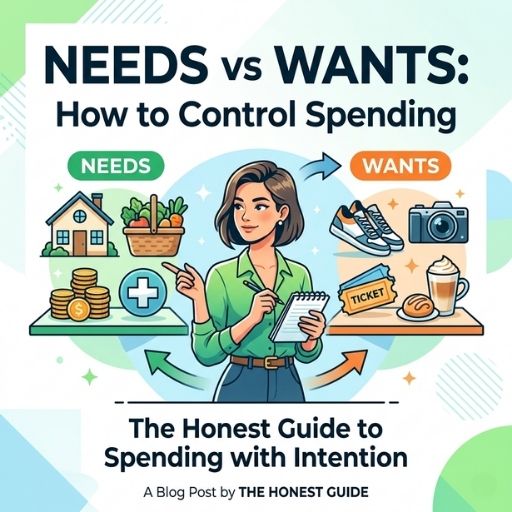
Description: Learn how to tell the difference between needs and wants and control your spending. A real, honest guide to spending with intention and building financial freedom.
The Problem Is Not That You Spend Too Much. It Is That You Cannot Tell the Difference Anymore.
Let me describe something that happens in millions of households every month without anyone fully noticing it is happening.
The month starts with the best intentions. A mental note about spending less, saving more, being more careful. The salary arrives. The EMIs go out. The groceries get bought. Life happens — a friend's birthday dinner, a sale notification on a favorite app, a new season dropping on a streaming service that requires the premium plan, a pair of shoes that was genuinely needed for work and then a second pair that was not quite as genuinely needed but were right there on the same page.
And then somehow, three weeks into the month, the account is running lower than it should be. The saving that was supposed to happen has not happened. And the frustrating thing — the genuinely confusing thing — is that nothing feels like it was wasted. Nothing feels like an obvious mistake. Every individual purchase, examined on its own, seemed reasonable at the time.
This is the needs-wants problem in its most common form. Not dramatic splurging. Not obvious recklessness. Just the slow, consistent blurring of the line between what is genuinely necessary and what has been made to feel necessary by habit, by marketing, by social expectation, and by the specific psychological mechanisms that the entire consumer economy is designed to exploit.
The line between needs and wants has never been blurrier. And the consequence of that blurriness — for millions of people earning decent incomes who cannot understand why they are not building savings — is the financial stagnation that feels mysterious but is actually very specifically caused.
This guide helps you see the line clearly again. And then gives you the practical tools to spend deliberately on both sides of it without guilt, without deprivation, and with the kind of intentional control that actually builds financial freedom.
Why the Line Got So Blurry — The Forces Working Against You
Before the framework and the tools, understanding why this distinction has become so difficult for so many people is genuinely important. Because the blurring of needs and wants is not personal weakness. It is the predictable result of specific forces operating on all of us continuously.
Marketing's primary job is converting wants into perceived needs.
The entire machinery of modern marketing — advertising, product design, social proof, scarcity messaging, influencer content — exists to make you feel that specific products and services are necessary rather than optional. The smartphone that is genuinely functional for all your communication needs is presented as insufficient without the new model. The subscription that adds genuine convenience is marketed as essential. The product that satisfies a mild preference is sold as solving a real problem.
This is not conspiracy. It is effective commercial communication doing exactly what it is designed to do. But understanding that it is happening — that what feels like a need has often been engineered to feel that way — creates useful critical distance between the feeling of needing something and the reality of what you actually require.
Social norms blur the line between standard of living and necessity.
What counts as a basic necessity is not fixed. It is socially constructed and constantly shifting. A smartphone was a luxury in 2007 and is now genuinely necessary for most professional and social participation. Air conditioning was an indulgence and has become, in many climates, a genuine health requirement during extreme heat events. These are real changes.
But the same social construction mechanism also operates on things that have not genuinely crossed the necessity threshold. Private school education for children in areas with functional public schools. Multiple streaming service subscriptions. Annual international vacations. New clothing every season. These things have become socially normalized in specific income brackets to the point where they feel like reasonable standards of living — and therefore like something close to needs rather than wants.
The feeling that something is a need because everyone around you has it is real and powerful. It is not the same as it actually being a need.
Convenience has been monetized in ways that make it feel essential.
The modern consumer economy has become extraordinarily efficient at converting inconvenience into paid services. Cooking your own food requires time, skill, and planning. Food delivery converts that investment into a payment. Washing your own car requires effort. Car washing services convert that effort into a payment. Managing your own investments requires knowledge and attention. Wealth management services convert that investment into fees.
Many of these services are genuinely worth their cost in specific circumstances. The problem is when convenience spending becomes reflexive — when the option of doing something yourself never seriously enters the mental calculus because the paid alternative has become so normalized that it feels like the default rather than the exception.
When convenience is the default, its cost becomes invisible. And invisible costs accumulate into the monthly deficit that produces financial stagnation despite adequate income.
The Real Framework — More Nuanced Than the Textbook Version
The classic needs-wants framework — food is a need, a luxury watch is a want, done — is conceptually clear and practically insufficient. Real spending decisions are almost never that simple.
Here is a more honest and more useful framework.
Tier 1 — Genuine Needs: Non-Negotiable Basics
These are the expenses without which basic life functioning becomes impossible or genuinely dangerous. Adequate food and water. Basic shelter — housing that is safe and appropriate for your family size. Basic clothing — functional protection from elements and social participation. Basic healthcare access. Basic transportation to work. Basic utilities — electricity, water, basic internet where it is a professional requirement.
The critical word in every category is basic. Not the highest quality version. Not the most convenient version. The functionally adequate version that serves the genuine need.
Tier 2 — Reasonable Comforts: Quality of Life Improvements
These are expenses beyond bare necessity that genuinely improve quality of life in ways that have real value — better nutrition, more comfortable housing, reliable transportation, communication tools that enable full participation in professional and social life, education and development that builds genuine capability.
These are not needs in the strict sense — you would survive without them. But they are not frivolous wants either. They represent reasonable investments in wellbeing, capability, and quality of life that can be defended rationally and funded without guilt within an adequate income.
Tier 3 — Genuine Wants: Chosen Pleasures
These are the discretionary pleasures that make life enjoyable and personally meaningful — entertainment, travel, dining experiences, hobbies, fashion beyond basic function, gifts, luxury purchases. These are not necessary. They are not harmful. They are the dimension of spending that expresses personal values and brings genuine enjoyment.
The problem is not Tier 3 spending. The problem is Tier 3 spending funded without acknowledgment — without the explicit choice that makes it satisfying rather than guilt-producing.
The Blurring Zone — Where Most Financial Problems Live
The practical problem is not distinguishing Tier 1 from Tier 3. The problem is the enormous blurring zone between Tier 2 and Tier 3 — the space where a basic need has been upgraded into a want so gradually that the upgrade is no longer visible.
The need is adequate housing. The want is the specific apartment in the specific neighborhood with the specific amenities at three times the cost of functionally adequate housing. The need is adequate nutrition. The want is daily food delivery plus restaurant meals several times per week plus premium grocery delivery plus coffee shop stops. The need is reliable transportation. The want is a new car financed beyond your means because the old car still runs.
Identifying where in your actual spending the need ends and the upgraded want begins — and then making conscious choices about which upgrades are genuinely worth their cost — is the practical work of spending control.
The Audit — Seeing Your Actual Spending Clearly
Before any changes, you need to see clearly what is actually happening.
Pull your last three months of bank statements and UPI transaction history — PhonePe, Google Pay, credit card statements. Categorize every expense. Not in the broad categories that make spending feel acceptable — "food," "transportation," "lifestyle" — but in the specific categories that make patterns visible.
The categories that typically reveal the most:
Food and beverages broken into components. Groceries. Food delivery apps. Restaurant meals. Coffee and chai shops. Each separately. The total across all food categories shocks most people — not because any individual category is outrageous but because the aggregate of all four is dramatically higher than the mental estimate of "food spending."
Convenience spending. Everything you paid for specifically because the alternative required effort. Delivery fees across all platforms. Cab rides that replaced public transport or walking. Laundry services. Any service that solved an inconvenience rather than a genuine incapacity.
Subscription spending. Every recurring monthly charge. Listed individually. Totaled. This number is almost always significantly higher than estimated.
Impulse purchases. Items bought in the moment without prior planning. Clothes, gadgets, accessories, home items, books, apps — anything that was not on a list or in a plan before the moment it was purchased.
Social spending. Dining out with friends, gifts, group activities, occasions. This category is emotionally complex because the spending is tied to relationships — which makes examining it feel like examining your relationships rather than just your spending.
Look at these numbers without judgment. You are not trying to feel bad. You are trying to see clearly. What you see is your actual spending priorities, expressed numerically — which may or may not match what you would say your priorities are if asked.
The Decision Framework — Spending With Intention
Here is the practical tool for making spending decisions more intentionally — applicable at the point of purchase rather than only in retrospect.
The 48-Hour Rule for Non-Essential Purchases
For any non-essential purchase above a personally meaningful threshold — one thousand rupees, two thousand rupees, whatever amount represents real money in your specific budget — impose a 48-hour waiting period before purchasing.
Add the item to a list. Come back to it 48 hours later. The questions to ask when you return:
Do I still want this? Has the desire persisted across 48 hours of not seeing the item, or has it faded? Impulse desire evaporates quickly. Genuine preference persists.
Why do I want this? What specific need or desire does this address? Name it honestly. If you cannot name it specifically, the purchase is likely impulse.
What am I actually buying? If it is a physical item, am I buying the item's function or its signal — what it says about me rather than what it does for me? If it is a service, am I buying genuine value or convenience I could reasonably provide myself?
Is this worth what it costs — specifically in terms of hours worked? A three-thousand-rupee purchase, for someone earning thirty thousand rupees per month, costs approximately half a workday. Is this thing or experience worth half a workday? That framing makes the real cost visceral in a way that the number alone often does not.
The Monthly Wants Allowance — Guilt-Free Spending Within Boundaries
The goal of spending control is not the elimination of Tier 3 spending. It is the conscious management of it within boundaries that protect your financial goals while allowing genuine enjoyment of money.
A monthly wants allowance — a predetermined amount designated specifically for discretionary spending without any accounting required — provides the structure that makes this possible.
Determine the amount. The right amount is what remains after your essential expenses, your savings commitment, and your reasonable comforts are funded. This is genuinely what you have available for discretionary wants without undermining your financial goals.
Spend it without guilt. When the money is in the wants category, spending it on genuinely wanted things is not a financial failure. It is the point. A dinner with friends, a piece of clothing you genuinely wanted, an entertainment experience — all of it is legitimate within this boundary.
Stop when it is gone. The discipline is the boundary, not the individual purchase. When the monthly wants allowance is exhausted, the wants spending stops for that month. Not cut in other categories to compensate. Not borrowed from next month. The boundary holds.
This approach — conscious allocation rather than vague restraint — produces dramatically better outcomes than the typical approach of trying to want less while spending without clear limits.
The Specific Spending Categories That Drain the Most
Food Delivery — The Biggest Hidden Drain
For most urban Indian households with smartphones and access to Swiggy or Zomato, food delivery represents one of the largest and least examined spending categories.
The genuine need is nutrition. The upgraded want is convenience food delivery with platform fees, delivery charges, packaging surcharges, and surge pricing on top of food costs that are already higher than home cooking.
A meal that costs two hundred rupees to make at home costs four hundred to six hundred rupees delivered — inclusive of all charges. Three deliveries per week is twelve to eighteen thousand rupees per month on food that would cost six thousand rupees cooked at home. The six to twelve thousand rupee monthly difference is the pure cost of the convenience.
This is not an argument against food delivery. It is an argument for consciously choosing it rather than defaulting to it — knowing the cost and deciding whether that cost is genuinely worth the specific convenience in each specific instance rather than ordering automatically because ordering is easier than thinking.
Subscriptions — The Death by a Thousand Monthly Charges
List every subscription you currently pay for. Total them. The number is almost always surprising.
The cognitive bias that makes subscriptions financially dangerous is the isolation effect — each subscription is evaluated individually at its monthly cost, which seems small. The aggregate is never evaluated because it requires deliberately adding all the small numbers together — which nobody does automatically.
A common subscription audit for a moderately engaged digital consumer in urban India:
Netflix — two hundred to six hundred rupees. Amazon Prime — three hundred rupees amortized monthly. Spotify — one hundred nineteen rupees. YouTube Premium — one hundred sixty-nine rupees. Swiggy One or Zomato Gold — one hundred fifty to two hundred rupees. Gym membership — one thousand to two thousand rupees. Cloud storage upgrades — one hundred to two hundred rupees. Various app subscriptions — two hundred to five hundred rupees.
Total: two thousand to four thousand five hundred rupees per month on subscriptions. Twenty-four thousand to fifty-four thousand rupees per year.
The honest question for each subscription: do I use this enough that it could not be reasonably replaced by the free version, a shared account, or simply not having it? For most people doing this audit honestly, two to four subscriptions fail this test clearly.
Upgrade Culture — When Good Enough Becomes Invisible
The specific pressure to have the latest version of devices, the newest clothing collections, the most recent home goods — creates a constant churn of replacement spending on things that are not worn out, broken, or functionally insufficient.
The phone that was purchased eighteen months ago functions identically to the new model for every genuine use case — calling, messaging, photography, navigation, apps. The new model is an upgrade in specifications. It is not an upgrade in genuine functional need.
The pattern of replacing functional items with upgraded versions before functional end of life is one of the most expensive expressions of want confusion. The genuine need was met by the item already owned. The want is the upgrade. Seeing this distinction clearly and choosing deliberately — yes, this upgrade genuinely serves me enough to justify its cost, or no, this item serves me fine — reclaims significant spending from automatic to intentional.
Making Peace With Wants — The Permission You Need to Give Yourself
Here is the reframe that makes spending control sustainable rather than miserable.
Controlling spending is not about wanting less. It is about choosing better — deciding deliberately which wants are worth their cost rather than funding all wants automatically without examination.
A life of no discretionary spending — no pleasures, no experiences, no purchases beyond bare necessity — is not the goal. It is not even a good goal. Money is a tool for living a good life. Completely denying yourself the pleasures that money can enable in the service of accumulating more money is not financial wisdom. It is a joyless optimization that defeats its own purpose.
The goal is conscious choice about wants. Funding the wants that genuinely matter — that bring real pleasure, real connection, real experiences — deliberately and without guilt, within the boundaries that protect your financial future. And not funding the wants that are automatic rather than chosen — the reflexive convenience spending, the impulse purchases that bring no lasting satisfaction, the upgrade spending on things you already have that serve you perfectly well.
The permission is to want things and spend on them — intentionally, within boundaries, without guilt.
The discipline is the boundary and the intentionality. Not the suppression of desire.
Final Thoughts — The Line Is Clearer Than It Feels
Here is what I want you to leave with.
Every time you feel confused about whether something is a need or a want — every time the distinction feels blurry or arbitrary — remember that the blurriness is largely manufactured. Manufactured by marketing that converts wants into perceived needs. By social norms that normalize upgraded wants as reasonable standards. By habit that makes the default option feel like the necessary option.
The line exists. It is not always sharp and it shifts legitimately over time as circumstances change. But it is not as invisible as the consumer economy needs it to be for its own purposes.
Seeing it clearly — in your own spending, in your own specific budget, with your own specific values about what genuinely matters — is the single most valuable financial practice available to you at any income level.
Not a budgeting app. Not a savings challenge. Not a financial planner.
Just honest clarity about what you genuinely need, what you genuinely value, and what is simply happening automatically without your full attention or your genuine consent.
Spend on what you need. Choose what you want. Question everything in between.
That is the whole practice. And it is available to you starting with the next purchase you make.
Frequently Asked Questions (FAQs)
Q1. How do you define needs vs wants in practical terms? A need is something without which basic life functioning — physical safety, health, ability to work and participate in social life — is genuinely compromised. A want is everything beyond that which improves quality of life, provides pleasure, or satisfies a preference rather than a genuine requirement. In practice, the most useful question is not "is this technically a need?" but "what is the minimum adequate version of this that genuinely serves the underlying function, and how much of what I am considering spending exceeds that minimum?" The excess above the adequate minimum is the want component.
Q2. Is it wrong to spend on wants when you are trying to save money? No. The goal of financial management is not the elimination of wants spending but its conscious management within boundaries that protect financial goals. A deliberately allocated monthly wants budget — money designated for discretionary spending within defined limits — allows genuine enjoyment of earned money without undermining financial objectives. The problem is not spending on wants. It is spending on wants automatically without defined limits or conscious choice.
Q3. What are the biggest wants disguised as needs for Indian middle-class households? The most common examples include: upgraded housing beyond genuinely needed space and safety — paying significantly premium rent for neighborhood or amenity rather than function. Daily food delivery as default rather than choice. New vehicle purchases when existing vehicles are functional. Private schooling in areas with adequate government schools. Annual international travel funded before emergency fund is established. The latest smartphone model before current model is genuinely insufficient. Premium gym memberships used two to three times per week when adequate exercise is achievable without them.
Q4. How do I stop impulse buying without making life feel restrictive? The 48-hour rule for purchases above a personally meaningful threshold removes most impulse buying without requiring sustained willpower. Most impulse desire fades within 48 hours — the item does not feel as compelling when you return to it after the initial wanting-moment has passed. For purchases that genuinely persist after 48 hours, the desire is more likely to represent genuine preference than impulse. Pairing the 48-hour rule with a monthly wants allowance — so that genuine preferences can be funded without guilt within a boundary — makes the approach sustainable rather than restrictive.
Q5. How do needs and wants change across different income levels and life stages? The specific contents of each category shift significantly with income and life stage while the underlying framework remains constant. What counts as adequate housing expands reasonably with income and family size. Childcare and education costs become relevant with children that were not present before. Healthcare requirements change with age. The framework — identify the genuine need, identify the minimum adequate version, consciously choose which upgrades are worth their cost — applies across all income levels and life stages even as the specific answers to those questions change.
Comments
ashakhandale
May 31,2026
9763369327