Factor Investing: Value, Growth, Momentum Explained — The Science Behind Smarter Stock Selection
By: compiled from various sources | Published on May 29,2026
Category Professional
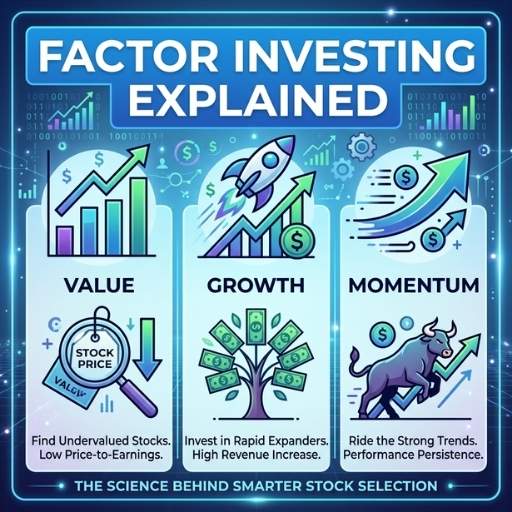
Description: Understand factor investing — value, growth, and momentum explained simply. An honest, practical guide to evidence-based investing for every serious Indian investor.
There Are Patterns in the Market That Repeat. The Question Is Whether You Know How to Use Them.
Let me start with something that genuinely changed how I think about investing.
I was reading through decades of academic research on stock market returns — the kind of reading that sounds boring until you realize it is actually a detective story about money. Specifically, I was trying to understand why certain categories of stocks consistently outperform others over long periods. Not individual stocks picked by clever analysts. Categories. Characteristics. Specific measurable qualities that seem to predict future returns with a reliability that pure random chance cannot explain.
The research kept pointing to the same conclusion.
The stock market is not a pure lottery where every stock has an equal chance of outperforming. Certain characteristics — being genuinely cheap relative to fundamentals, showing strong recent price momentum, having high quality earnings — have historically been associated with excess returns that persist across decades, across countries, and across economic cycles.
These characteristics are called factors. And the investing approach built around identifying and systematically owning stocks with these characteristics is called factor investing — sometimes called smart beta or systematic investing.
It is one of the most evidence-supported approaches in all of investment research. It is also one of the most misunderstood by ordinary investors who either dismiss it as too academic or embrace it without understanding what it actually involves.
This guide explains the three most important and most studied factors — value, growth, and momentum — in honest, plain terms. What the evidence actually says, what the real limitations are, and how Indian investors can practically access these approaches in their own portfolios.
What Factor Investing Actually Is
Before the individual factors, a clear definition of what factor investing actually means.
Traditional active investing tries to pick individual stocks that will outperform the market based on research, analysis, and judgment. Traditional passive investing owns the entire market through index funds without any selection at all.
Factor investing sits between these two approaches. It systematically overweights stocks with specific characteristics — factors — that academic research has identified as historically associated with excess returns. It is rules-based rather than judgment-based. It is diversified across many stocks rather than concentrated in individual picks. And it is grounded in decades of empirical evidence rather than in any individual analyst's assessment.
The foundational insight comes from Eugene Fama and Kenneth French — the economists whose research built the modern framework of factor investing. Their work demonstrated that a significant portion of investment returns could be explained by exposure to specific factors rather than by individual stock selection skill.
This had a profound implication. If certain characteristics systematically predict returns, you do not need to be a brilliant stock picker to capture those returns. You need a systematic, disciplined approach to owning stocks with the right characteristics — and the patience to maintain that approach through the periods when it underperforms.
Factor 1 — Value: Buying Cheap and Waiting for the Market to Notice
Value investing is the oldest and most extensively studied investment factor. Its intellectual roots go back to Benjamin Graham and David Dodd's Security Analysis in 1934 — the foundational text that gave Warren Buffett his investing philosophy.
What value investing actually means:
A value stock is one trading at a low price relative to its underlying financial fundamentals. There are several ways to measure this relationship.
Price to earnings ratio — the stock price divided by earnings per share. A low PE ratio means you are paying less for each rupee of earnings the company generates.
Price to book ratio — the stock price divided by the book value of assets per share. A low PB ratio means you are paying less than the accounting value of the company's assets.
Price to sales ratio — the stock price divided by revenue per share. Useful for companies with irregular earnings.
Price to free cash flow — the stock price divided by the cash the business actually generates after capital expenditure. Often considered the most honest measure of value.
Why value stocks have historically outperformed:
Two competing explanations exist in academic finance and both contain truth.
The risk explanation says that value stocks are cheap for a reason — they are typically companies facing genuine business challenges, uncertain futures, or unfashionable industries. Investors demand higher returns for accepting the genuine business risk these companies carry. The higher returns are compensation for real risk rather than a free lunch.
The behavioral explanation says that investors systematically overpay for exciting growth stories and underpay for boring, unglamorous businesses. This mispricing creates the opportunity — value stocks are cheap not because they are genuinely risky but because they are psychologically unappealing. Patient investors who can resist the appeal of exciting narratives capture the premium as prices eventually mean-revert to fundamentals.
Both explanations are probably partially right. The value premium reflects some genuine risk and some genuine behavioral mispricing — which means it is real but not riskless.
The honest limitation of value investing:
Value investing experienced its most significant historical underperformance during the 2010s — a decade in which growth stocks, particularly US technology companies, dramatically outperformed value stocks globally. This led many commentators to declare the value premium dead.
The more honest assessment is that the 2010s represented an unusually extended period of growth stock dominance driven by specific macroeconomic conditions — falling interest rates, expanding technology platform economics, and post-financial-crisis investor risk aversion that bid up profitable growth companies at the expense of cheaper cyclical businesses. Value recovered strongly in 2022 when interest rates rose sharply — exactly as the risk-based explanation of the value premium would predict.
Value investing works over long periods. It does not work every year. The investors who capture the value premium are those who maintain the discipline through extended periods of underperformance — which is psychologically genuinely difficult.
Factor 2 — Growth: Paying for Exceptional Business Quality
Growth investing involves buying stocks of companies with exceptional revenue and earnings growth — accepting higher valuations in exchange for the expectation of continued superior business performance.
What growth investing actually measures:
Revenue growth rate — how fast the company's sales are expanding. Earnings growth rate — how fast profits are growing. Return on equity — how efficiently the company converts shareholders' capital into profits. Profit margins — how much of each rupee of revenue the company retains as profit.
Growth stocks are typically companies in expanding markets with strong competitive advantages — the ability to maintain superior returns over time without being competed away. Technology platforms, consumer brands with strong moats, healthcare innovators — these are the categories growth investing historically concentrates in.
The relationship between growth and value:
Growth and value are often presented as opposites — value investors buy cheap, growth investors buy quality regardless of price. This framing is partially useful and partially misleading.
Warren Buffett — whose investing philosophy evolved from pure Graham-style value toward what is now better described as quality growth — has said that growth and value are joined at the hip. The value of any business is the present value of its future cash flows. A company growing its cash flows rapidly is genuinely more valuable than one growing slowly — the question is always whether the price being paid accurately reflects that growth potential.
The distinction that actually matters is between growth at a reasonable price — GARP investing — and growth at any price, where the expectation of future growth has been extrapolated so aggressively into the current price that the stock offers poor expected returns even if the growth materialises.
Why growth has been such a powerful factor in recent decades:
The specific economic conditions of the post-2008 era — low interest rates, expanding technology markets, winner-take-all competitive dynamics in digital platforms — created an environment where the best growth companies were genuinely extraordinary value creators. Amazon, Apple, Google, Reliance's Jio platforms — companies that built businesses of durable competitive advantage at genuinely unprecedented scale.
The challenge for growth investors in 2026 is that these extraordinary performers have been so thoroughly identified and celebrated that their valuations now reflect extraordinary expectations. The expected returns from owning well-known growth stocks at current valuations are lower than their historical returns — not because the businesses are worse but because the starting price is higher.
The honest limitation of growth investing:
Growth investing requires paying current prices for future outcomes — which requires forecasting that is genuinely difficult. Companies that appear to have exceptional growth prospects frequently disappoint. The competition that their growth attracts, the market saturation that eventually limits even the best businesses, the technology disruption that makes yesterday's growth story tomorrow's legacy business — all of these undermine growth forecasts with a frequency that individual and institutional investors consistently underestimate.
The premium paid for high-quality growth can take years or decades to be justified by actual business performance — during which time the patient growth investor experiences below-market returns. And when growth companies disappoint significantly — which happens regularly even to high-quality businesses — the valuation compression can be dramatic.
Factor 3 — Momentum: The Trend That Persists Longer Than It Should
Momentum is the factor that most directly contradicts the efficient market hypothesis — the academic theory that stock prices already incorporate all available information and therefore past price movements cannot predict future ones.
The empirical evidence on momentum is among the strongest in all of factor investing research. Stocks that have performed well over the past six to twelve months tend to continue outperforming over the subsequent three to twelve months. Stocks that have performed poorly tend to continue underperforming. This pattern — documented consistently across decades and across global markets — should not exist if markets were fully efficient.
Why momentum exists — the behavioral explanation:
Academic finance has struggled to explain momentum through traditional risk-based frameworks — momentum portfolios do not appear to carry obviously higher fundamental risk that would justify their higher returns. The behavioral explanation is more convincing.
Investors underreact to new information. When a company reports better than expected earnings, the stock price rises — but typically not by as much as the earnings improvement justified. Investors are anchored to the previous price and adjust too slowly. As subsequent quarters confirm the improvement, the price continues rising — creating the momentum pattern.
Investors also herd. When a stock is rising, additional investors pile in attracted by the rising price — further extending the trend beyond what fundamentals alone would justify.
Both mechanisms — underreaction to positive news and herding behavior amplifying trends — produce the momentum pattern that researchers have documented so consistently.
The significant risk in momentum investing:
Momentum strategies are subject to catastrophic reversal risk — sometimes called momentum crashes. When market conditions change dramatically — during the kind of sudden market reversal that occurred in March 2020 or in the 2008 financial crisis — momentum portfolios can lose enormous value very rapidly.
The logic is straightforward. A momentum portfolio owns the recent winners — which during a bull market tend to be the riskiest, most highly valued, most leveraged to economic expansion. When the market reverses, these are exactly the stocks that fall fastest and furthest. The momentum portfolio that had been performing well suddenly performs catastrophically.
Momentum strategies also require higher turnover than value or quality strategies — because yesterday's momentum stock is not necessarily tomorrow's. The transaction costs and tax implications of this turnover reduce the net momentum premium meaningfully.
The honest positioning of momentum:
Momentum is most useful as a complement to value and quality strategies rather than as a standalone approach. Combining value — which buys stocks that have often been falling in price — with momentum — which avoids stocks in sustained downtrends — produces portfolios that are better positioned than either approach alone.
The Multi-Factor Approach — Why Combining Factors Works
Here is the insight that makes factor investing genuinely powerful rather than just theoretically interesting.
Individual factors go through extended periods of underperformance. Value underperformed through the 2010s. Momentum crashes during market reversals. Growth underperformed after the 2021-2022 interest rate shift. Any investor who committed entirely to a single factor experienced extended periods where their approach appeared to have stopped working.
But different factors tend to underperform at different times. Value tends to underperform when growth is thriving — and vice versa. Momentum tends to underperform precisely during the market reversals when quality defensive stocks tend to outperform.
Combining multiple factors into a single portfolio — a multi-factor approach — produces more consistent performance across different economic environments than any single factor alone. Not because the factors cancel each other out but because their different underperformance cycles do not coincide — providing diversification across investment approaches just as diversification across asset classes provides diversification across economic environments.
The specific combination that most institutional research supports is value combined with quality combined with momentum — three factors with genuine academic support whose underperformance cycles are meaningfully distinct.
How Indian Investors Can Access Factor Investing
Here is the practical translation for Indian investors who want to implement factor-based approaches within the instruments available to them.
Factor funds in Indian mutual funds:
SEBI's mutual fund categorization framework includes provisions for factor-based funds. Several Indian asset management companies have launched factor funds that provide systematic exposure to specific factors.
Value funds — there is an existing SEBI category for value funds that requires funds to follow a value investment strategy. ICICI Prudential Value Discovery, UTI Value Opportunities, and several other established funds operate in this category.
Quality funds — funds that screen for high return on equity, low debt, and consistent earnings growth. DSP Quality Fund, ICICI Prudential US Bluechip Equity Fund for international quality exposure.
Momentum funds — a newer category in Indian mutual funds. Nifty 200 Momentum 30 Index Fund and similar products track momentum-based indices.
Multi-factor funds — funds that combine multiple factor approaches in a single portfolio. Several AMCs have launched or are developing multi-factor products as this approach gains recognition in India.
Smart beta ETFs and index funds:
Exchange-traded funds tracking factor-based indices provide low-cost access to factor investing. The Nifty 500 Value 50 Index, the Nifty 200 Quality 30 Index, and the Nifty 200 Momentum 30 Index all provide systematic factor exposure through index products rather than actively managed approaches.
The cost advantage of index-based factor products — typically lower expense ratios than actively managed factor funds — is meaningful over long holding periods.
Direct stock implementation for sophisticated investors:
Investors with sufficient knowledge and time can implement factor screens directly in stock selection — using financial data to identify stocks with low price-to-book ratios for value, high return on equity and earnings growth for quality, and strong six to twelve month price performance for momentum. This approach requires more research and ongoing maintenance but eliminates fund costs entirely.
The Realistic Expectations — What Factor Investing Can and Cannot Deliver
Here is the honest assessment that distinguishes serious engagement with factor investing from naive application of it.
What the evidence genuinely supports:
Factor premiums — the excess returns of factor portfolios over the broad market — have been documented across long historical periods and across multiple global markets. They are not the product of data mining or statistical accident. They reflect real patterns in how markets price risk and how investor behavior creates persistent opportunities.
What the evidence does not support:
Consistent factor outperformance every year or even every decade. The premiums are real over long periods and highly variable over short ones. An investor who expects their value fund to outperform the market every year will be consistently disappointed and will likely abandon the strategy during precisely the periods when it most needs to be maintained.
Factor investing also does not provide protection against broad market declines. A momentum fund falls during market crashes. A value fund falls during market crashes. The factor premium is the return above the market over long periods — not protection from market risk, which requires different tools.
The time horizon required:
Factor premiums require patience measured in years and often in decades rather than months. The academic evidence covers periods of thirty to fifty years. The investors who capture factor premiums are those who can maintain strategy through three to five years of underperformance — a period that feels very long when you are living through it and feels very short when you are reading about it in a research paper.
Final Thoughts — Evidence-Based Investing in a World of Noise
Here is the conclusion that all of this research and evidence points toward.
Factor investing is not a way to get rich quickly. It is not a shortcut that eliminates the fundamental requirement of patience and long-term thinking in equity investing. It is not a guarantee of outperformance in any specific year or specific market environment.
What it is — done thoughtfully, implemented systematically, maintained patiently — is a disciplined approach to equity investing that is grounded in decades of evidence rather than in individual analyst opinion, market narrative, or the kind of story-driven investment enthusiasm that has historically been associated with poor long-term outcomes.
The factors work because they are hard to maintain. Value investing requires buying stocks that feel uncomfortable — businesses with problems, industries out of favor, price charts pointing down. Momentum investing requires selling stocks that feel safe — last year's winners that the market loves — and buying ones that feel uncertain. Quality investing requires resisting the temptation of cheap cyclicals when the economy is booming and growth is easy.
The difficulty is the feature, not the bug. The behavioral challenge of maintaining factor discipline is precisely what ensures that the premium persists — because enough investors always find the discipline too hard and abandon the approach at the worst possible moment.
The investors who benefit are those who understand the evidence well enough to trust it when their emotions argue against it.
Which is, ultimately, the same quality that every successful long-term investment approach requires.
Frequently Asked Questions (FAQs)
Q1. What is the difference between factor investing and active investing? Active investing relies on individual analyst judgment and research to select specific stocks expected to outperform. Factor investing uses systematic, rules-based screens to own all stocks with specific measurable characteristics — value, quality, or momentum — regardless of individual analyst views. Factor investing is more diversified, more transparent, lower cost, and more consistent in its approach than active stock picking. It gives up the potential for the extraordinary outperformance that a truly exceptional active manager might deliver in exchange for the disciplined, evidence-based capture of systematic return premiums.
Q2. Which factor — value, growth, or momentum — has the strongest long-term evidence? Value has the longest documented history — the value premium has been studied since the 1930s and remains one of the most replicated findings in financial economics. Momentum has the strongest statistical evidence in terms of consistency across different markets and time periods, though it comes with the significant risk of momentum crashes. Quality — which overlaps with what is described here as growth characteristics — has shown the most consistent performance across different market environments with less dramatic underperformance cycles than value or momentum. Most academic researchers would say that combining all three provides better risk-adjusted outcomes than any single factor.
Q3. Can factor investing be done through regular Indian mutual funds? Yes. SEBI's mutual fund categorization includes value funds as an official category. Several AMCs have launched quality funds and momentum index funds. Multi-factor approaches are available through both actively managed funds and through ETFs tracking factor-based indices like the Nifty 200 Momentum 30 and Nifty 200 Quality 30. For most Indian retail investors, index-based factor funds or ETFs provide the most cost-effective access to factor premiums without requiring any individual stock analysis.
Q4. How long do you need to invest in factor funds to capture the premium? The academic evidence suggests that factor premiums are reliable over periods of ten years or more but highly variable over shorter periods. A reasonable minimum holding period for any factor strategy is five to seven years — enough to experience at least one full market cycle and to allow the factor's underperformance periods to be offset by its outperformance periods. Investors who cannot commit to this time horizon are better served by broad market index funds where the shorter-term experience is more predictable.
Q5. Is factor investing appropriate for conservative investors? Factor investing in equity markets carries the same market risk as any equity investment — the portfolio falls during broad market declines. Conservative investors who cannot tolerate significant short-term losses should not have large factor equity allocations regardless of the long-term evidence for factor premiums. Within an equity allocation that is appropriately sized for a conservative investor's risk tolerance, quality-oriented factor approaches tend to be more defensively positioned than pure value or momentum strategies — providing somewhat better downside protection during market stress while still capturing meaningful equity returns over the long term.
Comments
ashakhandale
May 31,2026
9763369327
ashakhandale
May 31,2026
9763369327
ashakhandale
May 31,2026
9763369327