What Is Lifestyle Inflation? — The Silent Wealth Killer Nobody Warns You About
By: compiled from various sources | Published on Jun 05,2026
Category Beginner
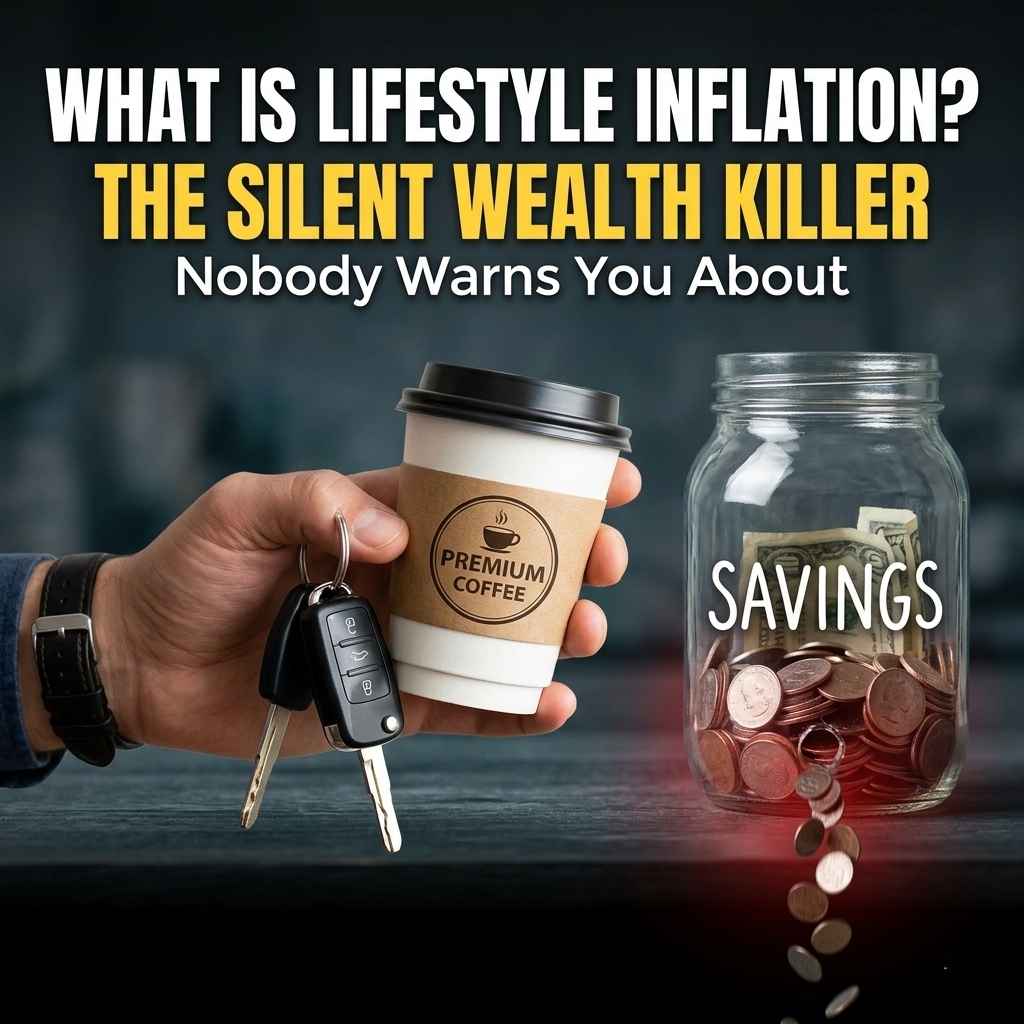
Description: Discover what lifestyle inflation is and how it silently destroys wealth despite rising income. An honest, practical guide to recognising and managing lifestyle creep.
You Are Earning More Than You Ever Have. So Why Does It Never Feel Like Enough?
Let me describe something that happens to almost everyone who receives a meaningful salary increase and that almost nobody connects to its actual cause.
The raise arrives. It is a good one — fifteen or twenty percent, the result of a promotion or a job switch or a strong performance review. In the moment it feels genuinely significant. You do the mental arithmetic. This is an extra eight thousand rupees per month. Ten thousand rupees per month. Real money that is going to make a real difference.
Three months later, you check your savings account. The balance is not significantly different from what it was before the raise. The extra money is gone. Not spent on anything dramatic or obviously reckless. Just gone. Absorbed by the month in ways that feel entirely reasonable in retrospect — a slightly better apartment, a few more restaurant meals, an upgrade on the phone that was admittedly overdue, a gym membership that seemed justified given the new salary level.
Six months later, the new income level has become the normal income level. The things you are spending it on have become the normal things. And the savings rate — the percentage of your income that is building your future — is approximately what it was before the raise.
The raise happened. The wealth building did not. And the mechanism responsible is one that almost nobody in personal finance talks about with the specificity and honesty it deserves.
That mechanism is lifestyle inflation. And this guide is going to explain exactly what it is, why it happens to almost everyone, what it actually costs over time, and what you can do about it without making your financial life feel like punishment.
What Lifestyle Inflation Actually Is
Lifestyle inflation — sometimes called lifestyle creep — is the gradual, incremental expansion of your spending as your income increases, such that your savings rate remains approximately constant despite earning significantly more money over time.
The key word is gradual. Lifestyle inflation almost never arrives as a single dramatic decision. It does not look like going from a modest apartment to a mansion in one move or trading in a functional car for an exotic one overnight.
It looks like a slightly better apartment when you move. A slightly more frequent pattern of dining out. The streaming service you could not justify before that now seems reasonable. The gym membership that fits within the new budget. The clothing choices that reflect a professional level that has changed. Each individually small. Each individually defensible. Collectively consuming the entire income increase before it ever reaches savings.
The insidious quality of lifestyle inflation is that it feels like responsible adult behaviour rather than financial carelessness. You are not gambling. You are not making obviously reckless choices. You are upgrading your life in ways that feel proportionate to your new income level. The problem is not any individual upgrade. The problem is that every income increase triggers upgrades across multiple categories simultaneously, and the aggregate of those upgrades consistently matches or exceeds the income increase.
Why It Happens — The Psychology Is More Powerful Than You Think
Understanding why lifestyle inflation happens is more important than simply being told it is bad. Because knowing it is bad without understanding the mechanism produces guilt without change — you feel worse about your spending without being able to actually do anything different about it.
The adaptation effect — why more always becomes normal.
Human beings are extraordinarily effective at adapting to new circumstances. This capacity for adaptation is genuinely valuable — it allows us to function in difficult conditions, to recover from setbacks, to maintain psychological stability through adversity.
But the same adaptation mechanism works in the opposite direction. Improvements in circumstances — better housing, better food, more comfortable transportation, more convenient services — become normal with remarkable speed. The pleasure and satisfaction they initially provide fades as they become the expected baseline rather than the appreciated upgrade.
This means that the enjoyment derived from any given lifestyle level is temporary. The new apartment that felt exciting and luxurious in month one feels ordinary in month six and inadequate in year two. The phone that was the upgrade becomes the minimum acceptable standard. The restaurant tier that felt like a treat becomes the normal option.
And when the familiar becomes normal, the psychology that was satisfied by the improvement begins seeking the next improvement. Lifestyle inflation is partly the spending consequence of this continuous adaptation process.
Social comparison — spending to maintain relative position.
Human beings do not experience their financial situation in isolation. We experience it in comparison — to colleagues, to friends, to the neighbourhood we live in, to the social media content we consume, to the implicit lifestyle standard of the social group we belong to or aspire to belong to.
When income increases, social context often shifts. A promotion comes with exposure to colleagues at a higher income level whose lifestyle choices establish an implicit new standard. Moving to a better neighbourhood brings proximity to neighbours whose spending patterns create new reference points. The social groups we join as our careers progress have lifestyle norms that create subtle pressure toward specific spending patterns.
None of this pressure is explicit. Nobody tells you that you should upgrade your car because you got promoted. But the social comparison mechanism is continuous and largely unconscious — and its effect on spending is real and significant.
The mental accounting of "I can afford this now."
There is a specific thought pattern that lifestyle inflation runs through consistently. "I can afford this now." The new income level makes previously out-of-reach spending feel like it has been unlocked — not as a choice but as a natural consequence of earning more.
This mental accounting is the psychological mechanism that converts income increases into spending increases rather than savings increases. The question "can I afford this?" gets answered by comparing the cost to income rather than by comparing it to financial goals. And at a higher income level, a significantly wider range of things are affirmable — which means a significantly wider range of spending feels justified.
The reframe that challenges lifestyle inflation is replacing "can I afford this?" with "does spending on this serve my financial goals?" These questions produce very different answers for most spending decisions.
The Real Cost — What Lifestyle Inflation Actually Takes From You
Here is the calculation that makes lifestyle inflation genuinely alarming rather than merely theoretically suboptimal.
Lifestyle inflation does not just reduce savings in the present. It reduces the compounding growth of money that would have been saved — which means it reduces future wealth by a multiple of the spending itself.
Consider two people — both earning fifty thousand rupees per month at age twenty-five.
Person A maintains their savings rate of twenty percent as their income grows. Over ten years their income grows to one lakh rupees per month through promotions and career progress. Their savings rate stays at twenty percent — so they save twenty thousand rupees per month by age thirty-five compared to ten thousand rupees at age twenty-five.
Person B allows lifestyle inflation to absorb every income increase. Their income grows identically to one lakh rupees per month over the same period. But their spending grows to match every increase — so their savings rate remains at twenty percent of the original income in absolute terms. They are still saving ten thousand rupees per month at age thirty-five despite earning twice as much.
The compounding difference over thirty years is not two times the savings — it is several times larger because the money saved earlier has more years to compound. Person A arrives at retirement with dramatically more wealth than Person B despite having earned identical income across their careers.
Lifestyle inflation is not just a spending problem. It is a compounding problem. Every rupee consumed by lifestyle expansion is not just a rupee not saved — it is many rupees not accumulated through decades of investment returns.
| Scenario | Monthly Savings at 35 | Estimated Corpus at 60 (12% return) |
|---|---|---|
| 20% savings rate growing with income | ₹20,000 | ₹3.8 crore+ |
| Savings flat despite income doubling | ₹10,000 | ₹1.9 crore |
| Difference | ₹10,000/month | Nearly ₹2 crore |
The two crore rupee gap is not produced by any difference in investment strategy, in market performance, or in financial sophistication. It is produced entirely by the decision about what happens to income increases — savings or spending.
The Sneakiest Forms of Lifestyle Inflation — The Ones Nobody Notices
The subscription accumulation.
Individual subscriptions cost very little. The pattern of adding subscriptions as income grows — each one individually affordable, none individually examined — produces a monthly subscription burden that can reach three to six thousand rupees for someone who has never deliberately chosen their subscription portfolio as a whole.
Each subscription was added at a moment when the monthly cost felt trivially affordable. None is individually worth cancelling. Together they represent a significant spending category that exists entirely because income increased to the point where each addition felt harmless.
The convenience spending spiral.
At lower income levels, the slightly inconvenient but cheaper option is genuinely worth it. Cooking at home rather than ordering delivery. Public transport rather than cab rides. Doing something yourself rather than hiring it out.
As income grows, each inconvenient option gets replaced by its convenient paid alternative — individually reasonable, collectively expensive. The person who used to spend two thousand rupees on groceries and cook most meals at home now spends six thousand rupees across grocery delivery, restaurant meals, and food delivery. The absolute spending increase is four thousand rupees per month on the same basic function of feeding themselves — the difference being entirely convenience spending that lifestyle inflation justified.
The quality floor ratchet.
Once you have spent at a certain quality level, it becomes the minimum acceptable. The restaurant tier you used to treat as a special occasion becomes the baseline. The clothing quality you bought for a promotion becomes the standard. The apartment amenities you chose when moving become the minimum requirements for the next search.
This quality floor ratchet means that downward spending adjustment — even temporarily — becomes psychologically difficult in ways that upward adjustment never is. You can easily spend more than you did before. Spending less than you have been spending feels like deprivation even when it would have felt like normal life a few years earlier.
The celebration inflation.
Birthdays, festivals, holidays, weddings, anniversaries — occasions whose celebration cost expands reliably with income in ways that nobody explicitly decides. The birthday that used to be a home-cooked meal becomes a restaurant dinner becomes a weekend trip. The Diwali gifts that used to be modest become elaborate. The holiday that used to be domestic becomes international.
Each celebration's cost increase is justified by the occasion and by the income level that makes it "affordable." Together they represent significant annual spending that grows consistently with income without ever being deliberately chosen as a financial priority.
The Lifestyle Inflation Trap in India — Specific Context
The lifestyle inflation dynamic has specific expressions in the Indian middle-class context that deserve honest attention.
The comparison culture in Indian social life.
Indian social events — weddings, festivals, family gatherings — create specific and powerful lifestyle inflation pressure. The visibility of consumption at these occasions, the comparisons that happen explicitly or implicitly, and the specific social meaning attached to spending on weddings and festivals creates categories of spending that grow dramatically with income in ways that other cultures do not experience as strongly.
A wedding budget in urban India that would have been considered generous at one income level becomes modest at a higher one — because the social reference group has shifted and the implicit standard has risen. This specific form of lifestyle inflation is particularly difficult to manage because the spending is socially important and because the consequences of underspending feel social rather than financial.
The housing and education pressure.
Two categories where lifestyle inflation is both understandable and financially significant in India are housing and children's education.
Housing cost in Indian metros has grown so significantly that many families feel genuine pressure to upgrade to larger, better-located apartments as income grows — not purely through lifestyle inflation but through genuinely changing family needs. The challenge is distinguishing the genuine need component from the lifestyle preference component and being honest about which is driving the decision.
Private school fees — and the specific quality of school that is seen as appropriate for a given income level — represent a form of lifestyle inflation that is particularly difficult to manage because it involves children's futures. The parent who feels that their increased income obligates them to a more expensive school for their child is experiencing a genuine and understandable motivation — but one that can produce significant financial pressure if not examined honestly.
The car upgrade culture.
India's car culture has specific lifestyle inflation dynamics. The car as social status signal — visible to neighbours, to family, to colleagues — creates specific pressure to upgrade as income grows. The EMI structure that makes cars affordable at multiple price points enables this upgrade pattern by converting large capital decisions into monthly payments that each feel manageable.
The specific cost of car lifestyle inflation is not just the EMI — it is the insurance, the fuel, the maintenance, and the depreciation that together make the car one of the most expensive ongoing lifestyle expenses in most middle-class Indian household budgets.
Managing Lifestyle Inflation Without Making Life Miserable
Here is the part that most financial guides get wrong — treating lifestyle inflation management as a discipline exercise rather than a design exercise.
You cannot willpower your way out of lifestyle inflation indefinitely. You can design your financial system to limit its damage while still allowing your standard of living to improve meaningfully with your income.
The fifty percent rule for income increases.
Every time your income increases — salary raise, bonus, additional income source — direct fifty percent of the increase to savings before allowing the remaining fifty percent to reach your spending account.
This rule does two things simultaneously. It ensures that every income increase builds wealth — the fifty percent directed to savings is permanent. And it allows your standard of living to genuinely improve with your income — the remaining fifty percent gives you real spending power growth.
The psychology of this approach is important. You are not denying yourself the benefit of earning more. You are ensuring that you benefit permanently through savings and temporarily through spending rather than entirely through spending that normalizes and disappears.
Automate the savings increase.
The moment an income increase arrives — before it has reached your spending account, before you have made any decisions about what to do with it, before lifestyle inflation has had the opportunity to claim it — increase your automatic savings transfer proportionally.
If your monthly salary increases by ten thousand rupees, increase your automatic savings transfer by five thousand rupees on the same day. The savings increase happens before any decision about the spending increase. This removes the spending decision from the domain where lifestyle inflation operates.
Audit deliberately rather than adjust instinctively.
Rather than allowing lifestyle to adjust continuously and instinctively to income, conduct a deliberate lifestyle audit once per year. Look at every significant spending category and ask honestly which represent genuine improvements to your quality of life and which represent inflation that has become normalized without genuinely adding value.
The gym membership you never use. The premium subscription whose benefit does not justify the cost difference over the basic version. The restaurant tier that has become default rather than chosen. The car upgrade that was driven more by social expectation than by genuine transportation need.
This deliberate audit — done with genuine honesty rather than defensiveness — typically identifies two to four categories where spending has inflated beyond the genuine value being received. Adjusting these categories does not feel like deprivation because the honest assessment reveals that the spending was not producing equivalent enjoyment or satisfaction anyway.
Protect the savings rate, not the savings amount.
The specific commitment that resists lifestyle inflation most effectively is protecting your savings rate — the percentage of income directed to savings — rather than just your savings amount in absolute rupees.
At a ten percent savings rate on fifty thousand rupees per month, you save five thousand rupees. If income rises to eighty thousand rupees and the savings rate is maintained at ten percent, you save eight thousand rupees. If the savings rate rises to fifteen percent, you save twelve thousand rupees.
The savings amount has increased and the lifestyle has improved — both outcomes are achieved by protecting the rate rather than allowing lifestyle inflation to absorb the entire income increase.
The Permission You Need — Spending on What Genuinely Matters
Here is the reframe that makes lifestyle inflation management sustainable rather than punishing.
The goal is not spending less. The goal is spending better — deliberately choosing the lifestyle improvements that genuinely improve your quality of life while not automatically upgrading every category of spending simply because your income has increased.
There are things genuinely worth spending more on as your income grows. Better quality food that improves health. Housing that is genuinely more suitable for your family's needs. Experiences that create lasting memories. Education that builds genuine capability. Travel that expands perspective.
There are things not worth the automatic inflation that income growth typically produces. The car upgrade driven by social expectation rather than genuine transportation improvement. The restaurant tier that is default rather than chosen. The subscription accumulation that nobody consciously selected as a portfolio. The quality floor ratchet that makes the previous standard feel inadequate when it is genuinely fine.
The difference between chosen lifestyle improvement and automatic lifestyle inflation is intentionality. The same amount of spending, deliberately chosen for genuine value, produces better financial and psychological outcomes than the same spending that happened automatically without conscious selection.
Spend more on what you genuinely value.
Spend the same or less on everything that has just become normal.
Save the difference.
That is the whole framework. And it is available to you at exactly the income level you are at right now.
Final Thoughts — The Raise That Changes Everything Is the One You Do Not Spend
Here is what I want to leave you with.
Every income increase you receive in your career is an opportunity. Not just an opportunity to live better right now — though that is real and legitimate. An opportunity to permanently improve your financial future by directing some portion of the increase to assets rather than consumption.
The people who build genuine wealth across ordinary careers are almost never those who earned the most. They are those who consistently directed a meaningful portion of every income increase to savings and investment before lifestyle inflation could claim it.
That consistency — across years and decades, through promotions and job changes and bonus payments — is what produces the compound growth that makes the numbers genuinely significant at retirement rather than just impressive in any given month.
Lifestyle inflation is not your enemy if you understand it. It is a natural and human response to improving circumstances that can be managed with simple, specific design choices that do not require you to deny yourself anything genuinely important.
The raise is coming. What you do with it in the first thirty days determines whether it builds your future or just improves your present.
That choice is worth making deliberately.
Frequently Asked Questions (FAQs)
Q1. What is the difference between lifestyle inflation and a genuine improvement in standard of living? The honest distinction is intentionality and proportionality. A genuine improvement in standard of living is a deliberate choice to spend more on something that genuinely improves quality of life — better housing for a growing family, improved nutrition, meaningful experiences — made with awareness of its financial cost and deliberate acceptance of that trade-off. Lifestyle inflation is the automatic, unconscious expansion of spending across multiple categories as income rises, without deliberate choice and without proportional improvement in actual satisfaction or quality of life. The same spending decision can be either depending on whether it was consciously chosen or automatically adopted.
Q2. How do I know if I am experiencing lifestyle inflation? The clearest indicator is the inability to identify where income increases went. If you received a meaningful salary increase in the past one to two years and your savings balance has not increased proportionally — and you cannot specifically account for where the additional income was spent — lifestyle inflation is the most likely explanation. Additional indicators include the feeling that your current income feels barely adequate despite being higher than it has ever been, the sense that downward spending adjustment in any category would feel like deprivation despite those categories being recent additions to your spending, and the consistent experience that savings targets feel aspirational rather than achieved despite income growth.
Q3. Is some lifestyle inflation acceptable or should all income growth go to savings? Some lifestyle improvement with income growth is not just acceptable — it is one of the legitimate rewards of professional achievement. Earning more should enable living better to some degree. The financially sound approach is deliberately choosing which lifestyle improvements genuinely matter and funding those while protecting a meaningful portion of income growth for savings. The fifty percent rule — directing half of every income increase to savings and allowing half to improve lifestyle — provides a practical balance between present enjoyment and future security that most financial advisors consider sustainable and appropriate.
Q4. What is the most effective way to prevent lifestyle inflation from consuming a bonus or windfall? The most effective approach is making the savings decision before the money reaches your spending account — ideally on the same day the bonus is received. Decide in advance what percentage of any windfall goes directly to savings and transfer that amount immediately, before any spending decisions are made. The behavioral research consistently shows that people spend significantly more of a windfall when it sits in a spending account for days or weeks compared to when the savings allocation is made immediately on receipt. The rule itself matters less than the immediacy of its implementation.
Q5. How does lifestyle inflation affect retirement planning specifically? Lifestyle inflation affects retirement planning in two compounding ways. First, it reduces the savings that accumulate toward retirement by consuming income that would otherwise be invested. Second, it raises the retirement corpus required — because a higher lifestyle standard requires more wealth to sustain in retirement than a more modest one. A household that has inflated their lifestyle to require eighty thousand rupees per month needs a corpus that generates eighty thousand rupees monthly in perpetuity. A household that maintained a fifty thousand rupee monthly lifestyle on the same income needs a significantly smaller corpus. Both the savings accumulated and the target required move in the wrong direction when lifestyle inflation is unchecked.
Comments
No comment yet. Be the first to comment