Behavioral Finance: How Emotions Impact Investing — The Science of Why Smart People Make Terrible Investment Decisions
By: compiled from various sources | Published on Jun 08,2026
Category Professional
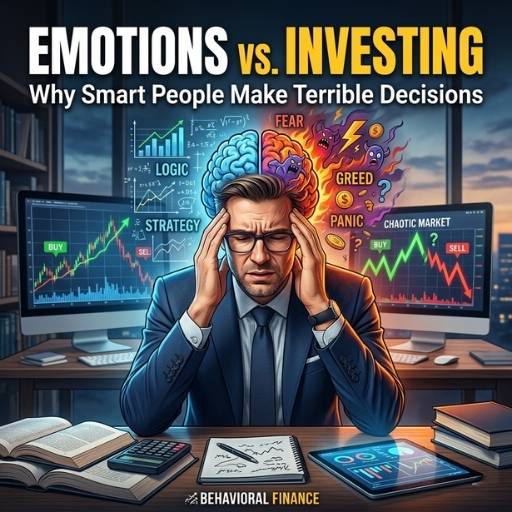
Description: Discover how emotions impact investing through behavioral finance. An honest, practical guide to understanding your investment psychology and making better financial decisions.
The Enemy of Your Investment Portfolio Is Not the Market. It Is You.
Let me start with something that I found genuinely uncomfortable when I first understood it properly.
I consider myself a reasonably intelligent person. I have read enough about investing to understand the basic principles — diversification, long-term thinking, the mathematical certainty of compounding, the futility of market timing. I know these things. I have read the research. I have understood the evidence.
And I have still made every single emotional investing mistake that the research documents. Every one of them. Not in some distant past before I learned better. After learning better. Multiple times.
I sold a position during a market downturn because the anxiety of watching it fall was more than I could comfortably tolerate — even though I knew intellectually that selling at a loss and missing the recovery was the worst possible response. I held a losing position far longer than any rational analysis justified because selling would have made the loss real and permanent. I allocated too much to an investment that had recently performed well — not because the future prospects justified it but because the recent performance felt like evidence of quality.
Each of these decisions was emotionally driven. Each contradicted what I knew intellectually. And each cost me real money in ways that were entirely predictable given the behavioral finance research that I had already read.
This is the central puzzle of behavioral finance. Knowing about psychological biases does not reliably protect against them. Understanding that loss aversion causes poor decisions does not prevent loss aversion from causing poor decisions. The research is sobering about this — mere awareness is not sufficient defense against the emotional mechanisms that have been shaped by millions of years of evolution to override deliberate analytical thinking in moments of perceived threat.
What behavioral finance provides is not a guaranteed cure for emotional investing. It provides something more honest and ultimately more useful — a precise map of the specific psychological mechanisms that cause intelligent people to make poor investment decisions, which is the necessary precondition for building the specific systems and habits that partially compensate for those mechanisms.
This guide is that map. Honestly drawn.
What Behavioral Finance Actually Is
Behavioral finance is the field that applies psychological research to understanding how and why people make financial decisions that deviate from what rational economic models predict.
Traditional financial theory — built on the foundation of efficient market hypothesis and rational actor models — assumes that investors process available information accurately and make decisions that maximize expected returns relative to accepted risk. This model produces elegant mathematical frameworks and genuinely useful insights about long-term market behavior.
It also produces predictions about investor behavior that are systematically wrong. Real investors do not process information accurately — they process it through psychological filters that consistently distort in predictable directions. Real investors do not maximize rational expected utility — they respond to emotional states, cognitive shortcuts, and social pressures in ways that produce systematic and costly errors.
Behavioral finance — developed most significantly by Daniel Kahneman, Amos Tversky, Richard Thaler, and Robert Shiller — documents these deviations from rational behavior, explains their psychological origins, and explores their consequences for markets and for individual investors.
The field won three Nobel Prizes in Economics — Kahneman in 2002, Shiller in 2013, and Thaler in 2017 — which is about as strong an institutional endorsement as academic finance provides.
The Psychological Architecture of Poor Investment Decisions
Loss Aversion — The Asymmetry That Costs You Money
The foundational finding of behavioral finance — from Kahneman and Tversky's prospect theory — is that losses are psychologically approximately twice as painful as equivalent gains are pleasurable. Losing ten thousand rupees feels roughly twice as bad as gaining ten thousand rupees feels good.
This asymmetry — loss aversion — produces a specific pattern of irrational investment behavior that is extraordinarily consistent across cultures, income levels, and levels of financial sophistication.
Investors hold losing positions far longer than any rational analysis of expected future returns would justify. The psychological cost of selling and realising a loss — making it permanent and real — is greater than the psychological cost of continuing to hold a position with poor future prospects while maintaining the fiction that the loss is only "on paper." The brain treats unrealised losses as potentially recoverable. Realised losses as permanently real. This distinction, which has no rational financial basis, is powerful enough to override analysis.
Investors also exit winning positions too quickly. The anxiety of watching a gain potentially disappear is sufficient to motivate premature sale — taking a certain smaller gain to avoid the risk of a larger potential loss. This produces the systematic pattern of cutting winners short and letting losers run — the precise opposite of the "let profits run, cut losses" principle that rational investing recommends.
The practical cost of loss aversion across an investment lifetime is significant. Studies by Terrance Odean examining actual investor trading data found that the stocks investors sold outperformed the stocks they retained — meaning investors were systematically selling winners too early while holding losers too long, producing inferior returns to simply holding the entire portfolio.
What to do about loss aversion:
Pre-commit to specific decision rules at the time of investment rather than at the time of loss. Decide in advance — when you are not in the emotional state of watching an investment fall — what conditions would warrant selling. Write this down. Having a pre-committed rule removes the in-the-moment loss aversion from the decision process.
Review your portfolio less frequently. Loss aversion is triggered by observing losses. Investors who check their portfolio daily experience more emotional activation from market fluctuations than those who review monthly or quarterly — and research shows they make worse decisions as a result. Building a deliberate habit of infrequent portfolio review reduces the number of times loss aversion has the opportunity to distort decisions.
Confirmation Bias — Only Seeing What You Already Believe
Confirmation bias is the tendency to seek, interpret, and remember information in ways that confirm existing beliefs while discounting or ignoring information that contradicts them.
In investing, confirmation bias operates with particular destructiveness. An investor who has committed to a position in a specific stock or sector will unconsciously filter the information stream — emphasising news and analysis that supports the investment thesis while dismissing contrary evidence as misguided or temporary.
This produces a specific failure mode. The investor holds a position through deteriorating fundamentals because they have filtered out the signals that the investment thesis has failed. They seek confirming opinions from others who agree with their position. They explain away contradicting evidence as the market not yet understanding what they understand.
The irony is that the more research an investor has done on a specific investment, the more subject to confirmation bias they typically are — because the time and effort invested in the original thesis creates emotional commitment that makes objective reassessment psychologically costly.
Warren Buffett famously uses the "newspaper test" for investment decisions — asking what a knowledgeable, critical journalist would write about the investment. This deliberate adversarial framing helps compensate for confirmation bias by constructing the counter-argument that bias naturally suppresses.
What to do about confirmation bias:
Deliberately seek disconfirming information before making investment decisions. Before purchasing a position, read the most compelling bearish case. Before holding a position through a downturn, genuinely engage with the argument that the investment thesis has failed.
Create a pre-mortem practice — before making an investment, imagine it has failed significantly and work backward to identify the most plausible causes. This exercise forces engagement with the failure scenarios that confirmation bias naturally minimizes.
Overconfidence — The Most Expensive Bias in Finance
Overconfidence is the most consistently documented and most financially costly bias in investment research. Studies across multiple countries and multiple decades consistently find that investors overestimate their ability to select superior investments, overestimate the accuracy of their predictions about market movements, and underestimate the role of randomness in investment outcomes.
The overconfidence bias has a specific expression in investment behavior — excessive trading. Investors who are overconfident in their ability to identify superior opportunities trade more frequently than is rational. This excessive trading generates transaction costs, tax friction, and — most significantly — produces inferior returns compared to simply holding a diversified portfolio.
Brad Barber and Terrance Odean's landmark research on individual investor trading found that the most active traders — those whose overconfidence produced the highest trading frequency — produced returns approximately six percentage points below the market annually after transaction costs. The investors who traded least performed closest to market returns.
The irony is that investment knowledge and experience do not reliably reduce overconfidence. Research consistently finds that professional investors — fund managers, analysts — are no less subject to overconfidence than retail investors. The specific domain knowledge increases confidence more than it increases accuracy.
What to do about overconfidence:
Track your investment predictions and outcomes with honest record-keeping. Most investors have significantly worse memories of their incorrect predictions than of their correct ones — creating the illusion of higher accuracy than the actual record supports. Maintaining a decision journal that records both the prediction and the outcome provides the humbling feedback that subjective memory does not.
Default to index investing for the core portfolio — which is not a capitulation to overconfidence but a rational response to the evidence that most active investment decisions, including those of professional investors, do not add returns above passive alternatives after costs.
Herding — Safety in Numbers That Leads Off a Cliff
Herding is the tendency to follow the investment crowd — to buy what other investors are buying and sell what they are selling, not because independent analysis supports those decisions but because the social proof of crowd behavior feels validating and because going against the crowd feels exposed and uncomfortable.
Herding is not irrational from an evolutionary perspective. In genuinely uncertain situations, the behavior of others provides valuable information. If everyone around you is running away from something, following them makes sense even without understanding the specific threat.
In investment markets, herding produces the specific pattern of bubbles and crashes that characterize market history. During bubbles, investors pile into rising assets because rising prices and crowd participation feel like evidence of genuine value rather than speculative excess. During crashes, investors exit falling assets because falling prices and crowd exit feel like evidence of permanent danger rather than temporary mispricing.
The precise moments when herding behavior is most intense — the top of a bubble, the bottom of a crash — are the moments when rational analysis most clearly indicates the opposite of what the crowd is doing. Buying during market panic and selling during market euphoria is the rational strategy that herding makes psychologically almost impossible.
Warren Buffett's famous instruction — to be greedy when others are fearful and fearful when others are greedy — is a direct description of the anti-herding behavior that rational investing requires and that human psychology consistently resists.
What to do about herding:
Build a contrarian awareness practice — when you notice strong consensus around an investment narrative, treat that consensus as a signal to examine your assumptions rather than a validation of them. Strong consensus is not always wrong — but it is worth scrutinizing specifically because of how herding distorts crowd judgment.
Pay attention to your emotional state during market extremes. If you feel that the market will clearly continue in its current direction indefinitely — whether up or down — that feeling of certainty is a reliable signal that herding psychology has taken hold. Genuine market uncertainty never disappears even when crowd sentiment suggests it has.
Anchoring — The First Number That Captured Your Mind
Anchoring is the tendency to rely disproportionately on the first piece of information encountered when making decisions — even when that information is arbitrary or irrelevant to the actual decision.
In investing, anchoring creates specific and costly decision patterns. Investors anchor to purchase price — treating the price they paid for an investment as a reference point that influences whether they hold or sell. The purchase price has no rational relevance to future returns — what matters is the investment's future prospects, which are independent of what was paid in the past. But investors consistently treat positions trading above purchase price as profitable wins and positions below purchase price as painful losses — and make hold or sell decisions based on this anchoring rather than on objective assessment of future prospects.
Anchoring to recent market levels produces similar distortions. Investors who witnessed their portfolio at a high point anchor to that level — experiencing the subsequent decline as loss even if the portfolio remains well above where it was years earlier. This anchoring produces unnecessary distress about normal market fluctuation and can drive selling behavior that is irrational relative to the full historical context.
What to do about anchoring:
Evaluate investment decisions prospectively rather than retrospectively. The relevant question is never "am I up or down from what I paid" but "given current price and conditions, does holding this investment offer better expected returns than the alternatives?" Framing the decision this way removes the purchase price anchor from the evaluation.
When reviewing portfolio performance, use long time horizons rather than recent high points as reference periods. A portfolio that has fallen twenty percent from its twelve-month high but has grown three hundred percent over ten years is performing well — but anchoring to the recent high creates the subjective experience of failure.
Mental Accounting — Why Money in Different Pockets Gets Spent Differently
Mental accounting is the tendency to treat money differently based on its source, its category, or the psychological account it is assigned to — despite the rational equivalence of all money.
In investing, mental accounting produces specific patterns of irrational behavior. Investors treat "house money" — returns earned on investments — differently from original capital — spending or risking the gains more freely because they feel psychologically different from earned income even though they are financially equivalent.
Tax refunds get spent more freely than equivalent salary income. Bonus payments fund purchases that regular income would not support. Money designated as "investment" is held more rigidly than money designated as "savings" even when the financial logic of switching between them is clear.
Mental accounting also produces the reluctance to sell appreciated investments to fund new opportunities — because selling crystallizes the gain and removes it from the "investment" mental account, creating a feeling of loss even when the reallocation is financially rational.
What to do about mental accounting:
Treat all money as functionally equivalent regardless of source. The rupee from a bonus is worth exactly as much as the rupee from salary. The rupee of investment return is worth exactly as much as the rupee of original investment. Decisions about what to do with money should be based on what serves financial goals — not on which mental account the money came from.
The Market-Level Consequences — How Individual Psychology Creates Collective Irrationality
Here is the dimension of behavioral finance that extends beyond individual investor mistakes to explain broader market phenomena.
Individual investor psychological biases, when aggregated across millions of participants simultaneously, produce collective market behaviors that rational market theory cannot explain.
Asset bubbles:
The dot-com bubble of the late 1990s, the US housing bubble of the mid-2000s, the cryptocurrency bubble of 2021 — all share the same behavioral fingerprint. Overconfidence in a narrative about permanent transformation. Herding that amplifies price appreciation beyond fundamental justification. Anchoring to recent price history that makes extreme valuations feel normal. Confirmation bias that filters out warnings about unsustainable conditions.
The bubble dynamic — rising prices attracting more buyers whose buying drives further price increases, creating the appearance of validation that attracts further buyers — is the emergent consequence of individual behavioral biases operating simultaneously at scale.
Market crashes:
The same mechanism in reverse. Falling prices trigger loss aversion. Loss aversion drives selling. Selling drives further price decline. Falling prices trigger herding — if everyone else is selling, selling must be right. The crash represents not a sudden discovery that assets were overvalued but a rapid collective shift from the overconfident optimism that sustained the bubble to the excessive pessimism that drives prices below rational fundamental value.
The investing opportunities that produce the greatest long-term returns are almost always created by this collective irrationality — assets priced below fundamental value because behavioral bias has driven the crowd to exit.
Building Investment Habits That Compensate for Psychology
Here is the practical synthesis — the specific habits that behavioral finance research identifies as most effective at partially compensating for the psychological mechanisms that produce poor investment decisions.
Automate the core investment behaviors.
The most powerful defense against emotional investing is removing emotions from the decision loop entirely for the most important investment behaviors. Automatic SIP contributions that invest regardless of market conditions. Automatic rebalancing that sells outperforming assets and buys underperforming ones without requiring a decision. Automatic savings transfers that fund investment before spending has the opportunity to consume them.
Automation does not require overcoming psychological biases. It bypasses them.
Reduce portfolio observation frequency.
The research is clear — investors who observe their portfolios more frequently experience more emotional activation and make worse decisions. Checking your portfolio daily is not more prudent than checking monthly. It is more emotionally disruptive and more conducive to the loss aversion and herding responses that produce poor outcomes.
Maintain a written investment policy statement.
An investment policy statement — written when you are not under market stress — documents your target allocation, your rebalancing rules, your investment thesis, and your commitment to maintain strategy through market fluctuations. It is a message from your calm, rational self to your future emotional self — providing a pre-committed framework that counteracts the in-the-moment emotional distortions that market stress produces.
Build a decision journal.
Record investment decisions and their rationale at the time they are made. Review the record regularly against outcomes. This practice provides the honest feedback about decision quality that subjective memory — which systematically distorts toward remembering correct predictions and forgetting incorrect ones — cannot provide.
Final Thoughts — The Most Honest Thing Behavioral Finance Teaches
Here is the conclusion that all of this research honestly points toward.
The psychological mechanisms that produce poor investment decisions are not weaknesses you can eliminate through sufficient knowledge or willpower. They are features of human cognition — extraordinarily useful in the environments that shaped them, genuinely problematic in the specific context of navigating financial markets.
Awareness helps but does not protect. Systems help more than awareness. Humility helps most of all.
The investor who builds investment systems that acknowledge psychological limitations — who automates the behaviors that emotion would distort, who reduces the frequency of emotionally driven decisions, who maintains written commitments to strategy — will outperform the investor who trusts their own rationality to override their own psychology in the heat of market stress.
Because in that specific contest — your conscious rationality versus your evolutionary psychology in a moment of perceived financial threat — your evolutionary psychology wins most of the time.
The question is not whether you will be emotionally affected by market movements.
You will be. Every investor is.
The question is whether you have built systems that compensate for that effect before it produces decisions you will regret.
Frequently Asked Questions (FAQs)
Q1. What is behavioral finance and how is it different from traditional finance? Behavioral finance is the field that applies psychological research to understanding how real investors actually make financial decisions — as opposed to how rational economic models assume they would make them. Traditional finance assumes investors process information accurately and make decisions that maximize rational expected utility. Behavioral finance documents the systematic ways real investor behavior deviates from this rational model — through identifiable psychological biases including loss aversion, overconfidence, herding, anchoring, and confirmation bias — and explores the consequences of these deviations for both individual portfolios and market-level price dynamics.
Q2. Is loss aversion the most important bias for investors to understand? Loss aversion is arguably the most fundamental behavioral finance concept because it underlies several other investment biases and produces some of the most consistently costly investment behaviors. The tendency to hold losing positions too long, exit winning positions too early, and feel disproportionate distress about losses relative to equivalent gains — all driven by loss aversion — produces measurable and significant return drag across investor portfolios. Understanding loss aversion is important not because awareness eliminates it but because understanding the specific mechanism helps in designing systems — like pre-committed selling rules and infrequent portfolio review — that partially compensate for it.
Q3. Why do smart and well-educated investors still make emotional investment mistakes? Intelligence and education reduce some forms of investment error but not the emotional investment errors that behavioral finance documents. The psychological mechanisms underlying loss aversion, overconfidence, and herding are evolutionary features of human cognition that operate below the level of deliberate rational thought. More financial knowledge can actually increase overconfidence — creating stronger attachment to investment theses that makes confirmation bias more rather than less severe. The research consistently finds that professional investors including fund managers are as subject to behavioral biases as retail investors — the biases are not primarily a function of knowledge deficiency but of psychological architecture.
Q4. What is the most effective behavioral finance technique for improving investment outcomes? Automation of core investment behaviors — automatic contributions, automatic rebalancing, automatic savings — is the most consistently effective behavioral finance intervention for most investors. Automation removes emotional decision-making from the investment processes where it causes the most damage. The investor who contributes automatically to an SIP regardless of market conditions captures more of the long-term equity premium than the investor who makes discretionary contribution decisions that emotion distorts. Beyond automation, reducing portfolio observation frequency and maintaining written investment commitments made before market stress both produce meaningful behavioral improvement.
Q5. How does behavioral finance explain market bubbles and crashes? Market bubbles emerge from the collective action of individual behavioral biases operating simultaneously at scale. Overconfidence in a narrative about permanent transformation drives initial price appreciation. Rising prices attract herding behavior — investors follow the crowd in rather than independent analysis. Anchoring to recent price history makes extreme valuations feel normal. Confirmation bias filters out warnings. The bubble collapses when this psychological equilibrium shifts — when enough investors update their beliefs and the herding mechanism reverses, driving prices down through loss aversion-driven selling that attracts further herding in exit. Both bubble inflation and crash deflation represent the market-level consequences of individual behavioral biases rather than rational reassessment of fundamental value.
Q6. Can behavioral finance principles be applied to Indian equity markets specifically? Yes — the behavioral biases documented in behavioral finance research are cross-cultural and appear consistently across Indian equity markets as in other global markets. Indian retail investor behavior during market events including the 2020 COVID crash and the subsequent recovery demonstrated classic behavioral patterns — panic selling at market lows, increased purchase activity at market highs following recovery, and systematic under-participation in equity markets among investors whose loss aversion outweighs their awareness of equity's long-term return advantages. SEBI has incorporated behavioral finance insights into its investor education initiatives — acknowledging that improving investment outcomes for Indian retail investors requires addressing psychological barriers alongside knowledge deficiencies.
Comments
No comment yet. Be the first to comment