Common Money Mistakes Beginners Make — The Honest List Nobody Shows You Until It's Too Late
By: compiled from various sources | Published on Jun 17,2026
Category Beginner
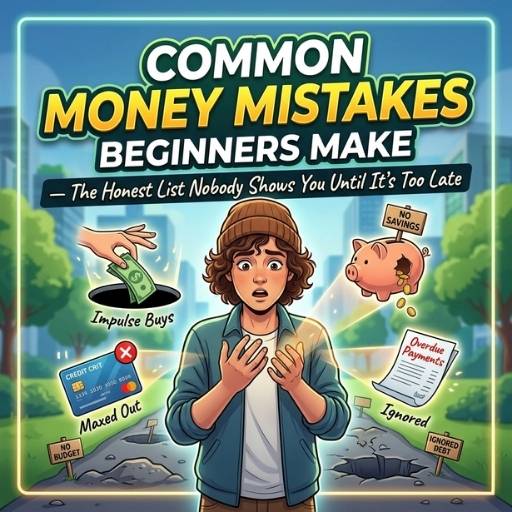
Description: Discover the most common money mistakes beginners make and how to avoid them. A real, honest guide to the financial errors that quietly cost people years of progress.
Nobody Warns You About These. So Let Me.
Let me start with something I genuinely wish someone had told me clearly when I started earning my own money.
Nobody sits you down and explains the specific, predictable mistakes that almost every person makes in their first few years of financial independence. There is no orientation session. No mandatory course. You are simply handed a salary, a bank account, and access to credit, and expected to figure out the rest through trial and error — mostly error, as it turns out, because the mistakes that cost beginners the most money are remarkably consistent and remarkably avoidable once someone actually names them clearly.
I made almost every mistake on this list. Not because I was reckless or financially illiterate in some obvious way. I read articles. I had a vague sense that saving was important. I just did not understand the specific, practical traps that exist between knowing you should be financially responsible and actually being financially responsible.
This guide names those traps clearly. Not in the abstract, vague way that most financial advice does — "spend less than you earn" — but in the specific, recognizable way that lets you see exactly which mistake you might currently be making and exactly what to do differently.
Mistake 1 — Treating Take-Home Pay as Spendable Income
This is the foundational mistake from which most other beginner mistakes flow.
When your salary arrives, the entire amount feels like money available for spending. It is not. A meaningful portion of that money has already been claimed — by your future emergency fund, by your future retirement, by your future self who will need money for goals that have not happened yet but absolutely will.
The beginner mistake is mentally treating the full salary as discretionary, then trying to find money for savings from whatever happens to be left over at the end of the month. This almost never works, because spending naturally expands to fill available income.
The fix: Treat savings as a bill you pay yourself — automatically, immediately, before any other spending decision. The moment your salary arrives, a predetermined percentage moves to savings before you see it as available money. What remains in your spending account is your actual take-home pay for decision-making purposes.
Mistake 2 — Not Understanding the Real Cost of Credit Card Debt
Most beginners understand abstractly that credit card debt is "bad" without understanding specifically how destructive the actual mathematics are.
Credit card interest in India typically runs between thirty-six and forty-four percent annually. At these rates, a ten thousand rupee balance that is not paid off becomes a genuinely serious financial problem within a year or two if only minimum payments are made — because the interest compounds faster than most beginners' mental model of "I'll pay it off eventually" can keep up with.
The specific beginner trap is treating the credit card limit as available money rather than as a short-term borrowing facility that must be repaid in full to avoid catastrophic interest costs. Carrying a balance "because the minimum payment is manageable" is the single most expensive common financial behavior available to a young earner.
The fix: Treat credit cards exclusively as a payment convenience tool, paid in full every single month without exception. If you cannot pay the full statement balance, you are spending money you do not have at an interest rate that will make the original purchase cost dramatically more than its sticker price.
Mistake 3 — Lifestyle Matching Income Immediately
Covered in depth in the lifestyle inflation guide, but worth restating specifically as a beginner mistake because it happens so early and so consistently.
The first salary, the first real income, creates an almost irresistible urge to immediately establish a lifestyle that matches the new earning level — the apartment, the wardrobe, the dining habits, the gadgets that signal "I am now a working professional."
The mistake is doing this immediately rather than gradually, and doing it without any parallel commitment to savings. The beginner who upgrades their entire lifestyle in the first six months of earning establishes spending patterns and expectations that are extremely difficult to walk back later, even as the genuine need to save and invest becomes more financially urgent.
The fix: Maintain a meaningfully simpler lifestyle than your income technically allows for the first one to two years of earning, specifically to build savings habits and an emergency fund before lifestyle expansion claims the available margin.
Mistake 4 — No Emergency Fund Before Anything Else
A remarkably common beginner pattern is starting to invest — SIPs, stocks, even cryptocurrency — before having any emergency fund at all. This feels productive and forward-thinking. It is actually a significant structural risk.
Without an emergency fund, any unexpected expense — a medical issue, a phone replacement, a family emergency — forces either high-interest debt or the premature liquidation of investments, frequently at exactly the wrong time from a market perspective.
The fix: Build at least one month of essential expenses in a simple savings account before starting any investment activity, then continue building toward three to six months while investing simultaneously at a more modest pace. Emergency fund and investment are not sequential in the long run, but the very first stage of financial life should prioritize the emergency buffer.
Mistake 5 — Ignoring Employer Retirement Benefits
Many beginners, especially those early in formal employment, do not pay close attention to EPF contributions, do not understand what NPS options might be available, and treat retirement planning as something to think about "later" — defined as some vague point in their thirties or forties.
The mathematics of compounding mean that money invested in your twenties has dramatically more time to grow than identical money invested in your thirties. A beginner who ignores retirement planning entirely in their twenties is not just delaying contributions — they are permanently forfeiting years of compounding that cannot be recovered by contributing more later.
The fix: Understand your EPF contribution and employer matching from your very first job. If voluntary additional retirement contributions are available and you can afford even a modest amount, start them immediately rather than waiting for an income level that feels "ready."
Mistake 6 — Buying Insurance as Investment
A specific and costly beginner mistake in the Indian context is purchasing traditional endowment or ULIP insurance policies, sold by an agent or a well-meaning relative, as a combined "insurance plus investment" product.
These products consistently underperform the alternative of purchasing pure term insurance separately and investing the remaining premium difference in mutual funds. The combined products carry high costs embedded in their structure, and beginners frequently do not understand this because the products are marketed specifically to obscure the cost comparison.
The fix: Purchase pure term life insurance for protection — inexpensive and providing large coverage — and invest separately in mutual funds or other instruments for wealth building. Do not combine the two functions in a single product regardless of what an agent recommends, because the combined products consistently serve the agent's commission better than your financial interests.
Mistake 7 — Following Investment Tips Without Understanding Them
Beginners are particularly vulnerable to investment tips from friends, family WhatsApp groups, social media influencers, and stock market "gurus" promising specific returns or specific stock picks.
The mistake is not that all such tips are wrong — some genuinely are not — but that acting on a tip without understanding why it might be a good investment means you have no framework for knowing when to sell, no understanding of the actual risk involved, and no ability to distinguish a genuinely informed recommendation from confident-sounding nonsense.
The fix: Never invest in anything you cannot explain in your own words, including why it might lose money and under what conditions you would sell it. If a tip does not meet this bar, it is not yet a basis for investment regardless of how confident the source sounds.
Mistake 8 — Not Tracking Where Money Actually Goes
As detailed extensively in the expense tracking guide, the single most common beginner financial mistake is operating without any clear picture of actual monthly spending, relying instead on a vague sense of where money goes that is almost always inaccurate.
This mistake is not really about the tracking itself — it is about the decisions that become impossible without the tracking. You cannot meaningfully reduce spending in a category you have not identified as a problem. You cannot calculate a realistic savings target without knowing your actual essential expenses.
The fix: Spend one focused session reviewing three months of actual bank and UPI transaction history, categorized honestly, before making any assumptions about your spending patterns or setting any budget targets.
Mistake 9 — Co-signing or Lending Money Without Clear Boundaries
A specific beginner mistake that has nothing to do with markets or budgets: lending significant money to friends or family, or co-signing loans, without clear repayment terms or honest assessment of the relationship's ability to absorb the financial and emotional cost if repayment does not happen.
Beginners, often eager to be helpful and not yet experienced in how these situations frequently unfold, are particularly vulnerable to this mistake — both because they may not have significant savings to lose and because saying no to family is genuinely difficult early in one's independent financial life.
The fix: Any money lent to friends or family should be treated mentally as a gift you can afford to give, not a loan you expect repaid. If you cannot afford to lose the money entirely, do not lend it, regardless of the relationship pressure involved.
Mistake 10 — Comparing Your Financial Journey to Curated Social Media Lives
Covered in the money psychology guide but worth restating specifically for beginners, who are particularly exposed to this distortion during the years when their financial base is smallest and their social media consumption is often highest.
The specific beginner version of this mistake is benchmarking your financial progress — your salary, your possessions, your lifestyle — against the curated presentations of peers on Instagram and LinkedIn, which systematically overrepresent success and underrepresent struggle, debt, and financial stress.
The fix: Recognize explicitly that social media financial signaling is not a reliable benchmark for your own situation, and find real, honest financial conversations — with a mentor, a financially literate friend, or even your own structured research — to calibrate genuine expectations rather than curated ones.
Final Thoughts — Beginner Mistakes Are Normal. Persisting in Them Is the Real Risk.
Every single mistake on this list is genuinely common. Almost everyone who has ever earned money has made several of them, often simultaneously, in their first years of financial independence.
The actual risk is not making these mistakes once. It is not recognizing them, and therefore repeating them for years, compounding their cost the way interest compounds — quietly, consistently, and far more significantly than it feels like in any single month.
Reading this list and recognizing yourself in two or three of these mistakes is not a failure. It is the necessary first step toward correcting course while the time value of money is still working in your favor rather than against it.
Start with the one mistake on this list that you recognize most clearly in yourself.
Fix that one first. The rest become significantly easier once the first habit is genuinely in place.
Frequently Asked Questions (FAQs)
Q1. What is the single most damaging financial mistake beginners make?
Carrying credit card debt while making only minimum payments is widely considered the most damaging single beginner mistake, because the interest rate of thirty-six to forty-four percent annually compounds faster than almost any other financial behavior can outpace. Lifestyle inflation that immediately consumes income increases is a close second in terms of long-term wealth impact, because it establishes spending patterns that become progressively harder to reverse and that prevent savings habits from ever forming.
Q2. How much should a beginner save before starting to invest?
Most financial planners recommend building at least one month of essential expenses before starting any investment activity, then continuing to build toward a three to six month emergency fund while investing modestly in parallel. The emergency fund protects against the need to liquidate investments prematurely or take on high-interest debt when unexpected expenses arise, which is a genuinely common occurrence in the first few years of financial independence.
Q3. Is it really a mistake to buy insurance-cum-investment products like ULIPs?
For most beginners, yes. These combined products consistently carry higher embedded costs than purchasing pure term insurance and investing separately in mutual funds, and the structure of the products often obscures this cost difference from buyers who are not already financially sophisticated. The general financial planning consensus strongly favors separating insurance and investment into distinct products purchased independently.
Q4. How do I stop comparing my financial situation to other people my age?
Recognize that the information you have about other people's financial situations is almost always incomplete and frequently curated for social presentation rather than accurate. Focus instead on tracking your own progress against your own starting point and your own specific goals, using concrete numbers — your savings rate, your emergency fund size, your debt levels — rather than comparative social impressions that are unreliable by design.
Q5. What should I do first if I recognize several of these mistakes in my own financial life?
Start with whichever mistake is actively costing you the most money right now, which for most people is high-interest debt if it exists. Pay that down aggressively before focusing heavily on other goals, since the guaranteed "return" of eliminating thirty-six percent interest debt exceeds almost any other financial action available to you. Once high-interest debt is addressed, move to building the emergency fund, then to addressing lifestyle and tracking habits simultaneously.
Comments
No comment yet. Be the first to comment