Building Multiple Income Streams — The Honest Guide to Earning Beyond Your Salary
By: compiled from various sources | Published on Jun 20,2026
Category Intermediate
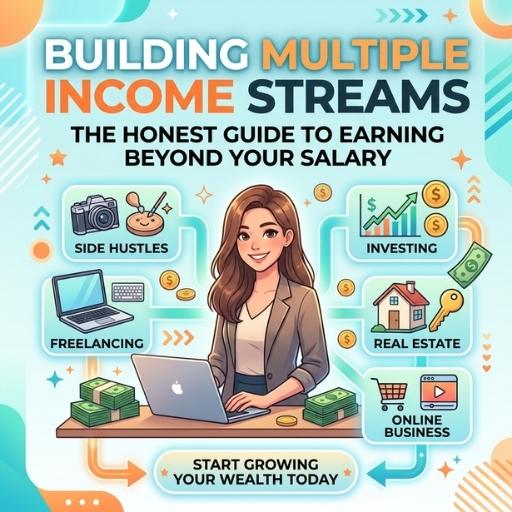
Description: Learn how to build multiple income streams that actually work in 2026. An honest, practical guide to earning beyond your salary for every income level and life stage.
One Source of Income Is Not a Financial Plan. It Is a Single Point of Failure.
Let me start with something that happened to someone I know that I think about more than I probably should.
He was thirty-one years old, working at a mid-sized technology company in Pune, earning a salary that by any reasonable measure was comfortable. Not extraordinary but genuinely good — enough to support his lifestyle, contribute to savings, and feel reasonably secure about his financial near-term future.
Then his company announced layoffs. His role was eliminated. The salary that had been arriving with reliable monthly certainty for four years simply stopped.
What followed was eight months of job searching during a period when the technology sector was contracting, his emergency fund was insufficient for that duration, and the financial stress of the situation affected everything — his relationships, his health, his confidence in interviews, his ability to think clearly about long-term decisions.
He eventually found a new role. The story does not end in disaster. But what he said afterward has stayed with me.
"I had one source of income and I treated it like it was permanent. It was not permanent. Nothing about a job is permanent. And I had nothing else."
That sentence — "I had nothing else" — is the entire argument for building multiple income streams in four words.
A single salary, regardless of its size, is a single point of failure. When it fails — and over a full career, most people experience at least one significant income disruption — there is nothing else. The financial consequences of that nothing else are real, immediate, and sometimes lasting.
Multiple income streams are not a luxury reserved for entrepreneurs or side hustle enthusiasts. They are a basic structural requirement of financial resilience in an economy where employment security is not guaranteed and where the gap between a financial shock and financial catastrophe is determined largely by whether alternative income exists to bridge it.
This guide explains how to build them. Honestly, practically, and without the unrealistic promises that most multiple income stream content relies on.
The Honest Starting Point — What Multiple Income Streams Actually Means
Before the specific strategies, some definitional honesty that most guides in this space avoid.
Multiple income streams does not mean passive income that requires no effort. The phrase "passive income" — as used in most internet content about financial freedom — is almost always either misleading or describing an end state that required significant active effort to create. There is no genuinely effortless income stream available to most people. There is income that requires ongoing active effort. And there is income that required significant upfront effort to create and now requires less ongoing maintenance.
Multiple income streams also does not mean doing ten things simultaneously at the cost of doing none of them well. The most common multiple income stream failure mode is spreading effort across too many streams too early — generating modest revenue from several sources while failing to develop any single stream to the point where it provides meaningful income.
What multiple income streams actually means practically: building additional sources of income beyond your primary salary or business, sequentially rather than simultaneously, with realistic timelines and realistic income expectations for each stage of development.
The Framework — Four Categories of Additional Income
Every income stream available to most people falls into one of four categories. Understanding which category you are working in changes how you approach building it, what timeline is realistic, and what effort is required.
Category 1 — Active Income From Skills You Already Have
This is the fastest to start and the most immediately accessible. You already have professional skills — skills someone paid you to develop, skills that have market value beyond your current employer. Offering those skills to additional clients or in additional contexts generates income from capability you already possess.
Examples: freelance work in your professional field, consulting, tutoring or teaching in areas of expertise, contract work through platforms.
Realistic timeline to first income: weeks to a few months.
Realistic income potential: significant — often comparable per-hour rates to your primary employment, sometimes higher.
Effort required: ongoing active effort proportional to income earned.
Category 2 — Income From Created Assets
You create something once — a course, a digital product, written content, software, a template, a guide — and that asset generates income when people purchase it, without requiring you to recreate it each time. This is the category that most closely resembles genuine passive income, though the creation phase requires significant upfront work.
Examples: online courses, ebooks, templates and digital downloads, stock photography or music, software tools.
Realistic timeline to meaningful income: six months to two years, including creation time and audience development time.
Realistic income potential: highly variable — most digital products generate modest income, a small percentage generate significant income.
Effort required: high upfront, lower ongoing maintenance, but requires ongoing marketing effort to drive sales.
Category 3 — Income From Capital
Money generating money — investment returns, rental income, dividend income, interest income. This category genuinely provides income without ongoing time investment once the capital is deployed, but it requires capital to deploy — which means it builds slowly for most people starting from modest savings.
Examples: equity mutual fund returns, rental property income, dividend-paying stocks, fixed deposits, peer-to-peer lending.
Realistic timeline to meaningful income: years to decades, dependent on how much capital is available and how consistently additional capital is deployed.
Realistic income potential: proportional to capital deployed — meaningful passive income from investments typically requires significant capital base.
Effort required: low ongoing effort once deployed, significant upfront effort in selecting and monitoring.
Category 4 — Income From Platforms and Audiences
Building an audience through content creation and monetizing that audience through advertising, sponsorship, affiliate marketing, merchandise, or direct support. This is the category that social media has made newly accessible and that most passive income content focuses on — and it is also the category with the most survivorship bias, where the successes are highly visible and the failures are invisible.
Examples: YouTube channel monetization, blog advertising revenue, podcast sponsorship, social media creator funds, affiliate marketing commissions.
Realistic timeline to meaningful income: one to three years of consistent content creation before most creators reach meaningful monetization.
Realistic income potential: most creators earn modest amounts; a small percentage earn significant income; a very small percentage earn extraordinary income.
Effort required: high and sustained — consistent content creation is genuinely demanding work.
Where to Start — The Honest Sequencing
Here is the specific sequencing advice that most multiple income stream content omits because it is less exciting than promising multiple simultaneous income streams.
Start with Category 1 — active income from existing skills — and do it first.
The reason is straightforward. Category 1 generates income fastest from effort you can start immediately, using skills you already have. The money is real and near-term rather than speculative and distant. And the additional income from Category 1 can fund the development of longer-timeline Category 2, 3, and 4 streams — making those streams easier to build without financial pressure.
The specific Category 1 stream that makes most sense depends on your professional field and your specific skills. Some examples relevant to Indian professionals in 2026:
A software developer can offer freelance development services through Upwork, Toptal, or direct client relationships — immediately commanding rates comparable to or exceeding their salaried hourly equivalent.
A marketing professional can offer freelance content writing, social media management, or campaign consulting to small businesses that cannot afford full-time marketing staff.
A finance professional can offer bookkeeping, tax preparation assistance, or financial modeling services to small business owners.
A teacher or trainer can offer tutoring, coaching, or online teaching through platforms including Vedantu, Chegg, or directly through scheduled sessions.
A designer can offer freelance design services through platforms or direct client relationships.
The specific field matters less than the principle — identify the skills your primary employment has developed, identify who else might value those skills, and create a mechanism for those additional clients to pay you for them.
Building the First Stream — The Practical Steps
Step 1 — Identify your most marketable skill specifically
Not broadly — "I work in technology" is not specific enough. What specifically do you do that someone else would pay for? "I build React frontend applications" or "I write long-form SEO content for SaaS companies" or "I manage Facebook advertising campaigns for e-commerce stores" — this level of specificity is what makes you findable and hireable.
Step 2 — Determine the right channel for your first clients
For most professionals starting their first freelance stream, the choice is between platforms (Upwork, Fiverr, PeoplePerHour, Toptal depending on your field) or direct outreach to potential clients in your network or industry.
Platforms have the advantage of existing client traffic — people searching for your service can find you without you having to find them. The disadvantage is competition and platform fees. Direct client development through your professional network has no platform fees and can generate higher-value relationships, but requires more active outreach effort to initiate.
Step 3 — Price your services honestly
The most common beginner mistake in freelancing is underpricing — charging dramatically below market rates under the assumption that lower prices will attract clients faster. This strategy generates low-paying clients and makes building a sustainable freelance income stream unnecessarily difficult.
Research market rates for your specific skill through platform data, professional community conversations, and industry salary surveys. Price within market range from the start, even as a new freelancer, and differentiate through quality and professionalism rather than through price.
Step 4 — Treat the first stream as a real business from day one
Register for GST if required based on your projected revenue. Maintain separate accounting for freelance income. Understand the tax implications of additional income beyond your salaried employment. These administrative foundations matter more as income grows, but establishing them early prevents the complications of retroactive accounting and compliance.
Building the Second Stream — Once the First Is Established
The temptation is to build all streams simultaneously from the beginning. The practical reality is that most people who attempt this end up with multiple underdeveloped streams rather than one well-developed stream providing meaningful income.
The sequencing that works: establish the first stream to the point where it generates consistent additional income with manageable ongoing effort. Then use some of that additional income and time margin to begin developing the second stream.
The natural second stream for most people:
If your first stream is active freelance income: the natural second stream is a created asset from your expertise — an online course, a guide, a template library — that generates income from the same expertise without requiring your time for each transaction. You go from selling hours to selling products created from your knowledge.
If your first stream is investment income: the natural second stream is expanding the capital base through additional investment instruments — adding equity exposure to a fixed income foundation, or adding real estate exposure to equity.
If your first stream is content/platform income: the natural second stream is direct monetization of the audience you have built — a course or product sold directly to your audience rather than relying solely on platform advertising revenue.
The Indian Context — Specific Opportunities Worth Understanding
Freelancing platforms and the global client opportunity:
India's technical and creative professional workforce has a specific structural advantage in the global freelance market — strong English communication skills, competitive pricing relative to Western markets, and deep expertise in technology, creative, and professional services that global clients need.
The combination of platforms like Upwork and Toptal with India's professional skill base creates genuine income opportunities that did not exist at scale a decade ago. An Indian software developer offering services at rates competitive with their Indian salaried income can earn three to five times equivalent rates in Western client markets.
YouTube and the Hindi content opportunity:
YouTube monetization for Hindi-language content creators has grown significantly as advertising rates for Indian audiences have improved. While English content still commands higher advertising rates, the absolute scale of Hindi-speaking internet audiences means Hindi content creators with genuine value to offer can build meaningful monetization from significantly smaller audiences than English content requires.
Affiliate marketing in growing Indian categories:
Affiliate marketing — earning commission by recommending products and driving purchases — has developed genuine income potential in specific Indian categories. Financial products including credit cards, loans, and investment platforms offer meaningful affiliate commissions. E-commerce through Amazon India and Flipkart affiliate programs. Insurance products. EdTech platform referrals.
The key constraint in affiliate marketing is audience — commission income is proportional to how many people see and act on your recommendations, which requires either significant existing audience or significant content marketing investment to build.
The stock market and systematic investment:
For Indian professionals, systematic equity investment through monthly SIPs is the most accessible and most evidence-supported path to building Category 3 capital income over time. The compounding mechanics are well-documented elsewhere in this series — the relevant point here is that even modest monthly investment amounts, sustained consistently over years, build a capital base that eventually generates meaningful passive income through growth and dividends.
The Time Reality — What Building Multiple Income Streams Actually Requires
Here is the honest accounting that most multiple income stream content avoids.
Building a meaningful additional income stream requires time — real time that comes from somewhere in your existing schedule. For most employed professionals, that somewhere is evenings, weekends, and time currently spent on lower-value activities.
This is not impossible. Many people successfully build additional income streams while maintaining full-time employment. But it requires honest acknowledgment that the time investment is real and sustained rather than occasional.
A realistic time budget for building a first freelance stream might look like ten to fifteen hours per week in the initial months — time spent on client development, service delivery, and administrative setup. As the stream becomes established and processes become efficient, ongoing maintenance might require five to eight hours weekly.
This is genuine commitment. It is also achievable for most people who identify clearly where their current time goes and make deliberate choices about what to prioritize differently.
The energy reality:
Time availability is not the only constraint. Mental and physical energy are finite. Attempting to build income streams while depleted — from demanding primary employment, from family obligations, from health challenges — produces lower quality output and higher burnout risk.
The honest advice is to start income stream building during periods of relative stability and energy rather than during already-demanding life phases, and to build at a sustainable pace rather than an intensive pace that cannot be maintained.
What to Do With the Additional Income
Here is the question that determines whether multiple income streams build wealth or simply fund lifestyle inflation.
Additional income from new streams should be deliberately allocated — not simply absorbed by the spending account where lifestyle inflation will claim it automatically.
A reasonable allocation framework for additional income streams in their development phase:
Reinvestment into the stream itself — tools, education, marketing, outsourcing of low-value tasks that free your time for higher-value activities. This investment accelerates the stream's development and long-term income potential.
Building the emergency fund — if not already at three to six months of expenses, additional income directed here first provides the financial resilience that makes everything else more secure.
Funding the next income stream — using income from Stream 1 to fund the development of Stream 2, whether through investment capital, course creation tools, or content marketing infrastructure.
Long-term investment — directing a meaningful percentage to systematic equity investment compounds the wealth-building effect across all streams simultaneously.
Final Thoughts — The Goal Is Resilience, Not Complexity
Here is what multiple income streams actually provide at their most fundamental level.
Not financial complexity. Not the social media identity of being a multi-stream entrepreneur. Not infinite passive income while you sleep.
Resilience. The specific, practical, genuinely valuable quality of having multiple sources of income such that the loss of any single one — however painful and disruptive — is not catastrophic. That the eight months of job searching that devastated my friend's finances would instead be navigated from a position of alternative income, depleted savings, and maintained forward progress rather than genuine financial crisis.
That resilience is worth building. It is worth the time investment required. It is worth the learning curve of the first uncomfortable client conversation or the first content piece that nobody reads or the first investment that does not perform as expected.
Because the alternative — a single point of income failure, and nothing else — is a financial structure that most careers will eventually test.
Build before the test arrives.
Because once it does, the time to build is already past.
Frequently Asked Questions (FAQs)
Q1. How many income streams should I have?
Quality over quantity is the honest answer. Two well-developed income streams providing meaningful income are worth significantly more than five underdeveloped streams providing negligible income. Most financial advisors suggest three to five income streams as a reasonable target for genuine financial resilience — a primary income source, one or two active additional streams, and investment income that grows over time. Building sequentially toward this target over years produces better outcomes than attempting all streams simultaneously from the beginning.
Q2. Can I build multiple income streams while working full time?
Yes, and most people who successfully build additional income streams do so while maintaining full-time employment — using the salary income as financial stability while building additional streams in available time. The key constraints are honest time accounting (identifying where the ten to fifteen weekly hours will come from), energy management (not attempting income stream building during already-depleted periods), and employer conflict of interest awareness (ensuring freelance work does not violate employment contract terms regarding outside work).
Q3. What is the fastest additional income stream to build?
Active freelancing in your existing professional skill set is consistently the fastest path to additional income — often generating first income within weeks rather than months. The reason is simple: you already have the skills, you simply need clients. Digital product creation, content monetization, and investment income all require longer development timelines before generating meaningful income. If speed is the priority — for example, to build emergency fund faster or to bridge a specific financial gap — active freelancing in your area of expertise is the most reliable quick-start option.
Q4. How do I handle taxes on multiple income streams in India?
Additional income beyond salaried employment is taxable in India as either business income or professional income depending on its nature. Freelance and consulting income above the GST registration threshold requires GST registration and compliance. All additional income must be declared in your ITR filing. Professional expenses related to generating the income — software, equipment, home office costs, professional development — are potentially deductible against the income. Consulting a chartered accountant for the first year of significant additional income is worth the cost to establish correct compliance foundations.
Q5. Is passive income actually achievable or is it mostly a myth?
Genuinely passive income — income that requires zero ongoing effort — is largely a myth for most people. What is achievable is income that requires low ongoing maintenance effort relative to its income generation, after significant upfront work to create it. Investment income from deployed capital comes closest to genuinely passive — it requires monitoring and occasional rebalancing but not ongoing active effort. Digital product income requires ongoing marketing effort to sustain sales. Content monetization requires ongoing content creation. Rental income requires property management. The honest framing is "lower-effort income" rather than "passive income" — achievable and valuable, but not effortless.
Comments
No comment yet. Be the first to comment