How Social Media Influences Your Spending — The Invisible Hand Reshaping Your Wallet
By: compiled from various sources | Published on Jul 03,2026
Category Beginner
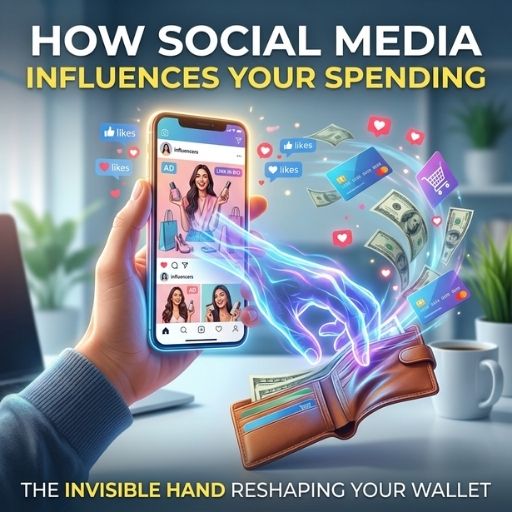
Description: Discover how social media influences your spending habits in 2026. An honest, practical guide to the psychological mechanisms behind social media's impact on your finances.
Your Phone Is the Most Effective Shopping Mall Ever Built. And You Carry It Everywhere.
Let me start with something that I think most people have experienced but very few have examined clearly.
You open Instagram. You are not shopping. You had no intention of shopping. You are simply doing what hundreds of millions of people do dozens of times a day — scrolling, watching, half-engaging with the stream of content that the algorithm has assembled specifically for you based on everything it knows about your attention patterns, your interests, and your behavioral responses.
Thirty minutes later you have added something to a cart. Or you have opened a new browser tab to look at something you saw. Or you have screenshot a product to revisit later. Or you have followed a brand account that you will see content from for weeks. Or you have simply absorbed an image of a lifestyle — a kitchen, a wardrobe, a travel destination, a body, an apartment — that has quietly recalibrated what feels normal, desirable, or necessary in your own life.
Nothing dramatic happened. No single moment felt like a significant decision. And yet your spending intentions, your sense of what you need, and your baseline understanding of what a life at your level should look like have been subtly and meaningfully changed by thirty minutes of content consumption.
This happens multiple times per day, every day, to billions of people globally. The aggregate financial consequence is extraordinary. And most of the people experiencing it have never examined the specific mechanisms by which it operates — which means they cannot make genuinely informed choices about how they engage with platforms whose business model depends on converting their attention into spending.
This guide names those mechanisms clearly. Not to make you paranoid about social media. Not to suggest you should delete your accounts. But to give you the specific understanding that makes genuinely informed financial engagement with these platforms possible.
The Business Model That Makes This Inevitable
Before the specific psychological mechanisms, understanding why social media platforms are designed to influence spending makes every subsequent point clearer.
Social media platforms are not free services that happen to run advertising. They are advertising businesses that use social features as the mechanism for capturing and holding attention. The product being sold is your attention — specifically, your sustained, engaged, targeted attention — and the customers are advertisers who pay for access to it.
The more time you spend on a platform, the more advertising revenue the platform generates. The more precisely the platform can match advertising content to your specific demonstrated interests, the more valuable that advertising is to advertisers and the more they pay for it. And the more effectively that advertising converts your attention into purchasing behavior, the more attractive the platform becomes as an advertising destination.
Every design decision in every major social media platform — the infinite scroll that has no natural stopping point, the variable reward mechanism of notifications and likes, the algorithmic curation that shows you content you are most likely to engage with, the seamless integration of shoppable content into organic content streams — is optimized for this business model.
This does not make these platforms malicious. But it does mean that the interests of the platforms and the interests of your financial wellbeing are not aligned. The platform benefits when you spend more time engaged, more emotionally activated, and more likely to make purchases in response to content. Your financial wellbeing benefits from spending less time in states of desire, comparison, and consumption impulse.
Understanding this misalignment is the starting point for engaging with social media in ways that serve your interests rather than the platform's.
Mechanism 1 — Social Comparison at Industrial Scale
Social comparison — the human tendency to evaluate our own circumstances relative to others — is one of the most fundamental and most documented psychological processes in human behavior. It is also, as we explored in the money psychology guide, one of the primary drivers of consumption spending.
Social media has industrialized social comparison in ways that have no historical precedent.
Before social media, your comparison reference group was limited by geography and social access — primarily the people you actually knew, in your neighborhood, your workplace, your extended family. This reference group was diverse in income, diverse in lifestyle, and representative of a realistic range of what people at your life stage actually experienced.
Social media has replaced this limited, realistic reference group with an algorithmically curated global network of highlight reels. The people whose content you see are not randomly selected from the population. They are the people whose content generates the most engagement — which systematically selects for people whose lives are visually attractive, whose consumption is aspirational, and whose experiences are exceptional rather than typical.
The practical consequence is that your comparison baseline — what feels normal, what feels adequate, what feels like a reasonable standard of living — has been calibrated against a reference group that is systematically biased toward exceptional consumption, exceptional appearance, and exceptional experience.
A wardrobe that would have felt entirely adequate when compared to your actual neighbors feels inadequate when compared to the fashion content your algorithm serves you. A holiday that would have been genuinely exciting when planned without social media reference feels ordinary against the travel content that has been normalizing extraordinary destinations as standard aspirational experiences.
This recalibration happens invisibly, continuously, and without any moment of conscious decision-making. The comparison is not a deliberate act. It is a background process that runs constantly during social media consumption and that shapes spending intentions as a side effect of the comparison itself.
Mechanism 2 — The Aspirational Identity Sell
Here is the specific mechanism by which the most effective social media marketing operates — and why it is so much more powerful than traditional advertising.
Traditional advertising sells products. The message is essentially: this product exists, it has these features, it costs this much, you should buy it.
Social media influencer marketing sells identities. The message is: this is the kind of person I am. I use these products. I live this kind of life. I make these choices. And because the audience has chosen to follow this person — because they find this person admirable, relatable, or aspirational — the products associated with the identity feel like pathways to the identity rather than simply things to buy.
The psychological mechanism is identification rather than persuasion. When you see an influencer whose lifestyle you admire using a specific skincare product, the feeling produced is not "this product sounds useful" — it is "this product is part of a life I want to live." The purchase feels less like a consumer decision and more like an identity expression.
This is more effective than traditional advertising for a specific reason. Persuasion can be resisted when you recognize it as persuasion. Identification feels like personal preference rather than commercial influence — which means the defenses that consumers apply to obvious advertising do not activate in the same way.
The influencer's audience does not feel marketed to. They feel like they are getting recommendations from someone they trust. The fact that the influencer is being paid for the recommendation — which disclosure requirements increasingly mandate being stated explicitly — does not eliminate the trust relationship because the audience has built genuine parasocial connection with the creator over time.
Mechanism 3 — The Algorithm That Knows Your Desires Before You Do
Social media algorithms are among the most sophisticated pattern-recognition systems ever built at consumer scale. They have processed behavioral data from billions of users across years of interaction — and what they have learned is how to predict, with extraordinary accuracy, what content will keep any specific user engaged.
For spending behavior specifically, this means the algorithm knows what categories of products you have previously shown interest in — through the content you have engaged with, the accounts you have followed, the links you have clicked, and the advertisements you have spent time viewing. It uses this knowledge to serve you more content in those categories — not just advertisements but organic content that reinforces your interest and expands your desire.
If you spent three minutes watching a home renovation Reel last week, you will see significantly more home renovation content this week. Not because you deliberately sought it out — because the algorithm identified your interest and is now feeding it. And as your interest is fed, it grows — you see more content, you engage more with that content, you develop more detailed awareness of products in that category, and your sense of what your home could and should look like is progressively upgraded by the content being served.
By the time you see a specific product advertisement in a category the algorithm has been warming for weeks, the groundwork for the purchase has been laid through organic content that did not feel like advertising at all.
This process — interest identification, organic content amplification, gradual desire development, eventual advertising exposure — is the full funnel that modern social media advertising operates. The advertisement at the end is the smallest and least important part of the commercial influence. The organic content amplification that preceded it is where the real work happened.
Mechanism 4 — Friction Removal and Impulse Activation
Traditional retail created natural friction between desire and purchase — you saw something you wanted, you had to physically go to a store, you had to interact with a salesperson, you had to handle the product, you had to pay with cash or card in a deliberate transaction. These friction points were not purely negative experiences — they also created natural pauses in which desire could be examined, compared, and sometimes reconsidered.
Social media commerce has systematically removed this friction. Instagram shopping allows purchase directly within the app without leaving the content stream. Shopify integration means a shoppable story can convert interest to purchase in four taps. Saved payment information means the transaction completes without the friction of entering card numbers. Express checkout options mean the entire purchase can be completed before the browsing session ends.
The removal of friction is deliberately designed to exploit what behavioral economics identifies as the peak of impulse desire — the moment immediately after content creates wanting, before rational reflection can engage. Every second of delay between desire and purchase opportunity is a second in which the desire might fade or the rational mind might engage with questions like "do I actually need this" or "can I afford this right now."
The frictionless purchase captures the desire at its peak, before those questions can be asked. The package arrives three days later to a person who may have largely forgotten the specific moment of wanting that triggered the purchase — and who may not connect the financial drain to the social media session that initiated it.
Mechanism 5 — FOMO and Artificial Scarcity
Fear of missing out — FOMO — is one of the most reliably exploited psychological mechanisms in social media commerce. The combination of social proof and scarcity messaging creates urgency that bypasses the deliberate consideration that good financial decisions require.
When content shows that other people have already bought something — the comment sections full of purchase confirmations, the user-generated content showing the product in use, the influencer content showing the product sold out — the social proof signals that missing this purchase means being excluded from an experience that others are already having.
Scarcity messaging amplifies this — "only three left," "sale ends tonight," "limited edition" — creating time pressure that makes the purchase feel urgent rather than optional. The combination of social exclusion fear and time pressure is specifically designed to prevent the one behavioral response that protects against impulse purchasing: waiting.
The thirty-day rule — waiting thirty days before buying anything non-essential — is effective precisely because it allows the FOMO and scarcity urgency to dissipate. Most desired purchases that feel urgent in the moment of social media exposure feel significantly less urgent thirty days later, when the specific content that triggered the desire has been replaced by dozens of other pieces of content and the specific urgency has expired.
Mechanism 6 — The Lifestyle Content That Resets Your Baseline
This is the mechanism that operates most slowly and most deeply — and that has the most significant long-term financial consequences.
Lifestyle content — the aspirational images of homes, wardrobes, meals, travel, relationships, and bodies that constitute a significant portion of most social media feeds — does not primarily sell specific products. It sells a vision of what a good life looks like. And through continuous exposure, it gradually resets what feels normal, adequate, or desirable in your own life.
The kitchen renovation content you have been consuming for six months has not been advertising any specific product most of the time. It has been gradually upgrading your baseline of what a kitchen should look like — so that your functional, perfectly adequate kitchen feels increasingly inadequate by comparison. When you eventually do renovate, or buy new kitchen items, or upgrade appliances, the spending does not feel like a response to social media influence. It feels like a personal decision based on your own preferences.
It is both of those things simultaneously. The preference was genuinely yours — you do genuinely prefer the upgraded kitchen over your existing one. But the preference was developed and intensified through a specific media environment that curated content to build that preference, for commercial reasons that had nothing to do with your actual need for a kitchen renovation.
This mechanism operates across every lifestyle category — travel, clothing, fitness, food, home goods, technology, personal care. The cumulative effect is a continuous upward pressure on spending baseline that feels like natural preference evolution but is substantially driven by curated commercial content.
The Indian Context — Specific Dynamics Worth Understanding
The aspirational middle-class content machine:
India's rapidly expanding social media creator economy has developed a specific content category — aspirational urban middle-class lifestyle content — that speaks directly to the largest and fastest-growing segment of Indian social media consumers. Content depicting urban professional lifestyles, café culture, travel experiences, home aesthetics, and fashion choices has created specific spending pressure among audiences who are experiencing rising incomes alongside rising lifestyle aspirations simultaneously.
Quick commerce and the instant gratification amplification:
India's extraordinarily developed quick commerce infrastructure — Blinkit, Zepto, Swiggy Instamart delivering in ten minutes — has combined with social media influence in a way that creates particularly powerful impulse purchase dynamics. The time between seeing something on Instagram and receiving it at home has been compressed to minutes in major Indian cities, essentially eliminating the natural friction that physical retail and even standard e-commerce delivery timelines provided.
The wedding and festival social pressure:
India's culturally significant social events — weddings, festivals, religious occasions — generate intense social media pressure around spending that has specific cultural weight beyond ordinary consumer marketing. The documentation and sharing of wedding and festival celebrations on social media creates comparison dynamics around event spending that can be particularly difficult to navigate because the spending is tied to genuine cultural values rather than purely commercial desires.
Influencer marketing in Indian vernacular languages:
The expansion of social media influence into Hindi and regional language content has extended the commercial influence mechanisms described throughout this guide to Indian audiences who were previously less exposed to English-language influencer marketing. Regional language influencers across platforms including Instagram, YouTube, and ShareChat have built audiences of extraordinary scale, and the brand partnerships accompanying that scale have introduced the identity-based influencer marketing model into vernacular content ecosystems.
What Actually Helps — The Practical Responses
Audit your feed deliberately:
Unfollow accounts whose content consistently creates desire for things you would not otherwise want. This is not about avoiding beautiful content — it is about being honest about which accounts leave you feeling inadequate or wanting things, versus which accounts leave you feeling inspired or informed. The former category is costing you money.
Separate browsing from buying:
When using social media, make a deliberate commitment to not completing purchases during the session. Screenshot things you are interested in. Revisit them forty-eight hours later through a direct product search rather than through the social media context that created the desire. This interrupts the frictionless-purchase mechanism while preserving your ability to buy things you genuinely want after consideration.
Use social media with specific intention:
The most expensive social media use is unfocused scrolling — opening an app with no specific purpose and allowing the algorithm to determine your experience. Using social media with specific intention — checking on specific accounts, responding to specific conversations, watching specific creators — limits your exposure to the algorithmically curated content stream that is most optimized for commercial influence.
Track the connection between social media consumption and spending:
Most people who honestly track their impulse purchases discover a strong correlation with social media consumption — specific purchases traceable to specific content encounters. Making this connection visible through honest expense tracking creates awareness that changes behavior more effectively than abstract knowledge that social media influences spending.
Apply a social media spending pause:
Any purchase discovered through social media — where you first encountered the product or desire through a social platform — automatically goes on a forty-eight-hour consideration list before purchase. This single rule captures most of the impulse-purchase-through-social-media behavior and prevents a significant proportion of it from completing without changing your fundamental social media engagement.
The Honest Conclusion — You Can Use Social Media Without Letting It Use You
Here is the reframe that makes all of this practical rather than simply alarming.
Social media's influence on spending is not mysterious, malevolent, or unstoppable. It is a specific set of mechanisms — social comparison, identity aspiration, algorithmic desire amplification, friction removal, FOMO activation, and baseline recalibration — that operate predictably and that can be meaningfully managed once you understand how they work.
You do not need to delete your accounts. You do not need to feel guilty about enjoying social media content. You do not need to become immune to the genuine human experience of finding something beautiful and wanting it.
What you need is the specific awareness that the platform you are using was designed to convert your attention into spending, that it is extraordinarily good at this, and that protecting your financial interests in this environment requires deliberate choices that the platform's design actively works against.
Make those choices deliberately. Use social media intentionally rather than compulsively. Apply the spending pause that interrupts the impulse purchase mechanism. Audit your feed honestly for content that costs you money by recalibrating your baseline upward. Track the connection between your consumption and your spending.
The algorithm is designed to know your desires better than you do.
The financial protection is in knowing your actual priorities better than the algorithm does.
Frequently Asked Questions (FAQs)
Q1. How much does social media actually influence consumer spending?
Research consistently shows significant social media influence on purchasing behavior. Studies across multiple markets indicate that a substantial percentage of social media users — estimates range from forty to seventy percent depending on the study and platform — have made purchases directly influenced by social media content including organic content and influencer recommendations. The financial scale is significant — global social commerce revenue is projected to exceed one trillion dollars annually by 2028. In India specifically, social media influence on purchase decisions is growing rapidly alongside smartphone penetration and the expansion of social commerce infrastructure on platforms including Instagram and WhatsApp.
Q2. Are influencer recommendations genuinely trustworthy or always commercially motivated?
Most significant influencer recommendations are commercially motivated — involving either paid partnerships, affiliate commissions, or product gifting that creates implicit commercial relationships even when not explicitly disclosed. Disclosure requirements in most markets require explicit acknowledgment of commercial relationships, though compliance varies. This does not mean every influencer recommendation is dishonest — many creators genuinely use and believe in products they recommend. But the commercial relationship means the recommendation is not the same as advice from a disinterested friend, and the selection of what to recommend is shaped by what brands are willing to pay for rather than purely by what is genuinely best for the audience.
Q3. What is the most effective way to reduce social media's influence on impulse buying?
The forty-eight-hour rule applied specifically to purchases discovered through social media is consistently the most effective single behavioral intervention — it interrupts the impulse purchase at the moment of maximum desire, before rational consideration engages, without requiring you to change your social media consumption. Combined with deliberately separating the browsing and buying contexts — not completing purchases within social media apps or immediately after social media sessions — this approach prevents most of the frictionless-impulse-purchase behavior that social media commerce infrastructure is designed to enable.
Q4. How does the algorithm know what products to show me?
Social media algorithms infer your product interests through multiple behavioral signals — content you spend time viewing (even without liking or commenting), accounts you follow, links you click, searches you conduct within the platform, purchases you have previously made through platform commerce features, and data shared between the platform and advertising partners about your behavior across other apps and websites. The combination of these signals allows remarkably precise interest modeling that can predict purchasing likelihood for specific product categories with accuracy that traditional advertising cannot approach. This precision is what makes social media advertising so commercially valuable and so effective at serving content that converts interest into purchase.
Q5. Is social media's influence on spending different for younger users?
Research suggests that younger users — particularly Generation Z and younger millennials — are more susceptible to social media's spending influence in some ways and more sophisticated about it in others. They are more likely to discover products through social media and to make purchases directly through social commerce features. They are also more likely to be aware of influencer commercial relationships and to discount recommendations accordingly. The net effect varies significantly by individual — younger users who have developed media literacy about social media's commercial dynamics can navigate the influence more effectively than those encountering it without that context.
Comments
dilip3833
July 14,2026
Good platform
dilip3833
July 14,2026
Very good
dilip3833
July 14,2026
Fantastic